Division of Biological Sciences, Neurobiology Section, University of California San Diego, La Jolla, CA 92093
Proc Natl Acad Sci U S A. 2021 Nov 30;118(48). doi: 10.1073/pnas.2111742118.
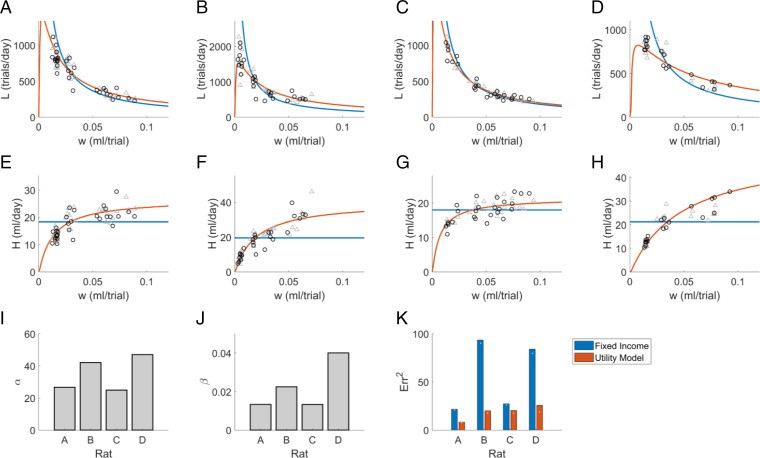
In the laboratory, animals' motivation to work tends to be positively correlated with reward magnitude. But in nature, rewards earned by work are essential to survival (e.g., working to find water), and the payoff of that work can vary on long timescales (e.g., seasonally). Under these constraints, the strategy of working less when rewards are small could be fatal. We found that instead, rats in a closed economy did more work for water rewards when the rewards were stably smaller, a phenomenon also observed in human labor supply curves. Like human consumers, rats showed elasticity of demand, consuming far more water per day when its price in effort was lower. The neural mechanisms underlying such "rational" market behaviors remain largely unexplored. We propose a dynamic utility maximization model that can account for the dependence of rat labor supply (trials/day) on the wage rate (milliliter/trial) and also predict the temporal dynamics of when rats work. Based on data from mice, we hypothesize that glutamatergic neurons in the subfornical organ in lamina terminalis continuously compute the instantaneous marginal utility of voluntary work for water reward and causally determine the amount and timing of work.
在实验室中,动物的工作动机往往与奖励幅度呈正相关。但在自然界中,工作所获得的奖励对生存至关重要(例如,努力寻找水源),而且工作的回报在长时间尺度上可能会有所变化(例如,季节性变化)。在这些限制下,当奖励较小时减少工作的策略可能是致命的。我们发现,在一个封闭的经济环境中,当奖励稳定减少时,老鼠会为了获取水奖励而做更多的工作,这一现象也在人类劳动力供应曲线上观察到。与人类消费者一样,老鼠表现出需求弹性,当努力的价格较低时,每天会消耗更多的水。这种“理性”市场行为的神经机制在很大程度上仍未得到探索。我们提出了一个动态效用最大化模型,可以解释老鼠劳动力供应(每天的试验次数)对工资率(每试验毫升)的依赖关系,并且还可以预测老鼠何时工作的时间动态。基于来自老鼠的数据,我们假设终板下丘脑穹窿下器官中的谷氨酸能神经元不断计算自愿工作获取水奖励的即时边际效用,并因果决定工作的数量和时间。