Tursic Anita, Vaessen Maarten, Zhan Minye, Vingerhoets Ad J J M, de Gelder Beatrice
Department of Cognitive Neuroscience, Faculty of Psychology and Neuroscience, Maastricht University, P.O. Box 616, 6200, MD, Maastricht, the Netherlands.
Department of Medical and Clinical Psychology, Tilburg University, P.O. Box 90153, 5000, LE, Tilburg, the Netherlands.
Neuroimage Rep. 2022 Jun 4;2(3):100105. doi: 10.1016/j.ynirp.2022.100105. eCollection 2022 Sep.
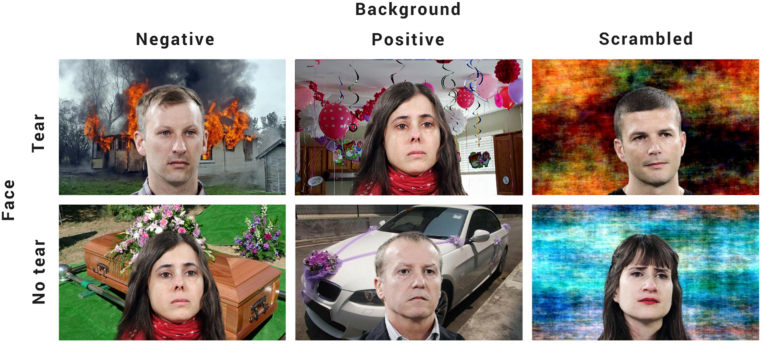
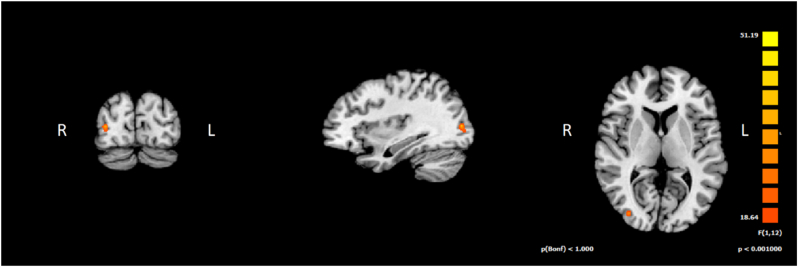
Only humans produce emotional tears, a fact that has been linked to triggering empathy, social bonding, and providing support in observers. Consequently, either the tears themselves play a crucial role in eliciting such behavior, or, alternatively, the negative context in which they are shed is responsible for these observers' reactions. The present study investigates whether the context in which we see an individual cry influences our perception of tears. We exposed participants (N = 13) to compound stimuli of faces with or without tears, combined with positive, negative, and scrambled backgrounds, while their brain activity was measured using functional magnetic resonance imaging (fMRI). Findings reveal that the lateral occipital gyrus responds to the presence of tears but that the contextual information does not influence this reaction; furthermore, tears appear to facilitate interpreting emotional facial expressions when combined with a positive context. These findings indicate that tears are a robust, unambiguous signal, the perception of which is insensitive to context but can still contribute to the context interpretation. This feature sets tears apart from other facial emotional expressions. This is likely due to their crucial evolutionary role as one of the foremost indicators of discomfort, signaling a need for help and their power to forge a bond between people.
只有人类会产生情感性泪水,这一事实与引发同理心、社会联系以及为观察者提供支持有关。因此,要么泪水本身在引发此类行为中起关键作用,要么是流泪时所处的负面情境导致了观察者的这些反应。本研究调查我们看到一个人哭泣的情境是否会影响我们对泪水的认知。我们让参与者(N = 13)观看有或没有泪水的面部与积极、消极和混乱背景相结合的复合刺激,同时使用功能磁共振成像(fMRI)测量他们的大脑活动。研究结果表明,枕外侧回对泪水的存在有反应,但情境信息不会影响这种反应;此外,当泪水与积极情境相结合时,似乎有助于对面部表情进行情感解读。这些发现表明,泪水是一种强烈、明确的信号,对其的认知对情境不敏感,但仍能有助于情境解读。这一特征使泪水有别于其他面部表情。这可能是由于它们在进化中起着关键作用,作为不适的首要指标之一,表明需要帮助,以及它们在人与人之间建立联系的力量。