Nair Vimala D, Nair P K Ramachandran, Dari Biswanath, Freitas Andressa M, Chatterjee Nilovna, Pinheiro Felipe M
Soil and Water Sciences Department, University of Florida, Gainesville, FL, United States.
School of Forest Resources and Conservation, University of Florida, Gainesville, FL, United States.
Front Plant Sci. 2017 Dec 11;8:2051. doi: 10.3389/fpls.2017.02051. eCollection 2017.
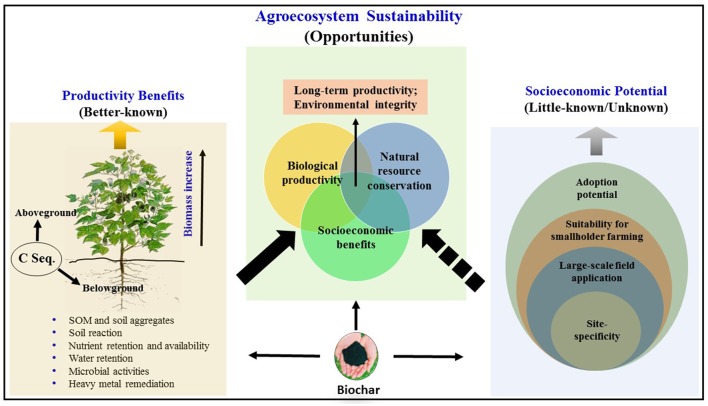
Interest in the use of biochar in agriculture has increased exponentially during the past decade. Biochar, when applied to soils is reported to enhance soil carbon sequestration and provide other soil productivity benefits such as reduction of bulk density, enhancement of water-holding capacity and nutrient retention, stabilization of soil organic matter, improvement of microbial activities, and heavy-metal sequestration. Furthermore, biochar application could enhance phosphorus availability in highly weathered tropical soils. Converting the locally available feedstocks and farm wastes to biochar could be important under smallholder farming systems as well, and biochar use may have applications in tree nursery production and specialty-crop management. Thus, biochar can contribute substantially to sustainable agriculture. While these benefits and opportunities look attractive, several problems, and bottlenecks remain to be addressed before widespread production and use of biochar becomes popular. The current state of knowledge is based largely on limited small-scale studies under laboratory and greenhouse conditions. Properties of biochar vary with both the feedstock from which it is produced and the method of production. The availability of feedstock as well as the economic merits, energy needs, and environmental risks-if any-of its large-scale production and use remain to be investigated. Nevertheless, available indications suggest that biochar could play a significant role in facing the challenges posed by climate change and threats to agroecosystem sustainability.
在过去十年中,农业领域对生物炭使用的兴趣呈指数级增长。据报道,生物炭施用于土壤时,可增强土壤碳固存,并带来其他土壤生产力方面的益处,如降低容重、提高持水能力和养分保持能力、稳定土壤有机质、改善微生物活性以及螯合重金属。此外,在高度风化的热带土壤中,施用生物炭可提高磷的有效性。在小农农业系统中,将当地可用的原料和农业废弃物转化为生物炭也可能很重要,而且生物炭的使用可能在苗圃生产和特色作物管理中有应用。因此,生物炭可对可持续农业做出重大贡献。虽然这些益处和机会看起来很有吸引力,但在生物炭广泛生产和使用普及之前,仍有几个问题和瓶颈有待解决。目前的知识状况很大程度上基于实验室和温室条件下有限的小规模研究。生物炭的性质随其生产原料和生产方法的不同而有所变化。原料的可用性以及其大规模生产和使用的经济价值、能源需求和环境风险(如有)仍有待研究。然而,现有迹象表明,生物炭在应对气候变化带来的挑战和农业生态系统可持续性面临的威胁方面可发挥重要作用。