Smithsonian Environmental Research Center. Edgewater, Maryland, United States of America.
PLoS One. 2013 Sep 30;8(9):e75932. doi: 10.1371/journal.pone.0075932. eCollection 2013.
Claims about the environmental benefits of charring biomass and applying the resulting "biochar" to soil are impressive. If true, they could influence land management worldwide. Alleged benefits include increased crop yields, soil fertility, and water-holding capacity; the most widely discussed idea is that applying biochar to soil will mitigate climate change. This claim rests on the assumption that biochar persists for hundreds or thousands of years, thus storing carbon that would otherwise decompose. We conducted a systematic review to quantify research effort directed toward ten aspects of biochar and closely evaluated the literature concerning biochar's stability.
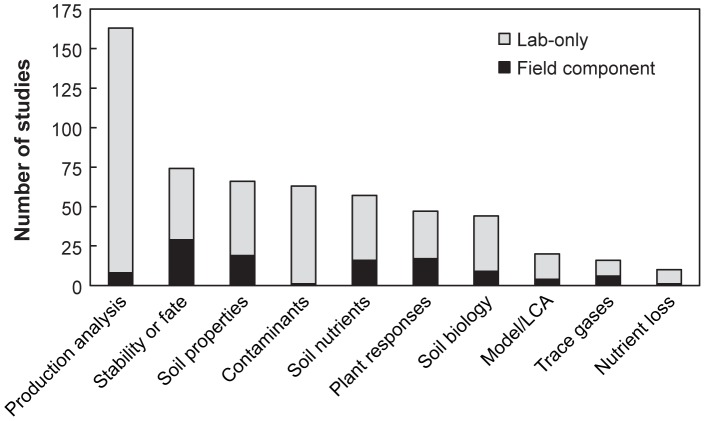
We identified 311 peer-reviewed research articles published through 2011. We found very few field studies that addressed biochar's influence on several ecosystem processes: one on soil nutrient loss, one on soil contaminants, six concerning non-CO2 greenhouse gas (GHG) fluxes (some of which fail to support claims that biochar decreases non-CO2 GHG fluxes), and 16-19 on plants and soil properties. Of 74 studies related to biochar stability, transport or fate in soil, only seven estimated biochar decomposition rates in situ, with mean residence times ranging from 8 to almost 4,000 years.
Our review shows there are not enough data to draw conclusions about how biochar production and application affect whole-system GHG budgets. Wide-ranging estimates of a key variable, biochar stability in situ, likely result from diverse environmental conditions, feedstocks, and study designs. There are even fewer data about the extent to which biochar stimulates decomposition of soil organic matter or affects non-CO2 GHG emissions. Identifying conditions where biochar amendments yield favorable GHG budgets requires a systematic field research program. Finally, evaluating biochar's suitability as a climate mitigation strategy requires comparing its effects with alternative uses of biomass and considering GHG budgets over both long and short time scales.
将生物质炭化并将所得的“生物炭”施用于土壤,据称此举具有环境效益,令人印象深刻。如果属实,这可能会影响全球的土地管理方式。据称,其益处包括增加作物产量、提高土壤肥力和保水能力;最广泛讨论的观点是,将生物炭施用于土壤将有助于减缓气候变化。这一说法基于生物炭可存续数百年乃至数千年从而封存原本会分解的碳这一假设。我们开展了一项系统性综述,旨在量化针对生物炭十个方面的研究工作,并对有关生物炭稳定性的文献进行了仔细评估。
我们共检索到 2011 年以前发表的 311 篇同行评议研究文章。我们发现,很少有野外研究涉及生物炭对几个生态系统过程的影响:一项研究涉及土壤养分流失,一项研究涉及土壤污染物,六项研究涉及非 CO2 温室气体(GHG)通量(其中部分研究结果不支持生物炭减少非 CO2 GHG 通量的说法),还有 16-19 项研究涉及植物和土壤特性。在 74 项与生物炭稳定性、在土壤中的迁移或归宿相关的研究中,仅有 7 项研究在现场估算了生物炭的分解速率,平均停留时间从 8 年到近 4000 年不等。
我们的综述表明,目前尚无足够的数据来推断生物炭的生产和应用如何影响整个系统的 GHG 预算。关键变量——生物炭在现场的稳定性的广泛估计值可能源于不同的环境条件、原料和研究设计。关于生物炭在多大程度上刺激土壤有机质分解或影响非 CO2 GHG 排放的信息则更为有限。要确定生物炭改良剂在何种条件下能产生有利的 GHG 预算,需要开展系统的野外研究计划。最后,评估生物炭作为减缓气候变化策略的适宜性需要将其影响与生物质的其他用途进行比较,并考虑从长短期两个时间尺度来评估 GHG 预算。