Makke Alaa, Homsi Abdulwahed, Guzaiz Montaha, Almalki Abdulrahman
Oral and Maxillofacial Department, Faculty of Dentistry, Umm Al-Qura University, Mecca, Saudi Arabia.
Int J Dent. 2017;2017:5478371. doi: 10.1155/2017/5478371. Epub 2017 Oct 30.
Implant-supported prostheses are currently the standard treatment for the replacement of missing teeth and deficiencies. Implant restorations can either be screw-retained, cement-retained, or both. The implant retention system type is typically chosen during the treatment plan. The primary purpose of this study is to investigate the frequency of implant restoration retention systems.
A five-page questionnaire was sent to private institutes, educational institutes, and governmental hospitals that provide dental services. The data were analyzed using descriptive statistics.
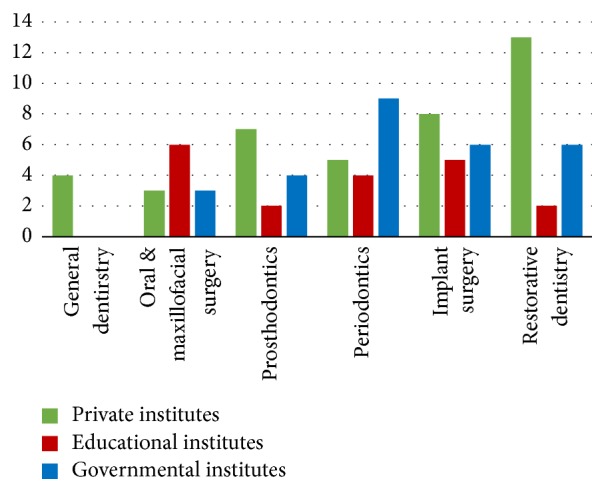
Prior to distribution, the surveys were proofread and pilot-tested at the Faculty of Dentistry at Umm Al-Qura University. The surveys were mailed to three groups: private institutes, educational institutes, and governmental hospitals. In total, 120 surveys were distributed and 87 surveys were returned, for a response rate of 73%. This included thirty-six surveys (41.4%) from private institutes, twenty-two surveys (25.3%) from educational institutes, and twenty-nine surveys (33.3%) from governmental hospitals.
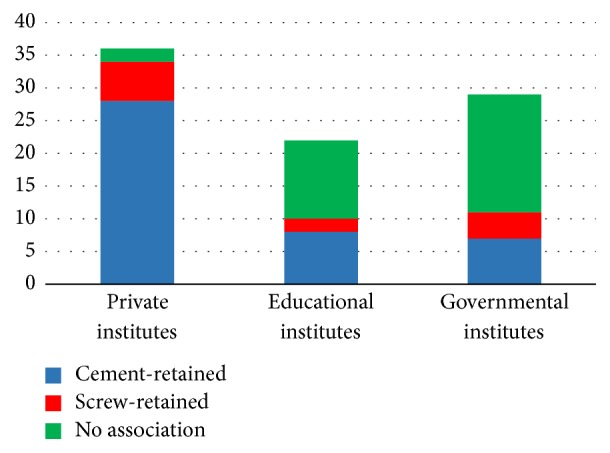
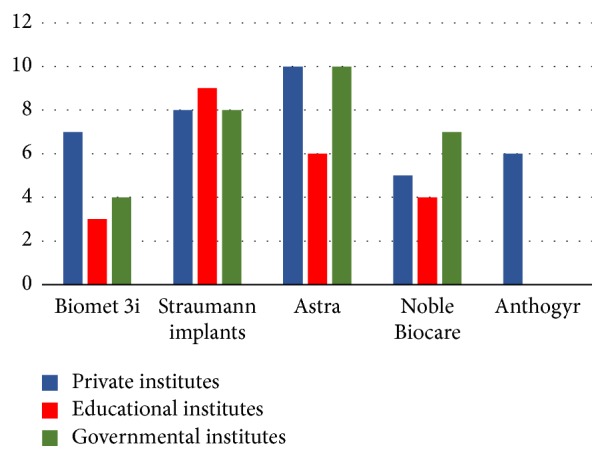
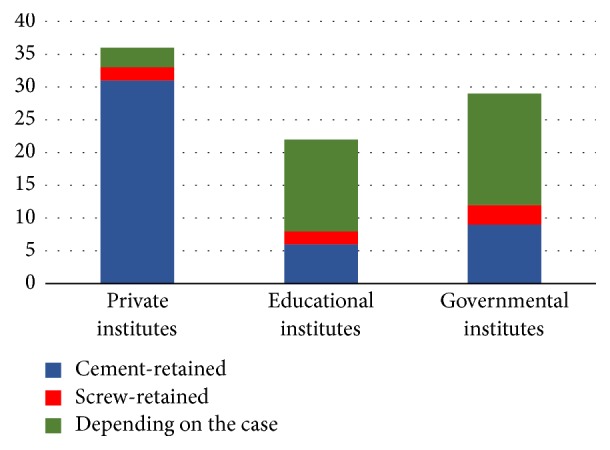
In general, Astra was cited as the most widely used implant system. In addition, cement-retained restorations were more frequently used than screw-retained restorations. However, dental implant failure was more frequently associated with cement-retained restorations than with screw-retained restorations.
种植体支持的修复体是目前缺失牙和牙列缺损修复的标准治疗方法。种植修复体可以是螺丝固位、粘结固位或两者皆有。种植体固位系统类型通常在治疗计划阶段选定。本研究的主要目的是调查种植修复体固位系统的使用频率。
向提供牙科服务的私立机构、教育机构和政府医院发送了一份五页的调查问卷。使用描述性统计方法对数据进行分析。
在分发之前,这些调查问卷在乌姆古拉大学牙科学院进行了校对和预测试。调查问卷被邮寄给三组对象:私立机构、教育机构和政府医院。总共分发了120份调查问卷,回收了其中的87份,回复率为73%。这包括来自私立机构的36份调查问卷(41.4%)、来自教育机构的22份调查问卷(25.3%)和来自政府医院的29份调查问卷(33.3%)。
总体而言,Astra被认为是使用最广泛的种植系统。此外,粘结固位修复体的使用频率高于螺丝固位修复体。然而,种植体失败与粘结固位修复体的关联比与螺丝固位修复体更为频繁。