Jain Vaibhav
Centre of Excellence for Translational Research in Asthma & Lung Disease, CSIR-Institute of Genomics and Integrative Biology (CSIR-IGIB), Mall Road, Delhi 110007, India.
Academy of Scientific and Innovative Research (AcSIR), Chennai 600113, India.
Med Sci (Basel). 2018 Jan 6;6(1):4. doi: 10.3390/medsci6010004.
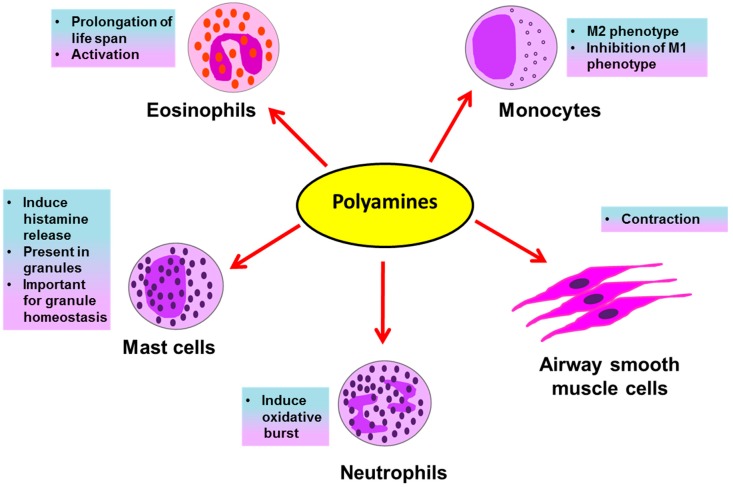
Asthma is a complex disease of airways, where the interactions of immune and structural cells result in disease outcomes with airway remodeling and airway hyper-responsiveness. Polyamines, which are small-sized, natural super-cations, interact with negatively charged intracellular macromolecules, and altered levels of polyamines and their interactions have been associated with different pathological conditions including asthma. Elevated levels of polyamines have been reported in the circulation of asthmatic patients as well as in the lungs of a murine model of asthma. In various studies, polyamines were found to potentiate the pathogenic potential of inflammatory cells, such as mast cells and granulocytes (eosinophils and neutrophils), by either inducing the release of their pro-inflammatory mediators or prolonging their life span. Additionally, polyamines were crucial in the differentiation and alternative activation of macrophages, which play an important role in asthma pathology. Importantly, polyamines cause airway smooth muscle contraction and thus airway hyper-responsiveness, which is the key feature in asthma pathophysiology. High levels of polyamines in asthma and their active cellular and macromolecular interactions indicate the importance of the polyamine pathway in asthma pathogenesis; therefore, modulation of polyamine levels could be a suitable approach in acute and severe asthma management. This review summarizes the possible roles of polyamines in different pathophysiological features of asthma.
哮喘是一种复杂的气道疾病,免疫细胞与结构细胞之间的相互作用会导致气道重塑和气道高反应性等疾病结果。多胺是一种小分子天然超阳离子,可与带负电荷的细胞内大分子相互作用,多胺水平的改变及其相互作用与包括哮喘在内的不同病理状况有关。据报道,哮喘患者的循环系统以及哮喘小鼠模型的肺部中多胺水平升高。在各种研究中,发现多胺可通过诱导炎症细胞(如肥大细胞和粒细胞(嗜酸性粒细胞和中性粒细胞))释放促炎介质或延长其寿命来增强其致病潜力。此外,多胺在巨噬细胞的分化和替代性激活中起关键作用,而巨噬细胞在哮喘病理过程中发挥重要作用。重要的是,多胺会引起气道平滑肌收缩,从而导致气道高反应性,这是哮喘病理生理学的关键特征。哮喘中多胺水平较高及其活跃的细胞和大分子相互作用表明多胺途径在哮喘发病机制中的重要性;因此,调节多胺水平可能是急性和重度哮喘管理的一种合适方法。本综述总结了多胺在哮喘不同病理生理特征中的可能作用。