Hua Fang, Walsh Tanya, Glenny Anne-Marie, Worthington Helen
Department of Orthodontics, Hubei-MOST KLOS & KLOBM, School and Hospital of Stomatology, Wuhan University, Luoyu Road No.237, Wuhan, 430079, China.
Cochrane Oral Health, Division of Dentistry, School of Medical Sciences, Faculty of Biology, Medicine and Health, The University of Manchester, Manchester Academic Health Science Centre, Oxford Road, Manchester, M13 9PL, UK.
BMC Med Res Methodol. 2018 Jan 10;18(1):6. doi: 10.1186/s12874-017-0469-3.
The reporting of randomised controlled trial (RCT) abstracts is of vital importance. The primary objective of this study was to investigate the association between structure format and RCT abstracts' quality of methodology reporting, informed by the current requirement and usage of structure formats by leading general medical/internal medicine journals (secondary objective).
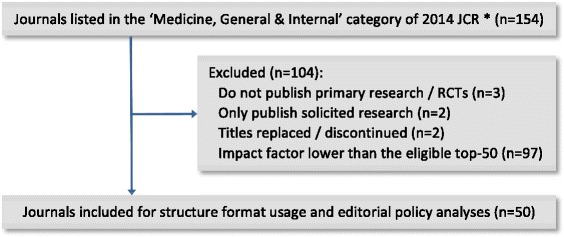
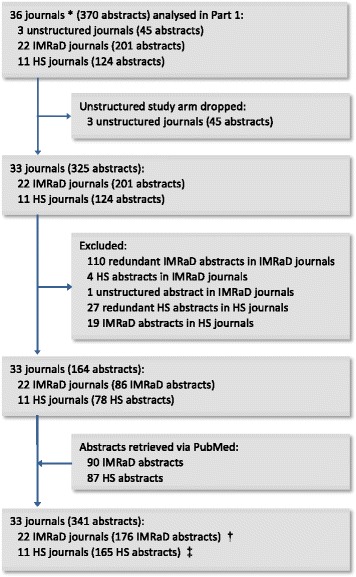
A two-part cross-sectional study. First, through hand searches, we identified all RCTs published in the top-50 high-impact general medical/internal medicine journals during July-December 2015 (n = 370), and retrieved the 'instructions to authors' of these journals. From these, we extracted the actual usage of structure formats and headings, as well as relevant journal policies. Then, after a pilot study and sample size calculation, we assessed the methodology reporting quality of 176 IMRaD (Introduction, Methods, Results, and Discussion) and 165 HS (Highly Structured) RCT abstracts sampled from 33 of the 50 selected journals, using a 9-item checklist developed based on the CONSORT for Abstracts guidelines (primary outcome: overall quality score, OQS; score range 0 to 9).
88% (324/370) of all identified RCT abstracts were structured, among which 66% (215/324) used the IMRaD format and 34% (109/324) used HS. According to journals' 'instructions to authors', 48% (24/50) journals required IMRaD, 32% (16/50) required HS, 8% (4/50) required unstructured, while the rest did not state any requirement on structure format. According to generalised estimation equation analysis adjusting for potential confounders and clustering effects, the OQS of HS abstracts was 0.5 (95% CI 0.1 to 1.0, p = 0.028) higher than IMRaD abstracts. More HS abstracts reported study setting (adjusted odds ratio, 4.2; 95% CI: 1.7 to 10.0; p = 0.001), definition of the main outcome measure (2.5; 1.3 to 4.9; p = 0.006) and the time point for main outcome assessment (3.0; 1.5 to 6.2; p = 0.002), whereas more IMRaD abstracts described the unit of randomisation (0.4; 0.3 to 0.8; p = 0.004).
For RCT abstracts, the IMRaD format is more frequently used and required by leading general medical/internal medicine journals than the HS format. Abstracts in the HS format report trial methodology more completely than those in the IMRaD format.
随机对照试验(RCT)摘要的报告至关重要。本研究的主要目的是在领先的综合医学/内科学期刊当前对结构格式的要求和使用情况的指导下,调查结构格式与RCT摘要方法学报告质量之间的关联(次要目的)。
一项分为两部分的横断面研究。首先,通过手工检索,我们确定了2015年7月至12月期间发表在排名前50的高影响力综合医学/内科学期刊上的所有RCT(n = 370),并检索了这些期刊的“作者须知”。从中,我们提取了结构格式和标题的实际使用情况以及相关的期刊政策。然后,在进行预试验和样本量计算后,我们使用基于CONSORT摘要指南制定的9项清单,评估了从50种选定期刊中的33种抽取的176篇IMRaD(引言、方法、结果和讨论)和165篇HS(高度结构化)RCT摘要的方法学报告质量(主要结局:总体质量得分,OQS;得分范围为0至9)。
所有确定的RCT摘要中有88%(324/370)是结构化的,其中66%(215/324)使用IMRaD格式,34%(109/324)使用HS格式。根据期刊的“作者须知”,48%(24/50)的期刊要求使用IMRaD格式,32%(16/50)要求使用HS格式,8%(4/50)要求使用非结构化格式,其余期刊未对结构格式提出任何要求。根据调整潜在混杂因素和聚类效应的广义估计方程分析,HS摘要的OQS比IMRaD摘要高0.5(95%CI 0.1至1.0,p = 0.028)。更多的HS摘要报告了研究背景(调整后的优势比,4.2;95%CI:1.7至10.0;p = 0.001)、主要结局指标的定义(2.5;1.3至4.9;p = 0.006)和主要结局评估的时间点(3.0;1.5至6.2;p = 0.002),而更多的IMRaD摘要描述了随机化单位(0.4;0.3至0.8;p = 0.004)。
对于RCT摘要,领先的综合医学/内科学期刊比HS格式更频繁地使用和要求使用IMRaD格式。HS格式的摘要比IMRaD格式的摘要更完整地报告试验方法。