Aydin Gülsah, Dekomien Gabriele, Hoffjan Sabine, Gerding Wanda Maria, Epplen Jörg T, Arning Larissa
Faculty of Health, University Witten-Herdecke, Alfred-Herrhausen-Strasse 50, 58448, Witten, Germany.
Department of Human Genetics, Ruhr-University, Gebäude MA5/39, Universitätsstraße 150, 44801, Bochum, Germany.
BMC Neurol. 2018 Jan 9;18(1):3. doi: 10.1186/s12883-017-1009-9.
Spinocerebellar ataxia (SCA) subtypes are often caused by expansions in non-coding regions of genes like SCA8, SCA10, SCA12 and SCA36. Other ataxias are known to be associated with repeat expansions such as fragile X-associated tremor ataxia syndrome (FXTAS) or expansions in the C9orf72 gene. When no mutation has been identified in the aforementioned genes next-generation sequencing (NGS)-based diagnostics may also be applied. In order to define an optimal diagnostic strategy, more information about the frequency and phenotypic characteristics of rare repeat expansion disorders associated with ataxia should be at hand.
We analyzed a consecutive cohort of 440 German unrelated patients with symptoms of cerebellar ataxia, dysarthria and other unspecific symptoms who were referred to our center for SCA diagnostics. They showed alleles in the normal range for the most common SCA subtypes SCA1-3, SCA6, SCA7 and SCA17. These patients were screened for expansions causing SCA8, SCA10, SCA12, SCA36 and FXTAS as well as for the pathogenic hexanucleotide repeat in the C9orf72 gene.
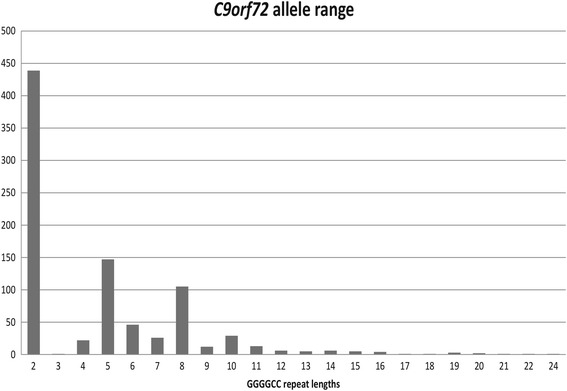
Expanded repeats for SCA10, SCA12 or SCA36 were not identified in the analyzed patients. Five patients showed expanded SCA8 CTA/CTG alleles with 92-129 repeats. One 51-year-old male with unclear dementia symptoms was diagnosed with a large GGGGCC repeat expansion in C9orf72. The analysis of the fragile X mental retardation 1 gene (FMR1) revealed one patient with a premutation (>50 CGG repeats) and seven patients with alleles in the grey zone (41 to 54 CGG repeats).
Altogether five patients showed 92 or more SCA8 CTA/CTG combined repeats. Our results support the assumption that smaller FMR1 gene expansions could be associated with the risk of developing neurological signs. The results do not support genetic testing for C9orf72 expansion in ataxia patients.
脊髓小脑共济失调(SCA)亚型通常由SCA8、SCA10、SCA12和SCA36等基因非编码区的扩增引起。其他共济失调已知与重复扩增有关,如脆性X相关震颤共济失调综合征(FXTAS)或C9orf72基因的扩增。当在上述基因中未发现突变时,也可应用基于下一代测序(NGS)的诊断方法。为了确定最佳诊断策略,应掌握更多关于与共济失调相关的罕见重复扩增疾病的频率和表型特征的信息。
我们分析了连续440例因SCA诊断转诊至我们中心的德国非亲属患者队列,这些患者有小脑共济失调、构音障碍和其他非特异性症状。他们在最常见的SCA亚型SCA1-3、SCA6、SCA7和SCA17的等位基因处于正常范围。对这些患者进行了导致SCA8、SCA10、SCA12、SCA36和FXTAS的扩增以及C9orf72基因致病性六核苷酸重复序列的筛查。
在所分析的患者中未发现SCA10、SCA12或SCA36的重复扩增。5例患者显示SCA8 CTA/CTG等位基因扩增,重复次数为92-129次。一名患有不明痴呆症状的51岁男性被诊断为C9orf72基因有大量GGGGCC重复扩增。对脆性X智力低下1基因(FMR1)的分析显示,1例患者有前突变(>50个CGG重复),7例患者等位基因处于灰色区域(41至54个CGG重复)。
共有5例患者显示92个或更多的SCA8 CTA/CTG联合重复。我们的结果支持这样的假设,即较小的FMR1基因扩增可能与出现神经体征的风险有关。结果不支持对共济失调患者进行C9orf72扩增的基因检测。