Interdisciplinary Program in Genetics, Texas A&M University, College Station TX, Texas, 77843, USA.
Department of Biology, Texas A&M University, College Station, Texas, TX, 77843, USA.
BMC Cancer. 2018 Jan 10;18(1):43. doi: 10.1186/s12885-017-3896-y.
The circadian clock is the basis for biological time keeping in eukaryotic organisms. The clock mechanism relies on biochemical signaling pathways to detect environmental stimuli and to regulate the expression of clock-controlled genes throughout the body. MAPK signaling pathways function in both circadian input and output pathways in mammals depending on the tissue; however, little is known about the role of p38 MAPK, an established tumor suppressor, in the mammalian circadian system. Increased expression and activity of p38 MAPK is correlated with poor prognosis in cancer, including glioblastoma multiforme; however, the toxicity of p38 MAPK inhibitors limits their clinical use. Here, we test if timed application of the specific p38 MAPK inhibitor VX-745 reduces glioma cell invasive properties in vitro.
The levels and rhythmic accumulation of active phosphorylated p38 MAPK in different cell lines were determined by western blots. Rhythmic luciferase activity from clock gene luciferase reporter cells lines was used to test the effect of p38 MAPK inhibition on clock properties as determined using the damped sine fit and Levenberg-Marquardt algorithm. Nonlinear regression and Akaike's information criteria were used to establish rhythmicity. Boyden chamber assays were used to measure glioma cell invasiveness following time-of-day-specific treatment with VX-745. Significant differences were established using t-tests.
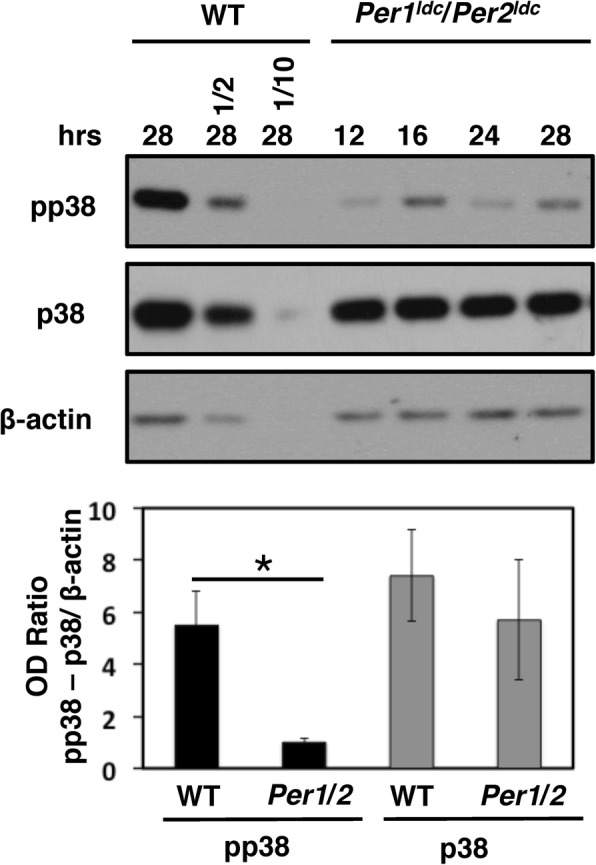
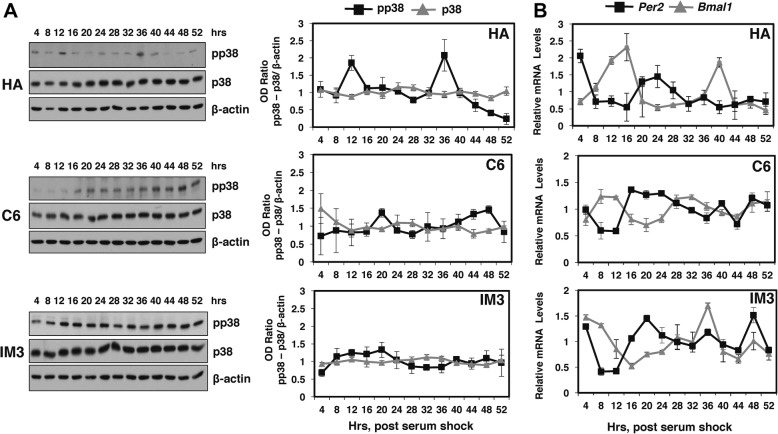
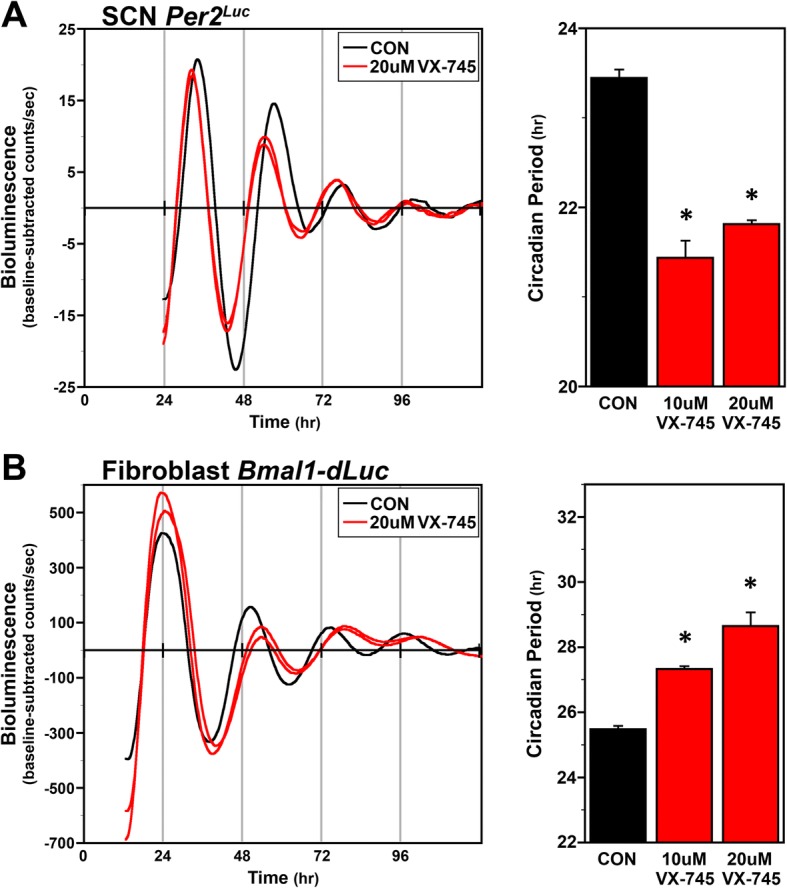
We demonstrate the activity of p38 MAPK cycles under control of the clock in mouse fibroblast and SCN cell lines. The levels of phosphorylated p38 MAPK were significantly reduced in clock-deficient cells, indicating that the circadian clock plays an important role in activation of this pathway. Inhibition of p38 MAPK activity with VX-745 led to cell-type-specific period changes in the molecular clock. In addition, phosphorylated p38 MAPK levels were rhythmic in HA glial cells, and high and arrhythmic in invasive IM3 glioma cells. We show that inhibition of p38 MAPK activity in IM3 cells at the time of day when the levels are normally low in HA cells under control of the circadian clock, significantly reduced IM3 invasiveness.
Glioma treatment with p38 MAPK inhibitors may be more effective and less toxic if administered at the appropriate time of the day.
昼夜节律钟是真核生物生物钟的基础。该时钟机制依赖于生化信号通路来检测环境刺激,并调节全身时钟控制基因的表达。MAPK 信号通路在哺乳动物的昼夜节律输入和输出途径中都有功能,这取决于组织;然而,关于作为已确立的肿瘤抑制因子的 p38 MAPK 在哺乳动物昼夜节律系统中的作用知之甚少。p38 MAPK 的表达和活性增加与癌症(包括多形性胶质母细胞瘤)的预后不良相关;然而,p38 MAPK 抑制剂的毒性限制了它们的临床应用。在这里,我们测试了定时应用特异性 p38 MAPK 抑制剂 VX-745 是否会降低体外胶质瘤细胞的侵袭特性。
通过 Western blot 确定不同细胞系中活性磷酸化 p38 MAPK 的水平和节律性积累。时钟基因荧光素酶报告细胞系的节律性荧光素酶活性用于测试 p38 MAPK 抑制对时钟特性的影响,方法是使用阻尼正弦拟合和 Levenberg-Marquardt 算法。非线性回归和 Akaike 信息准则用于建立节律性。使用 Boyden 室测定法在特定时间点用 VX-745 处理后测量神经胶质瘤细胞的侵袭性。使用 t 检验确定显著性差异。
我们证明了 p38 MAPK 在控制小鼠成纤维细胞和 SCN 细胞系的时钟下循环。在时钟缺陷细胞中,磷酸化 p38 MAPK 的水平显著降低,表明昼夜节律在该途径的激活中起着重要作用。用 VX-745 抑制 p38 MAPK 活性导致时钟的细胞类型特异性周期变化。此外,HA 神经胶质细胞中磷酸化 p38 MAPK 的水平呈节律性,而在具有侵袭性的 IM3 神经胶质瘤细胞中则呈高节律性。我们表明,在 IM3 细胞中,在正常情况下在 HA 细胞中昼夜节律控制下水平较低的时间点抑制 p38 MAPK 活性,显著降低了 IM3 的侵袭性。
如果在一天中的适当时间用 p38 MAPK 抑制剂治疗神经胶质瘤,可能会更有效且毒性更小。