Laboratory of Virology and Chemotherapy, Rega Institute for Medical Research, KU Leuven - University of Leuven, 3000, Leuven, Belgium.
Department of Oncology, Laboratory of Lipid Metabolism and Cancer, KU Leuven - University of Leuven, 3000, Leuven, Belgium.
J Transl Med. 2018 Jan 9;16(1):1. doi: 10.1186/s12967-017-1374-6.
Plasma extracellular vesicles (EVs), especially exosome-like vesicles (ELVs), are being increasingly explored as a source of potential noninvasive disease biomarkers. The discovery of blood-based biomarkers associated with ELVs requires methods that isolate high yields of these EVs without significant contamination with highly abundant plasma proteins and lipoproteins. The rising interest in blood-based EV-associated biomarkers has led to the rapid development of novel EV isolation methods. However, the field suffers from a lack of standardization and often, new techniques are used without critical evaluation. Size exclusion chromatography (SEC) has become the method of choice for rapid isolation of relatively pure EVs from plasma, yet it has technical limitations for certain downstream applications. The recently released exoEasy kit (Qiagen) is a new membrane affinity spin column method for the isolation of highly pure EVs from biofluids with the potential to overcome most of the limitations of SEC.
By using multiple complementary techniques we assessed the performance of the exoEasy kit in isolating ELVs from 2 ml of human plasma and compared it with the SEC qEV column (Izon Science).
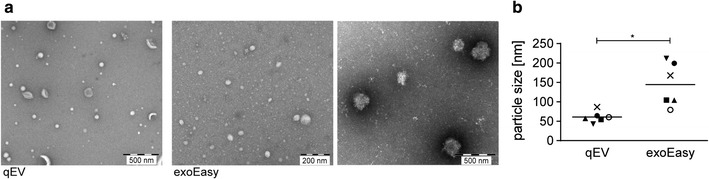
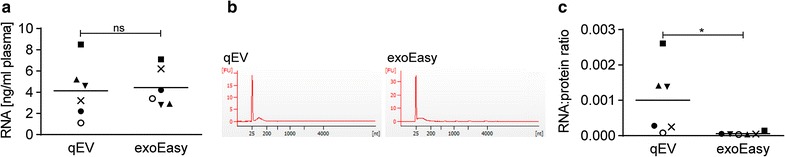
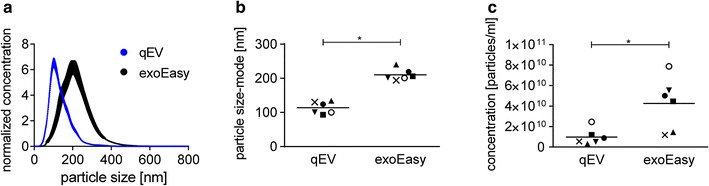
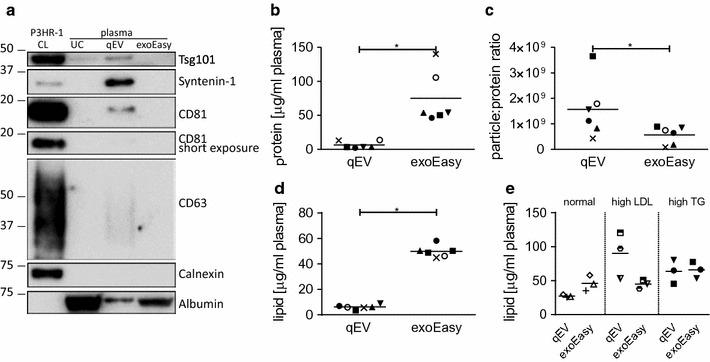
Our data show that exoEasy kit isolates a heterogenous mixture of particles with a larger median diameter, broader size range and a higher yield than the SEC qEV column. The exclusive presence of small RNAs in the particles and the total RNA yield were comparable to the SEC qEV column. Despite being less prone to low density lipoprotein contamination than the SEC qEV column, the overall purity of exoEasy kit EV preparations was suboptimal. The low particle-protein ratio, significant amount of albumin, very low levels of exosome-associated proteins and propensity to triglyceride-rich lipoprotein contamination suggest isolation of mainly non-ELVs and co-isolation of plasma proteins and certain lipoproteins by the exoEasy kit.
We demonstrate that performance of exoEasy kit for the isolation of ELVs for biomarker discovery is inferior to the SEC qEV column. This comprehensive evaluation of a novel EV isolation method contributes to the acceleration of the discovery of EV-associated biomarkers and the development of EV-based diagnostics.
血浆细胞外囊泡(EVs),特别是类外泌体囊泡(ELVs),作为潜在的非侵入性疾病生物标志物的来源,正越来越多地被探索。发现与 ELVs 相关的血液生物标志物需要使用能够在不显著污染高丰度血浆蛋白和脂蛋白的情况下分离高产量这些 EV 的方法。对基于血液的 EV 相关生物标志物的兴趣日益浓厚,导致了新型 EV 分离方法的快速发展。然而,该领域缺乏标准化,并且新技术经常在没有严格评估的情况下被使用。尺寸排阻色谱(SEC)已成为从血浆中快速分离相对纯净 EV 的首选方法,但它对于某些下游应用具有技术局限性。最近发布的 exoEasy 试剂盒(Qiagen)是一种新的膜亲和离心柱方法,用于从生物流体中分离高纯度的 EV,有可能克服 SEC 的大多数限制。
通过使用多种互补技术,我们评估了 exoEasy 试剂盒从 2ml 人血浆中分离 ELVs 的性能,并将其与 SEC qEV 柱(Izon Science)进行了比较。
我们的数据表明,exoEasy 试剂盒分离出的粒子是一种异质混合物,具有较大的中值直径、较宽的粒径范围和较高的产量,而 SEC qEV 柱则没有。粒子中仅存在小 RNA,并且总 RNA 产量与 SEC qEV 柱相当。尽管 exoEasy 试剂盒比 SEC qEV 柱不易受到低密度脂蛋白污染,但 EV 制剂的整体纯度仍不理想。低粒子-蛋白比、大量白蛋白、极低水平的外泌体相关蛋白和富含甘油三酯的脂蛋白污染倾向表明,exoEasy 试剂盒主要分离非 ELVs,同时也分离了血浆蛋白和某些脂蛋白。
我们证明,exoEasy 试剂盒用于发现生物标志物的 ELVs 分离性能不如 SEC qEV 柱。这种对新型 EV 分离方法的综合评估有助于加速 EV 相关生物标志物的发现和 EV 为基础的诊断。