Karasuyama Kazuyuki, Motomura Goro, Ikemura Satoshi, Fukushi Jun-Ichi, Hamai Satoshi, Sonoda Kazuhiko, Kubo Yusuke, Yamamoto Takuaki, Nakashima Yasuharu
Department of Orthopaedic Surgery, Graduate School of Medical Sciences, Kyushu University, 3-1-1 Maidashi, Higashi-ku, Fukuoka, Japan.
Department of Orthopaedic Surgery, Faculty of Medicine, Fukuoka University, 7-45-1 Nanakuma, 12 Jonan-ku, Fukuoka, Japan.
J Orthop Surg Res. 2018 Jan 10;13(1):6. doi: 10.1186/s13018-018-0714-4.
This study investigated the risk factors for postoperative complications requiring revision surgery within 3 years after transtrochanteric rotational osteotomy (TRO) for osteonecrosis of the femoral head (ONFH).
We reviewed 127 patients (147 hips) who underwent TRO (anterior or posterior rotational osteotomy) for ONFH between January 2002 and December 2014. Two patients were lost to follow-up, and five patients with progression of femoral head collapse requiring a salvage procedure such as total hip arthroplasty within 3 years after TRO were excluded. The better hip in patients treated bilaterally was also excluded (n = 20) to avoid duplication of patient demographics, leaving 120 hips (120 patients) for the analysis. We reviewed the medical records of each patient to screen for postoperative complications that required revision surgery within 3 years after surgery, recording the patient's age, sex, body mass index, surgical side, condition of the contralateral hip, previous alcohol intake, previous alcohol abuse, previous corticosteroid use, perioperative corticosteroid use, smoking status, preoperative stage and type of ONFH, preoperative activity level, and preoperative and final follow-up Japanese Orthopaedic Association scores. Differences between cases with and without complications were analyzed.
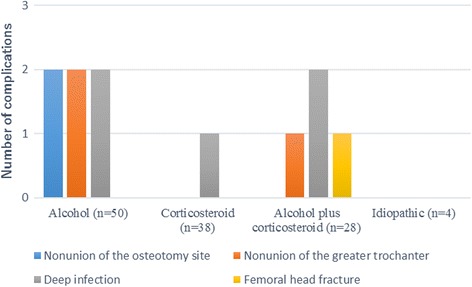
Eleven (9.2%) cases showed postoperative complications that required revision surgery. The most common complication was deep infection (n = 5), followed by nonunion of the greater trochanter (n = 3), nonunion of the intertrochanteric osteotomy site (n = 2), and femoral head fracture (n = 1). The multivariate analysis showed an independent association between previous alcohol abuse and postoperative complications (odds ratio, 13.5).
A correlation might exist between alcohol abuse and complications following a TRO procedure.
本研究调查了经转子旋转截骨术(TRO)治疗股骨头坏死(ONFH)后3年内需要翻修手术的术后并发症危险因素。
我们回顾了2002年1月至2014年12月期间因ONFH接受TRO(前路或后路旋转截骨术)的127例患者(147髋)。2例患者失访,5例在TRO后3年内出现股骨头塌陷进展需要进行挽救手术(如全髋关节置换术)的患者被排除。双侧治疗患者中较好的一侧髋关节也被排除(n = 20)以避免患者人口统计学重复,最终纳入分析的有120髋(120例患者)。我们查阅了每位患者的病历,以筛查术后3年内需要翻修手术的术后并发症,记录患者的年龄、性别、体重指数、手术侧、对侧髋关节状况、既往饮酒情况、既往酗酒史、既往使用皮质类固醇情况、围手术期皮质类固醇使用情况、吸烟状况、术前ONFH分期和类型、术前活动水平以及术前和末次随访时的日本骨科协会评分。分析有并发症和无并发症病例之间的差异。
11例(9.2%)出现了需要翻修手术的术后并发症。最常见的并发症是深部感染(n = 5),其次是大转子不愈合(n = 3)、转子间截骨部位不愈合(n = 2)和股骨头骨折(n = 1)。多因素分析显示既往酗酒与术后并发症之间存在独立关联(比值比,13.5)。
酗酒与TRO术后并发症之间可能存在相关性。