American Society for Engineering Education Postdoctoral Fellowship Program, U.S. Naval Research Laboratory, Washington, DC, USA.
Chemistry Division, U.S. Naval Research Laboratory, Washington, DC, USA.
J Healthc Eng. 2017;2017:5740975. doi: 10.1155/2017/5740975. Epub 2017 Nov 29.
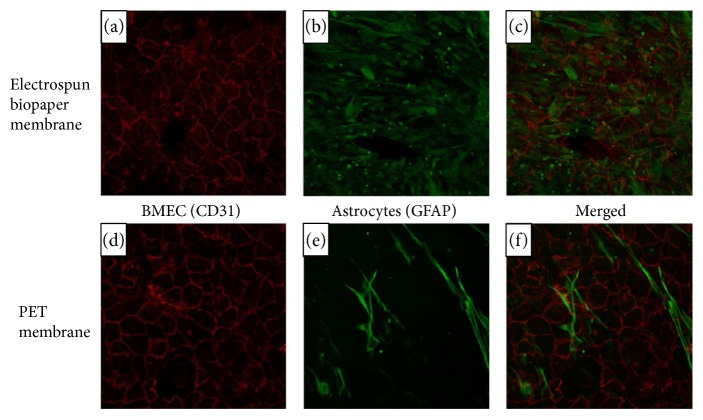
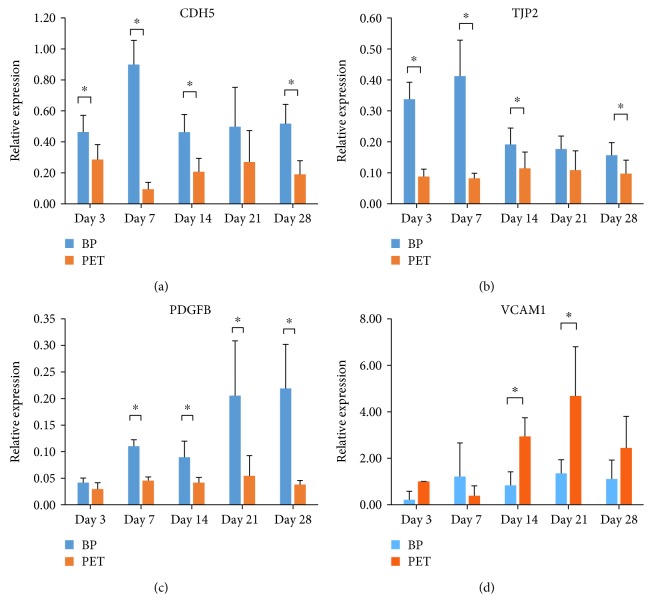
Disruption of the blood-brain barrier (BBB) is the hallmark of many neurovascular disorders, making it a critically important focus for therapeutic options. However, testing the effects of either drugs or pathological agents is difficult due to the potentially damaging consequences of altering the normal brain microenvironment. Recently, in vitro coculture tissue models have been developed as an alternative to animal testing. Despite low cost, these platforms use synthetic scaffolds which prevent normal barrier architecture, cellular crosstalk, and tissue remodeling. We created a biodegradable electrospun gelatin mat "biopaper" (BP) as a scaffold material for an endothelial/astrocyte coculture model allowing cell-cell contact and crosstalk. To compare the BP and traditional models, we investigated the expression of 27 genes involved in BBB permeability, cellular function, and endothelial junctions at different time points. Gene expression levels demonstrated higher expression of transcripts involved in endothelial junction formation, including TJP2 and CDH5, in the BP model. The traditional model had higher expression of genes associated with extracellular matrix-associated proteins, including SPARC and COL4A1. Overall, the results demonstrate that the BP coculture model is more representative of a healthy BBB state, though both models have advantages that may be useful in disease modeling.
血脑屏障(BBB)的破坏是许多神经血管疾病的标志,因此成为治疗选择的一个极其重要的焦点。然而,由于改变正常脑微环境可能带来潜在的破坏性后果,因此测试药物或病理制剂的效果非常困难。最近,体外共培养组织模型已被开发出来作为动物测试的替代方法。尽管这些平台成本低,但它们使用的是合成支架,无法构建正常的屏障结构、细胞串扰和组织重塑。我们创建了一种可生物降解的静电纺丝明胶垫“生物纸”(BP)作为内皮细胞/星形胶质细胞共培养模型的支架材料,允许细胞间接触和串扰。为了比较 BP 和传统模型,我们在不同时间点研究了 27 个参与 BBB 通透性、细胞功能和内皮连接的基因的表达。基因表达水平表明,BP 模型中与内皮连接形成相关的转录本,包括 TJP2 和 CDH5 的表达更高。传统模型中与细胞外基质相关蛋白相关的基因,如 SPARC 和 COL4A1 的表达更高。总的来说,这些结果表明,BP 共培养模型更能代表健康的 BBB 状态,尽管这两种模型都有在疾病建模中可能有用的优势。