Ismail Ahmed A, Almalki Mohammed, Agag Ahmed, Solan Yahya M, Bani Ibrahim A
Department of Occupational and Environmental Health, College of Public Health, University of Iowa, Iowa City, Iowa, USA.
Community Medicine and Public Health Department, Faculty of Medicine, Menoufia University, Shebin El-Kom, Egypt.
Int J Occup Environ Med. 2018 Jan 10;9(1):32-44. doi: 10.15171/ijoem.2018.1160.
Pesticide applicators are at risk of developing neurological symptoms and neurobehavioral deficits. This risk may increase if the applicator chews stimulant plants like khat.
To examine the sociodemographic and exposure determinants of neurological symptoms presentation, neurobehavioral performance, and cholinesterase activity among pesticide applicators in a vector control unit, Saudi Arabia.
In a cross-sectional study, 30 pesticide applicators and 32 non-applicators from a vector control unit in Jazan region, Saudi Arabia, were studied. The study participants completed an exposure and medical questionnaire, and a neurobehavioral test battery. Their blood samples were also tested for the measurement of butyryl cholinesterase (BChE).
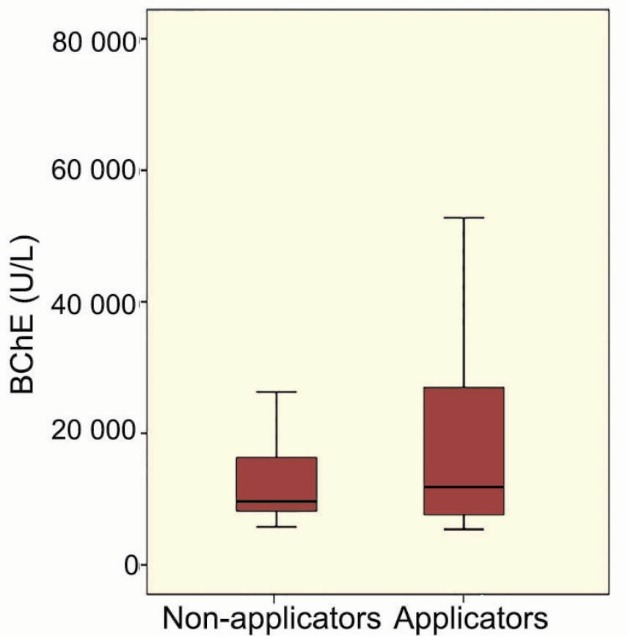
The mean blood BChE level was no significantly different between the applicators and non-applicators. Working in pesticide application and chewing khat were significant predictors of the neurological symptoms presentation and neurobehavioral deficits among the study participants. Each factor was associated with about 40% of the symptoms included in the questionnaire. Exposure to pyrethroids was significantly associated with a decrement in symbol digit test latency, tapping (TAP) non-preferred hand, and TAP alternating hands measures, representing the executive and motor speed/coordination functions. Khat chewing was associated with TAP preferred and non-preferred hands and serial digit learning measures, representing the memory and motor speed/coordination functions.
It seems that being exposed to pyrethroids and chewing khat are associated with neurological and neurobehavioral drawbacks among pesticide applicators.
农药施用者有出现神经症状和神经行为缺陷的风险。如果施用者咀嚼恰特草等刺激性植物,这种风险可能会增加。
研究沙特阿拉伯一个病媒控制单位中农药施用者神经症状表现、神经行为表现和胆碱酯酶活性的社会人口统计学和暴露决定因素。
在一项横断面研究中,对沙特阿拉伯吉赞地区一个病媒控制单位的30名农药施用者和32名非施用者进行了研究。研究参与者完成了一份暴露和医疗问卷以及一套神经行为测试。还对他们的血样进行了丁酰胆碱酯酶(BChE)测量测试。
施用者和非施用者的平均血BChE水平无显著差异。从事农药施用工作和咀嚼恰特草是研究参与者神经症状表现和神经行为缺陷的重要预测因素。每个因素与问卷中约40%的症状相关。接触拟除虫菊酯与符号数字测试潜伏期缩短、非优势手轻叩(TAP)以及优势手与非优势手交替轻叩测量值下降显著相关,这些测量值代表执行和运动速度/协调功能。咀嚼恰特草与优势手和非优势手的TAP以及连续数字学习测量值相关,这些测量值代表记忆和运动速度/协调功能。
似乎接触拟除虫菊酯和咀嚼恰特草与农药施用者的神经和神经行为缺陷有关。