Department of Zoology, Faculty of Science, Charles University, Prague 2, Czech Republic.
Institute for Environmental Studies, Faculty of Science, Charles University, Prague 2, Czech Republic.
Mol Ecol. 2018 Feb;27(4):949-958. doi: 10.1111/mec.14479. Epub 2018 Feb 26.
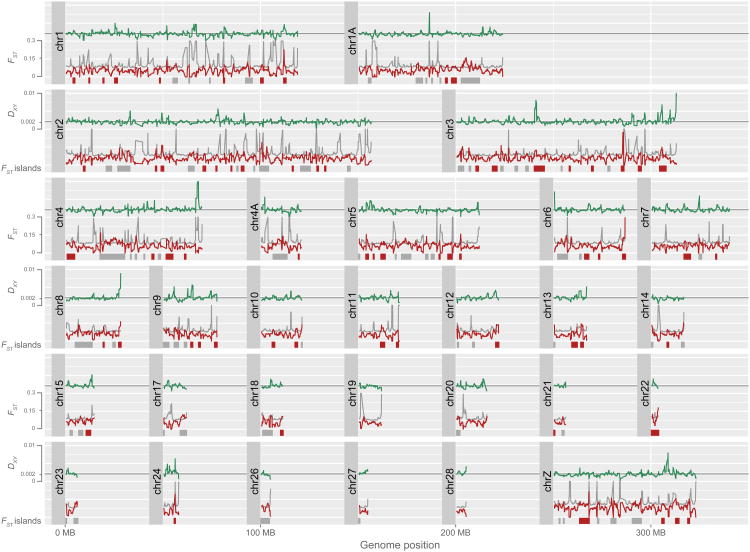
Hybrid sterility is a common first step in the evolution of postzygotic reproductive isolation. According to Haldane's Rule, it affects predominantly the heterogametic sex. While the genetic basis of hybrid male sterility in organisms with heterogametic males has been studied for decades, the genetic basis of hybrid female sterility in organisms with heterogametic females has received much less attention. We investigated the genetic basis of reproductive isolation in two closely related avian species, the common nightingale (Luscinia megarhynchos) and the thrush nightingale (L. luscinia), that hybridize in a secondary contact zone and produce viable hybrid progeny. In accordance with Haldane's Rule, hybrid females are sterile, while hybrid males are fertile, allowing gene flow to occur between the species. Using transcriptomic data from multiple individuals of both nightingale species, we identified genomic islands of high differentiation (F ) and of high divergence (D ), and we analysed gene content and patterns of molecular evolution within these islands. Interestingly, we found that these islands were enriched for genes related to female meiosis and metabolism. The islands of high differentiation and divergence were also characterized by higher levels of linkage disequilibrium than the rest of the genome in both species indicating that they might be situated in genomic regions of low recombination. This study provides one of the first insights into genetic basis of hybrid female sterility in organisms with heterogametic females.
杂种不育性是合子后生殖隔离进化的常见第一步。根据 Haldane 法则,它主要影响异型配子性别。虽然几十年来一直在研究具有异型配子雄性的生物体中杂种雄性不育的遗传基础,但具有异型配子雌性的生物体中杂种雌性不育的遗传基础却受到较少关注。我们研究了在二次接触区杂交并产生可育杂种后代的两种密切相关的鸟类物种(普通夜莺 [Luscinia megarhynchos] 和画眉夜莺 [L. luscinia])中的生殖隔离的遗传基础。根据 Haldane 法则,杂种雌性不育,而杂种雄性可育,允许物种之间发生基因流动。我们使用来自两个夜莺物种的多个个体的转录组数据,鉴定了高分化(F)和高分化(D)的基因组岛屿,并分析了这些岛屿内的基因含量和分子进化模式。有趣的是,我们发现这些岛屿富含与雌性减数分裂和代谢有关的基因。高分化和高分化岛屿在两个物种中的基因组其余部分中也表现出更高水平的连锁不平衡,表明它们可能位于重组率低的基因组区域。这项研究首次深入了解了具有异型配子雌性的生物体中杂种雌性不育的遗传基础。