Molecular Carcinogenesis Group, Department of Histology and Embryology, School of Medicine, National & Kapodistrian University of Athens, 75 Mikras Asias St, GR-11527, Athens, Greece.
Department of Immunology and Microbiology, University of Copenhagen, Blegdamsvej 3c, DK-2200, Copenhagen, Denmark.
BMC Genomics. 2018 Jan 10;19(1):37. doi: 10.1186/s12864-017-4375-1.
Senescence is a fundamental biological process implicated in various pathologies, including cancer. Regarding carcinogenesis, senescence signifies, at least in its initial phases, an anti-tumor response that needs to be circumvented for cancer to progress. Micro-RNAs, a subclass of regulatory, non-coding RNAs, participate in senescence regulation. At the subcellular level micro-RNAs, similar to proteins, have been shown to traffic between organelles influencing cellular behavior. The differential function of micro-RNAs relative to their subcellular localization and their role in senescence biology raises concurrent in situ analysis of coding and non-coding gene products in senescent cells as a necessity. However, technical challenges have rendered in situ co-detection unfeasible until now.
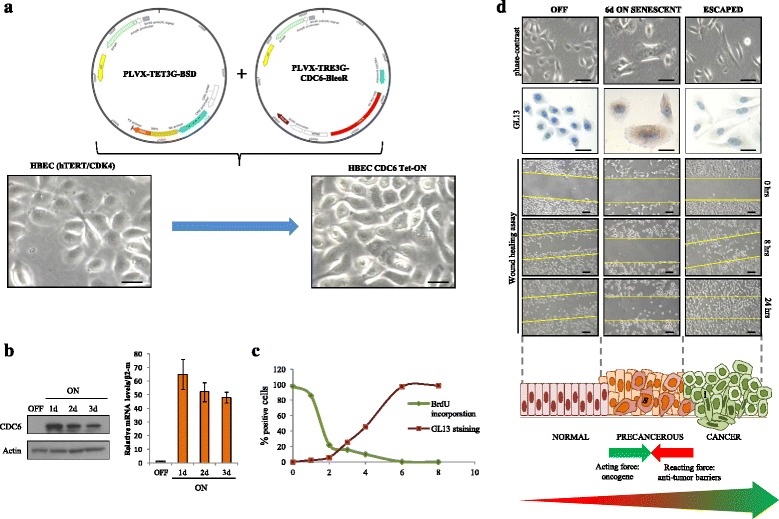
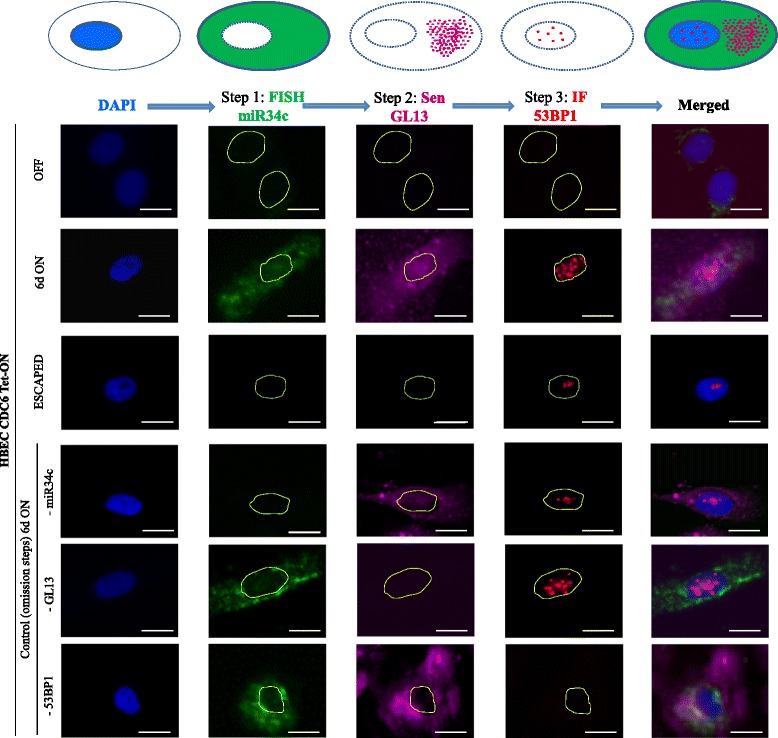
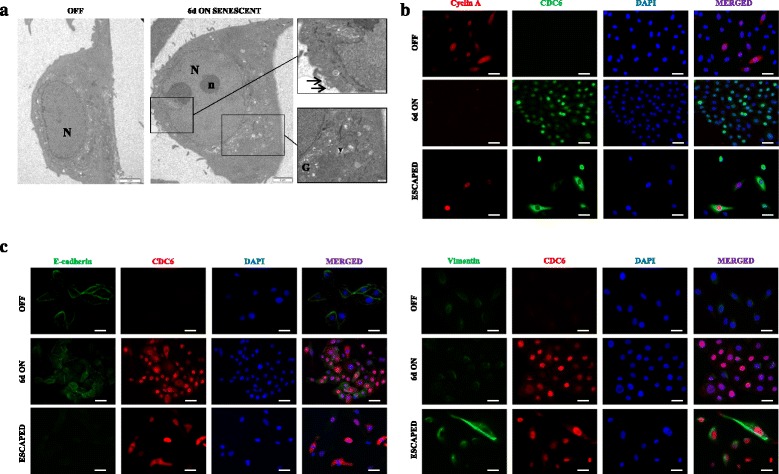
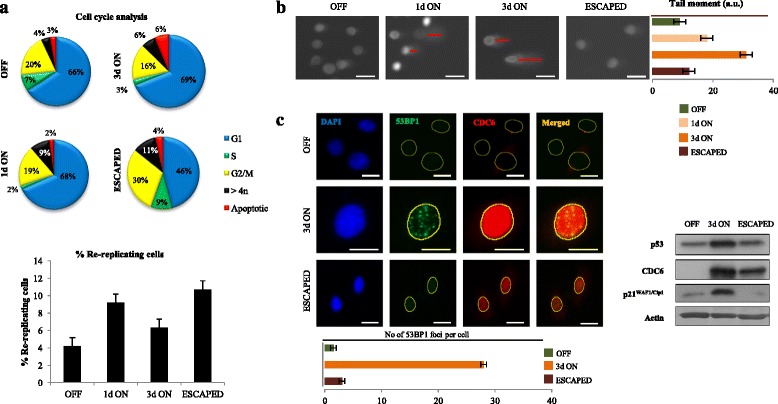
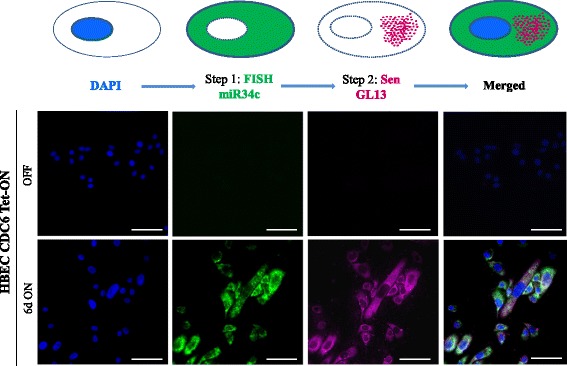
In the present report we describe a methodology that bypasses these technical limitations achieving for the first time simultaneous detection of both a micro-RNA and a protein in the biological context of cellular senescence, utilizing the new commercially available SenTraGor compound. The method was applied in a prototypical human non-malignant epithelial model of oncogene-induced senescence that we generated for the purposes of the study. For the characterization of this novel system, we applied a wide range of cellular and molecular techniques, as well as high-throughput analysis of the transcriptome and micro-RNAs.
This experimental setting has three advantages that are presented and discussed: i) it covers a "gap" in the molecular carcinogenesis field, as almost all corresponding in vitro models are fibroblast-based, even though the majority of neoplasms have epithelial origin, ii) it recapitulates the precancerous and cancerous phases of epithelial tumorigenesis within a short time frame under the light of natural selection and iii) it uses as an oncogenic signal, the replication licensing factor CDC6, implicated in both DNA replication and transcription when over-expressed, a characteristic that can be exploited to monitor RNA dynamics.
Consequently, we demonstrate that our model is optimal for studying the molecular basis of epithelial carcinogenesis shedding light on the tumor-initiating events. The latter may reveal novel molecular targets with clinical benefit. Besides, since this method can be incorporated in a wide range of low, medium or high-throughput image-based approaches, we expect it to be broadly applicable.
衰老(senescence)是一种涉及多种病理学的基本生物学过程,包括癌症。就致癌而言,衰老至少在其初始阶段代表了一种抗肿瘤反应,为了使癌症进展,需要规避这种反应。微小 RNA(microRNA)是一类调节性非编码 RNA,参与衰老调控。在亚细胞水平上,微小 RNA 与蛋白质类似,已被证明在细胞器之间运输,从而影响细胞行为。微小 RNA 相对于其亚细胞定位的功能差异及其在衰老生物学中的作用,使得在衰老细胞中同时分析编码和非编码基因产物成为必要。然而,技术挑战使得原位共检测至今无法实现。
在本报告中,我们描述了一种绕过这些技术限制的方法,首次利用新的商业上可获得的 SenTraGor 化合物,在细胞衰老的生物学背景下同时检测微小 RNA 和蛋白质。该方法应用于我们为研究目的生成的典型的人非恶性上皮模型中的致癌基因诱导衰老。为了对该新系统进行特征描述,我们应用了广泛的细胞和分子技术,以及转录组和微小 RNA 的高通量分析。
该实验设置具有三个优点,在此呈现并讨论:i)它填补了分子致癌学领域的“空白”,因为几乎所有相应的体外模型都是基于成纤维细胞的,尽管大多数肿瘤具有上皮起源;ii)它在自然选择的光线下在短时间内重现了上皮肿瘤发生的癌前和癌变阶段;iii)它使用复制许可因子 CDC6 作为致癌信号,该因子在过度表达时既参与 DNA 复制又参与转录,这一特性可用于监测 RNA 动力学。
因此,我们证明我们的模型非常适合研究上皮致癌发生的分子基础,阐明肿瘤起始事件。后者可能揭示具有临床益处的新分子靶标。此外,由于该方法可以整合到广泛的低、中或高通量基于图像的方法中,我们预计它具有广泛的适用性。