Buerk Donald G, Liu Yien, Zaccheo Kelly A, Barbee Kenneth A, Jaron Dov
School of Biomedical Engineering, Science and Health Systems, Drexel University, Philadelphia, PA, United States.
Front Physiol. 2017 Dec 13;8:1053. doi: 10.3389/fphys.2017.01053. eCollection 2017.
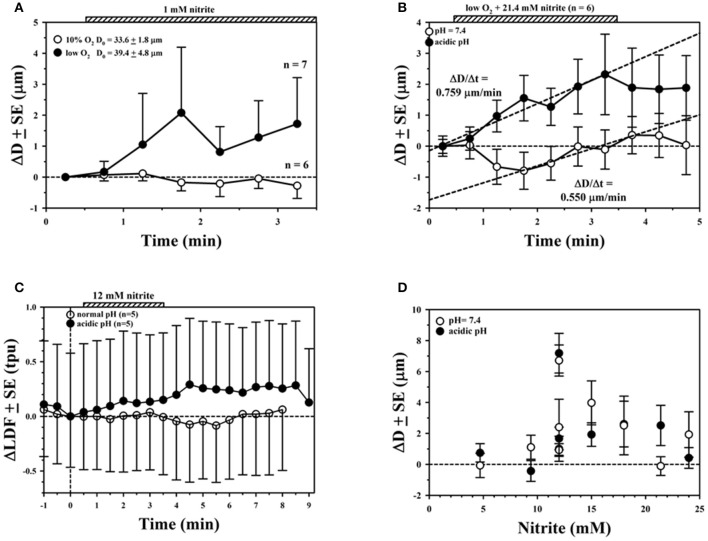
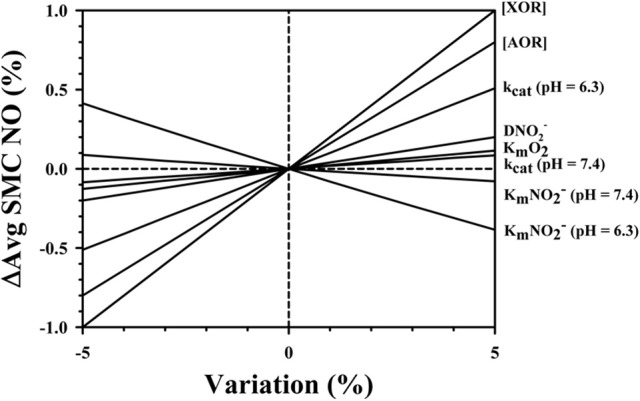
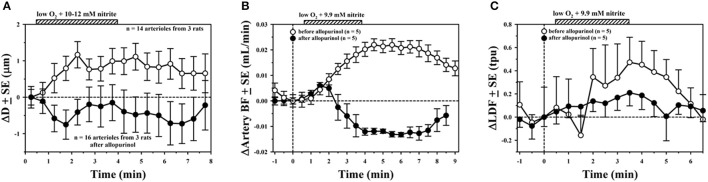
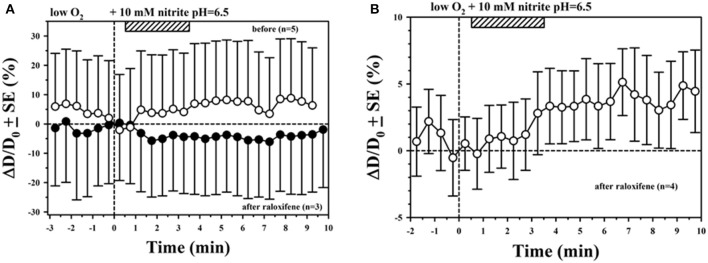
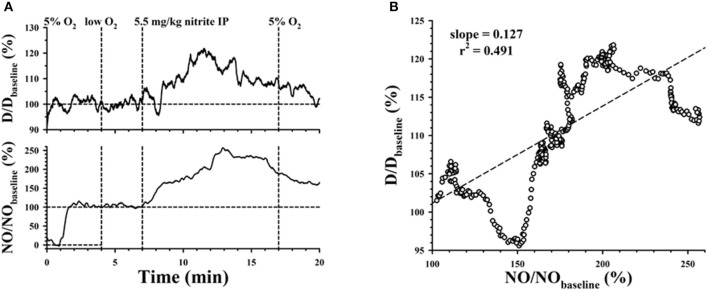
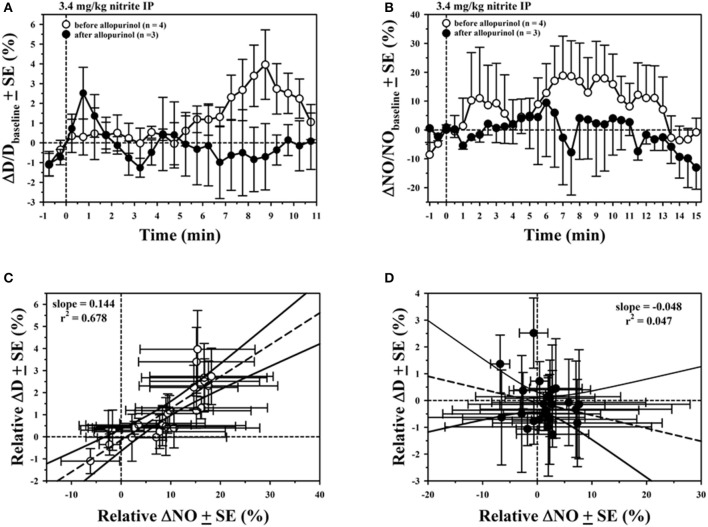
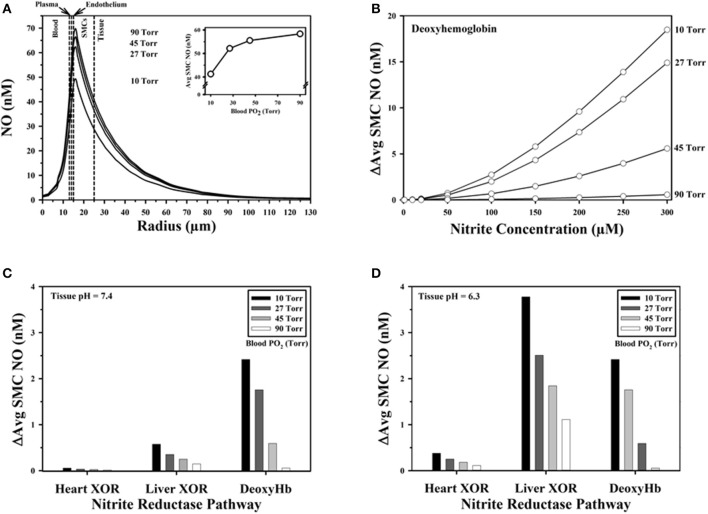
Nitric oxide (NO) generated from nitrite through nitrite reductase activity in red blood cells has been proposed to play a major role in hypoxic vasodilation. However, we have previously predicted from mathematical modeling that much more NO can be derived from tissue nitrite reductase activity than from red blood cell nitrite reductase activity. Evidence in the literature suggests that tissue nitrite reductase activity is associated with xanthine oxidoreductase (XOR) and/or aldehyde oxidoreductase (AOR). We investigated the role of XOR and AOR in nitrite-mediated vasodilation from computer simulations and from exteriorized rat mesentery experiments. Vasodilation responses to nitrite in the superfusion medium bathing the mesentery equilibrated with 5% O (normoxia) or zero O (hypoxia) at either normal or acidic pH were quantified. Experiments were also conducted following intraperitoneal (IP) injection of nitrite before and after inhibiting XOR with allopurinol or inhibiting AOR with raloxifene. Computer simulations for NO and O transport using reaction parameters reported in the literature were also conducted to predict nitrite-dependent NO production from XOR and AOR activity as a function of nitrite concentration, PO and pH. Experimentally, the largest arteriolar responses were found with nitrite >10 mM in the superfusate, but no statistically significant differences were found with hypoxic and acidic conditions in the superfusate. Nitrite-mediated vasodilation with IP nitrite injections was reduced or abolished after inhibiting XOR with allopurinol ( < 0.001). Responses to IP nitrite before and after inhibiting AOR with raloxifene were not as consistent. Our mathematical model predicts that under certain conditions, XOR and AOR nitrite reductase activity in tissue can significantly elevate smooth muscle cell NO and can serve as a compensatory pathway when endothelial NO production is limited by hypoxic conditions. Our theoretical and experimental results provide further evidence for a role of tissue nitrite reductases to contribute additional NO to compensate for reduced NO production by endothelial nitric oxide synthase during hypoxia. Our mathematical model demonstrates that under extreme hypoxic conditions with acidic pH, endogenous nitrite levels alone can be sufficient for a functionally significant increase in NO bioavailability. However, these conditions are difficult to achieve experimentally.
通过红细胞中亚硝酸盐还原酶活性从亚硝酸盐生成的一氧化氮(NO)被认为在缺氧性血管舒张中起主要作用。然而,我们之前通过数学建模预测,组织亚硝酸盐还原酶活性产生的NO比红细胞亚硝酸盐还原酶活性产生的NO要多得多。文献中的证据表明,组织亚硝酸盐还原酶活性与黄嘌呤氧化还原酶(XOR)和/或醛氧化还原酶(AOR)有关。我们通过计算机模拟和大鼠肠系膜外置实验研究了XOR和AOR在亚硝酸盐介导的血管舒张中的作用。对在正常或酸性pH值下用5% O₂(常氧)或零O₂(缺氧)平衡的灌注液灌注肠系膜时,灌注液中亚硝酸盐引起的血管舒张反应进行了量化。在用别嘌呤醇抑制XOR或用雷洛昔芬抑制AOR之前和之后,还进行了腹腔内(IP)注射亚硝酸盐的实验。还使用文献中报道的反应参数对NO和O₂转运进行了计算机模拟,以预测XOR和AOR活性产生的亚硝酸盐依赖性NO生成量与亚硝酸盐浓度、PO₂和pH值的关系。实验发现,当灌注液中亚硝酸盐>10 mM时,小动脉反应最大,但灌注液中的缺氧和酸性条件未发现统计学上的显著差异。用别嘌呤醇抑制XOR后,IP注射亚硝酸盐介导的血管舒张减弱或消失(P<0.001)。用雷洛昔芬抑制AOR前后对IP亚硝酸盐的反应不太一致。我们的数学模型预测,在某些条件下,组织中的XOR和AOR亚硝酸盐还原酶活性可显著提高平滑肌细胞中的NO水平,并且当内皮细胞NO生成受缺氧条件限制时可作为一种代偿途径。我们的理论和实验结果为组织亚硝酸盐还原酶在缺氧期间补充额外的NO以补偿内皮型一氧化氮合酶产生的NO减少中的作用提供了进一步证据。我们的数学模型表明,在极端缺氧且pH值呈酸性的条件下,仅内源性亚硝酸盐水平就足以使NO生物利用度在功能上显著增加。然而,这些条件在实验中很难实现。