Chamekh Mustapha, Deny Maud, Romano Marta, Lefèvre Nicolas, Corazza Francis, Duchateau Jean, Casimir Georges
Inflammation Unit, Laboratory of Pediatric Research, Faculty of Medicine, Queen Fabiola University Children's Hospital, Université Libre de Bruxelles, Brussels, Belgium.
Service of Immunology, Scientific Institute for Public Health (WIV-ISP), Brussels, Belgium.
Front Immunol. 2017 Dec 13;8:1806. doi: 10.3389/fimmu.2017.01806. eCollection 2017.
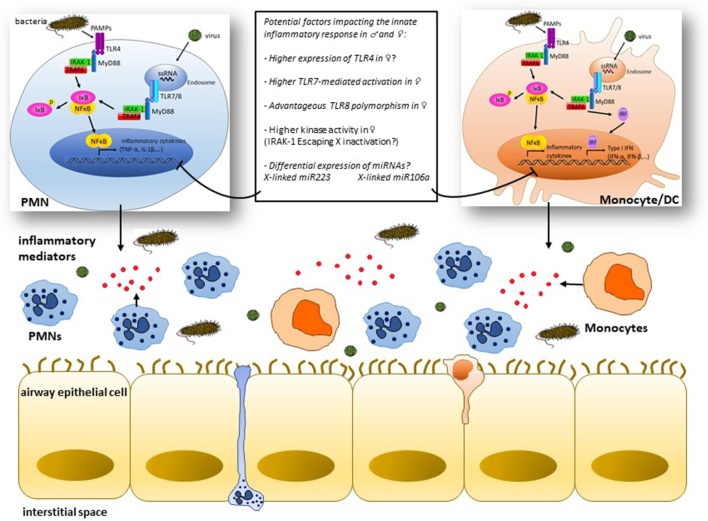
It is widely acknowledged that males and females exhibit contrasting degrees of susceptibility to infectious and non-infectious inflammatory diseases. This is particularly observed in respiratory diseases where human males are more likely to be affected by infection-induced acute inflammations compared to females. The type and magnitude of the innate immune inflammatory response play a cardinal role in this sex bias. Animal models mimicking human respiratory diseases have been used to address the biological factors that could explain the distinct outcomes. In this review, we focus on our current knowledge about experimental studies investigating sex-specific differences in infection-induced respiratory diseases and we provide an update on the most important innate immune mechanisms that could explain sex bias of the inflammatory response. We also discuss whether conclusions drawn from animal studies could be relevant to human.
人们普遍认为,男性和女性对感染性和非感染性炎症性疾病的易感性程度存在差异。这在呼吸系统疾病中尤为明显,与女性相比,人类男性更容易受到感染引起的急性炎症的影响。先天性免疫炎症反应的类型和强度在这种性别差异中起着关键作用。模拟人类呼吸系统疾病的动物模型已被用于研究可能解释不同结果的生物学因素。在这篇综述中,我们聚焦于目前关于感染诱导的呼吸系统疾病中性别特异性差异的实验研究的知识,并提供有关最重要的先天性免疫机制的最新信息,这些机制可以解释炎症反应的性别差异。我们还讨论了从动物研究得出的结论是否与人类相关。