Angelov Nikola, Soldatos Nikolaos, Ioannidou Effie, Carter Tonia C, Shimpi Neel, Applegate Joseph, Kookal Krishna Kumar, Parsegian Karo
Department of Periodontics and Dental Hygiene, UTHealth Houston School of Dentistry, Houston, TX, USA.
Division of Periodontics, Department of Regenerative and Reconstructive Sciences, School of Dentistry, Oregon Health & Science University, Portland, OR, USA.
Sci Rep. 2024 Apr 25;14(1):9504. doi: 10.1038/s41598-024-60094-7.
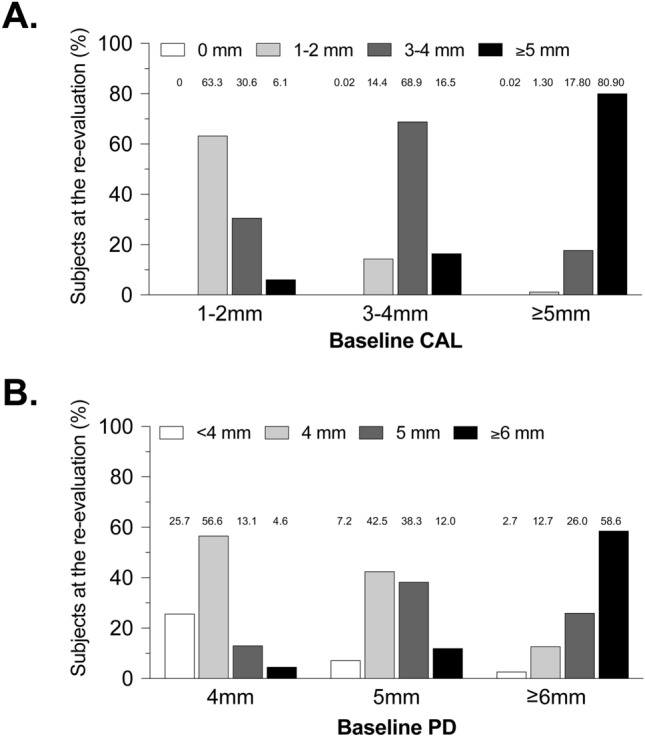
The present study examined the role of age and sex in the outcomes of non-surgical periodontal therapy (NSPT). De-identified demographic and periodontal characteristics of patients who presented for baseline periodontal evaluation, NSPT, and periodontal re-evaluation were abstracted from electronic health records. Independent associations of age and sex with severe periodontitis defined as ≥ 5 mm clinical attachment loss (CAL) and ≥ 6 mm probing depth (PD) were determined using multinomial logistic regression. The null hypothesis was rejected at α < 0.05. A total of 2866 eligible subjects were included in the analysis. Significantly lower odds of CAL ≤ 4 mm than CAL ≥ 5 mm (reference) were observed in adults aged 35-64 (odds ratio, OR, 0.19; 95% confidence interval, CI 0.13, 0.29) and ≥ 65 years (OR 0.13; 95% CI 0.07, 0.25) compared to those aged 18-34 years. Odds of PD < 4 mm versus PD ≥ 6 mm (reference) were lower in adults aged 35-64 years than those aged 18-34 years (OR 0.71; 95% CI 0.55, 0.90) and higher in females compared to males (OR 1.67; 95% CI 1.14, 2.44). These results suggest more compromised post-NSPT outcomes in older adults and males compared to the respective populations and highlight the need for personalized therapeutic strategies in these populations.
本研究探讨了年龄和性别在非手术牙周治疗(NSPT)结果中的作用。从电子健康记录中提取了前来进行基线牙周评估、NSPT和牙周复查的患者的匿名人口统计学和牙周特征。使用多项逻辑回归确定年龄和性别与定义为临床附着丧失(CAL)≥5mm和探诊深度(PD)≥6mm的重度牙周炎的独立关联。在α<0.05时拒绝原假设。共有2866名符合条件的受试者纳入分析。与18-34岁的成年人相比,35-64岁的成年人(比值比,OR,0.19;95%置信区间,CI 0.13,0.29)和≥65岁的成年人(OR 0.13;95%CI 0.07,0.25)中CAL≤4mm的几率显著低于CAL≥5mm(参照)。与18-34岁的成年人相比,35-64岁的成年人中PD<4mm与PD≥6mm(参照)的几率较低(OR 0.71;95%CI 0.55,0.90),女性比男性的几率更高(OR 1.67;95%CI 1.14,2.44)。这些结果表明,与各自人群相比,老年人和男性在NSPT后的结果更差,并强调了在这些人群中采用个性化治疗策略的必要性。