Werner Gijsbert D A, Zhou Yeling, Pieterse Corné M J, Kiers E Toby
Department of Ecological Science Vrije Universiteit Amsterdam Amsterdam The Netherlands.
Department of Zoology University of Oxford Oxford UK.
Ecol Evol. 2017 Nov 23;8(1):78-87. doi: 10.1002/ece3.3635. eCollection 2018 Jan.
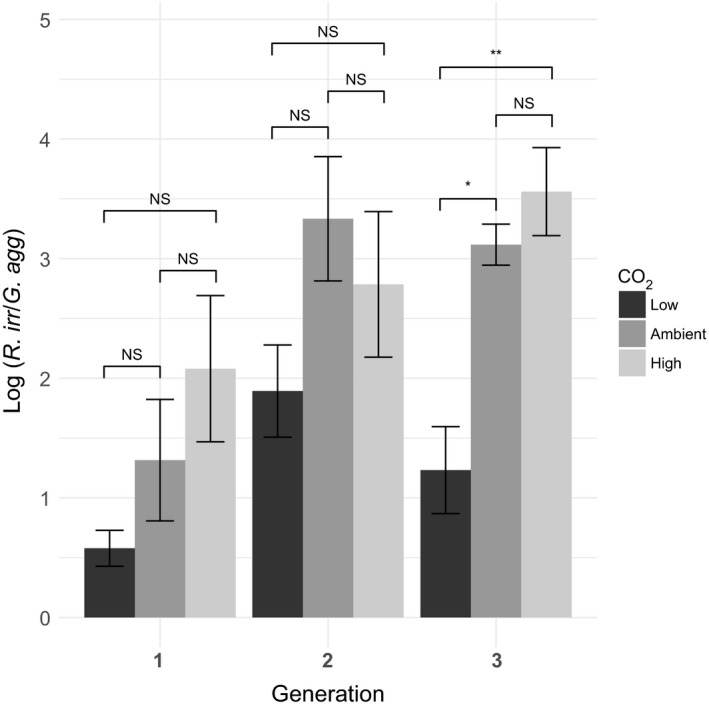
The symbiosis between plants and root-colonizing arbuscular mycorrhizal (AM) fungi is one of the most ecologically important examples of interspecific cooperation in the world. AM fungi provide benefits to plants; in return plants allocate carbon resources to fungi, preferentially allocating more resources to higher-quality fungi. However, preferential allocations from plants to symbionts may vary with environmental context, particularly when resource availability affects the relative value of symbiotic services. We ask how differences in atmospheric CO -levels influence root colonization dynamics between AMF species that differ in their quality as symbiotic partners. We find that with increasing CO -conditions and over multiple plant generations, the more beneficial fungal species is able to achieve a relatively higher abundance. This suggests that increasing atmospheric carbon supply enables plants to more effectively allocate carbon to higher-quality mutualists, and over time helps reduce lower-quality AM abundance. Our results illustrate how environmental context may affect the extent to which organisms structure interactions with their mutualistic partners and have potential implications for mutualism stability and persistence under global change.
植物与定殖于根部的丛枝菌根(AM)真菌之间的共生关系是世界上种间合作最重要的生态实例之一。AM真菌为植物提供益处;作为回报,植物将碳资源分配给真菌,优先将更多资源分配给质量更高的真菌。然而,植物对共生体的优先分配可能会因环境背景而有所不同,特别是当资源可用性影响共生服务的相对价值时。我们研究了大气CO₂水平的差异如何影响作为共生伙伴质量不同的AMF物种之间的根部定殖动态。我们发现,随着CO₂条件的增加以及经过多代植物,更有益的真菌物种能够实现相对更高的丰度。这表明,增加大气碳供应使植物能够更有效地将碳分配给质量更高的共生伙伴,并随着时间的推移有助于降低质量较低的AM丰度。我们的结果说明了环境背景如何可能影响生物体构建与其共生伙伴相互作用的程度,并对全球变化下共生关系的稳定性和持久性具有潜在影响。