Lee Sais-Beul, Hur Yeon-Jae, Cho Jun-Hyeon, Lee Jong-Hee, Kim Tae-Heon, Cho Soo-Min, Song You-Chun, Seo Young-Su, Lee Jungkwan, Kim Tae-Sung, Park Yong-Jin, Oh Myung-Kyu, Park Dong-Soo
National Institute of Crop Science, Milyang, Miryang, 50424, Republic of Korea.
Department of Microbiology, Pusan National University, Pusan, 46241, Republic of Korea.
Rice (N Y). 2018 Jan 10;11(1):3. doi: 10.1186/s12284-017-0197-7.
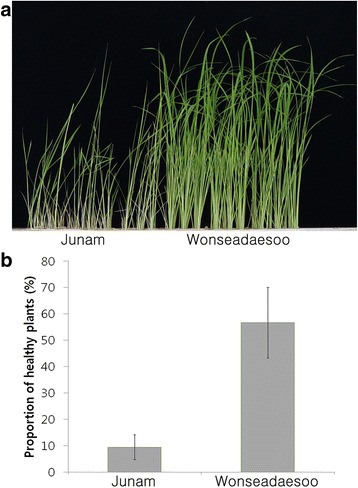
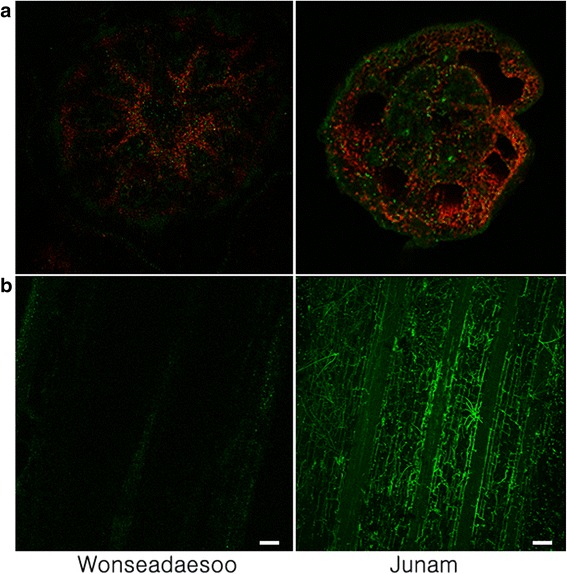
Bakanae or foot rot disease is a prominent disease of rice caused by Gibberella fujikuroi. This disease may infect rice plants from the pre-emergence stage to the mature stage. In recent years, raising rice seedlings in seed boxes for mechanical transplanting has increased the incidence of many seedling diseases; only a few rice varieties have been reported to exhibit resistance to bakanae disease. In this study, we attempted to identify quantitative trait loci (QTLs) conferring bakanae disease resistance from the highly resistant japonica variety Wonseadaesoo.
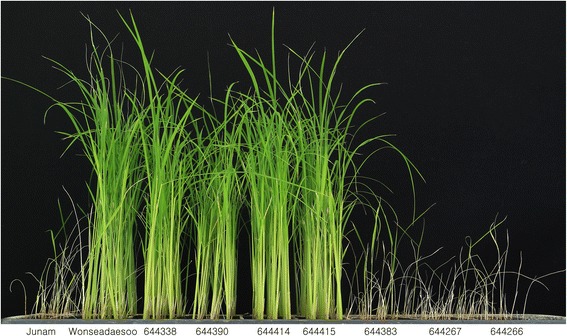
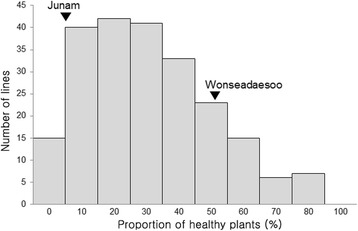
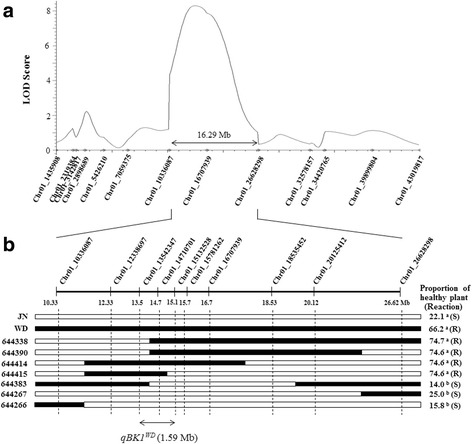
A primary QTL study using the genotypes/phenotypes of the recombinant inbred lines (RILs) indicated that the locus qBK1 conferring resistance to bakanae disease from Wonseadaesoo was located in a 1.59 Mb interval delimited on the physical map between chr01_13542347 (13.54 Mb) and chr01_15132528 (15.13 Mb). The log of odds (LOD) score of qBK1 was 8.29, accounting for 20.2% of the total phenotypic variation. We further identified a gene pyramiding effect of two QTLs, qBK and previously developed qBK1. The mean proportion of healthy plant for 31 F RILs that had no resistance genes was 35.3%, which was similar to that of the susceptible check variety Ilpum. The proportion of healthy plants for the lines with only qBK or qBK1 was 66.1% and 55.5%, respectively, which was significantly higher than that of the lines without resistance genes and that of Ilpum. The mean proportion of the healthy plant for 15 F RILs harboring both qBK and qBK1 was 80.2%, which was significantly higher than that of the lines with only qBK or qBK1.
Introducing qBK or pyramiding the QTLs qBK and qBK1 could provide effective tools for breeding rice with bakanae disease resistance. To our knowledge, this is the first report on a gene pyramiding effect that provides higher resistance against bakanae disease.
恶苗病或脚腐病是由藤仓赤霉引起的水稻主要病害。这种病害可在水稻从出苗前阶段到成熟阶段感染植株。近年来,采用秧盘育秧进行机械插秧增加了许多苗期病害的发生率;仅有少数水稻品种被报道对恶苗病具有抗性。在本研究中,我们试图从高抗粳稻品种农事台苏(Wonseadaesoo)中鉴定出赋予恶苗病抗性的数量性状基因座(QTL)。
利用重组自交系(RIL)的基因型/表型进行的初步QTL研究表明,农事台苏中赋予恶苗病抗性的基因座qBK1位于物理图谱上1.59 Mb的区间内,该区间在chr01_13542347(13.54 Mb)和chr01_15132528(15.13 Mb)之间界定。qBK1的对数优势(LOD)分数为8.29,占总表型变异的20.2%。我们进一步鉴定了两个QTL(qBK和先前开发的qBK1)的基因聚合效应。31个不含抗性基因的F代RIL中健康植株的平均比例为35.3%,与感病对照品种Ilpum相似。仅含有qBK或qBK1的株系中健康植株的比例分别为66.1%和55.5%,显著高于不含抗性基因的株系和Ilpum。同时含有qBK和qBK1的15个F代RIL中健康植株的平均比例为80.2%,显著高于仅含有qBK或qBK1的株系。
导入qBK或聚合QTL qBK和qBK1可为培育抗恶苗病水稻提供有效工具。据我们所知,这是关于提供更高恶苗病抗性的基因聚合效应的首次报道。