State Key Laboratory of Molecular Vaccinology and Molecular Diagnostics, School of Life Sciences, School of Public Health, Xiamen University, Xiamen, 361102, China.
Beijing Wantai Biological Pharmacy Enterprise, Beijing, 102206, China.
Emerg Microbes Infect. 2018 Jan 10;7(1):2. doi: 10.1038/s41426-017-0003-z.
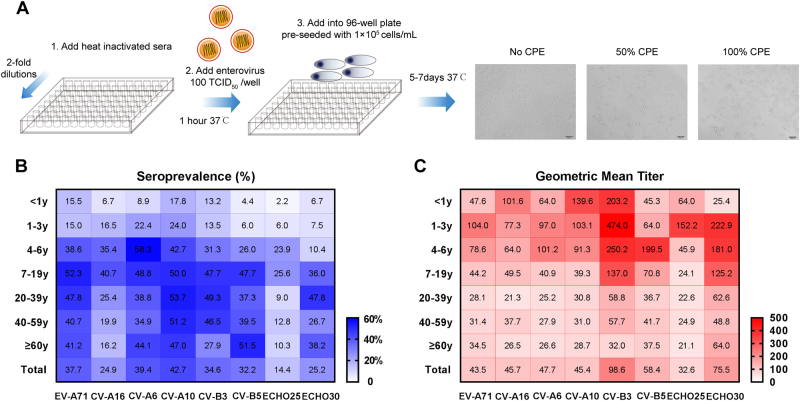
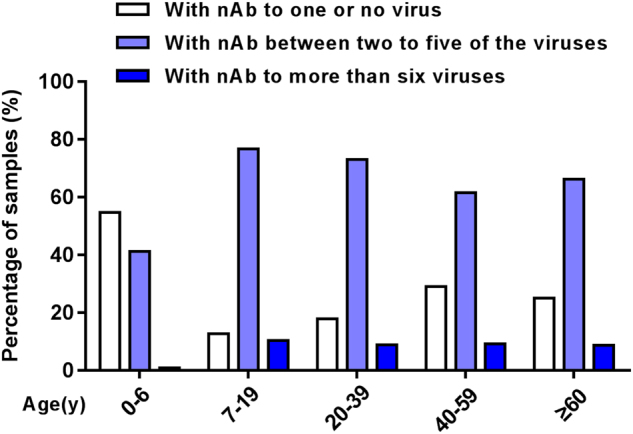
Human enteroviruses (EVs) are the most common causative agents infecting human, causing many harmful diseases, such as hand, foot, and mouth disease (HFMD), herpangina (HA), myocarditis, encephalitis, and aseptic meningitis. EV-related diseases pose a serious worldwide threat to public health. To gain comprehensive insight into the seroepidemiology of major prevalent EVs in humans, we firstly performed a serological survey for neutralizing antibodies (nAbs) against Enterovirus A71 (EV-A71), Coxsackie virus A16 (CV-A16), Coxsackie virus A6 (CV-A6), Coxsackie virus A10 (CV-A10), Coxsackie virus B3 (CV-B3), Coxsackie virus B5 (CV-B5), Echovirus 25 (ECHO25), and Echovirus 30 (ECHO30) among the healthy population in Xiamen City in 2016, using micro-neutralization assay. A total of 515 subjects aged 5 months to 83 years were recruited by stratified random sampling. Most major human EVs are widely circulated in Xiamen City and usually infect infants and children. The overall seroprevalence of these eight EVs were ranged from 14.4% to 42.7%, and most of them increased with age and subsequently reached a plateau. The co-existence of nAbs against various EVs are common among people ≥ 7 years of age, due to the alternate infections or co-infections with different serotypes of EVs, while most children were negative for nAb against EVs, especially those < 1 year of age. This is the first report detailing the seroepidemiology of eight prevalent EVs in the same population, which provides scientific data supporting further studies on the improvement of EV-related disease prevention and control.
人类肠道病毒(EVs)是感染人类的最常见病原体,可导致多种有害疾病,如手足口病(HFMD)、疱疹性咽峡炎(HA)、心肌炎、脑炎和无菌性脑膜炎。EV 相关疾病对全球公共卫生构成严重威胁。为了全面了解人类主要流行 EV 的血清流行病学,我们首先使用微量中和试验对 2016 年厦门市健康人群中针对肠道病毒 A71(EV-A71)、柯萨奇病毒 A16(CV-A16)、柯萨奇病毒 A6(CV-A6)、柯萨奇病毒 A10(CV-A10)、柯萨奇病毒 B3(CV-B3)、柯萨奇病毒 B5(CV-B5)、埃可病毒 25(ECHO25)和埃可病毒 30(ECHO30)的中和抗体(nAbs)进行了血清学调查。通过分层随机抽样共招募了 515 名 5 个月至 83 岁的受试者。厦门市大多数主要的人类 EV 广泛传播,通常感染婴儿和儿童。这 8 种 EV 的总体血清阳性率在 14.4%至 42.7%之间,大多数随着年龄的增长而增加,并随后达到稳定水平。由于交替感染或混合感染不同血清型的 EV,年龄≥7 岁的人群中存在针对多种 EV 的 nAbs 共存,而大多数儿童对 EV 的 nAb 呈阴性,尤其是年龄<1 岁的儿童。这是首次详细报告同一人群中 8 种流行 EV 的血清流行病学情况,为进一步开展 EV 相关疾病预防和控制研究提供了科学数据。