Yale School of Public Health, 60 College ST, New Haven, CT, 06520, USA.
School of Statistics and The center for Applied Statistics, Renmin University of China, 59 Zhongguancun Ave., Beijing, 100872, China.
Sci Rep. 2018 Jan 11;8(1):548. doi: 10.1038/s41598-017-19081-4.
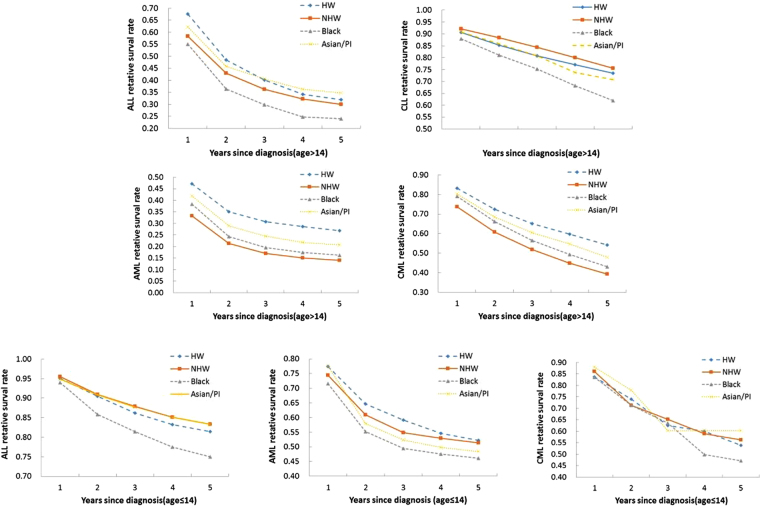
Leukemia is a malignant progressive disease and has four major subtypes. Different racial groups differ significantly in multiple aspects. Our goal is to systematically and comprehensively quantify racial differences in leukemia. The SEER database is analyzed, and comprehensive descriptive analysis is provided for the four major subtypes, namely ALL (acute lymphoblastic leukemia), CLL (chronic lymphoblastic leukemia), AML (acute myeloid leukemia), and CML (chronic myeloid leukemia), and for two age groups (≤14 and >14) separately. The racial groups studied include NHW (non-Hispanic White), HW (Hispanic White), BL (Black), and API (Asian and Pacific Islander). Univariate and multivariate analyses are conducted to quantify racial differences in patients' characteristics, incidence, and survival. For patients' characteristics, significant racial differences are observed in gender, age at diagnosis, diagnosis era, using radiation for treatment, registry, cancer history, and histology type. For incidence, significant racial differences are observed, and the patterns vary across subtypes, gender, and age groups. For most of the subtypes and gender and age groups, Blacks have the worst five-year survival, and significant racial differences exist. This study provides a comprehensive epidemiologic description of racial differences for the four major leukemia subtypes in the U.S.
白血病是一种恶性进行性疾病,有四个主要亚型。不同的种族群体在多个方面存在显著差异。我们的目标是系统全面地量化白血病的种族差异。对 SEER 数据库进行分析,并对四大主要亚型(ALL(急性淋巴细胞白血病)、CLL(慢性淋巴细胞白血病)、AML(急性髓系白血病)和 CML(慢性髓系白血病)以及两个年龄组(≤14 岁和>14 岁)分别进行综合描述性分析。所研究的种族群体包括 NHW(非西班牙裔白人)、HW(西班牙裔白人)、BL(黑人)和 API(亚洲和太平洋岛民)。进行单变量和多变量分析以量化患者特征、发病率和生存率方面的种族差异。对于患者特征,在性别、诊断时的年龄、诊断时代、治疗中使用辐射、登记处、癌症史和组织学类型方面存在显著的种族差异。在发病率方面,观察到显著的种族差异,且模式因亚型、性别和年龄组而异。对于大多数亚型和性别以及年龄组,黑人的五年生存率最差,存在显著的种族差异。本研究为美国四种主要白血病亚型的种族差异提供了全面的流行病学描述。