Department of Psychological and Brain Sciences, University of California Santa Barbara, Santa Barbara, CA, 93106-9660, USA.
Department of Psychological and Brain Sciences, University of California Santa Barbara, Santa Barbara, CA, 93106-9660, USA; Department of Molecular, Cellular and Developmental Biology and the Neuroscience Research Institute, University of California Santa Barbara, Santa Barbara, CA, 93106-9625, USA.
Drug Alcohol Depend. 2018 Mar 1;184:1-11. doi: 10.1016/j.drugalcdep.2017.10.031. Epub 2018 Jan 5.
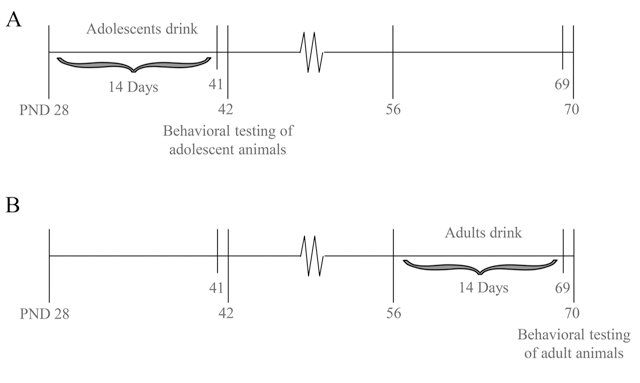
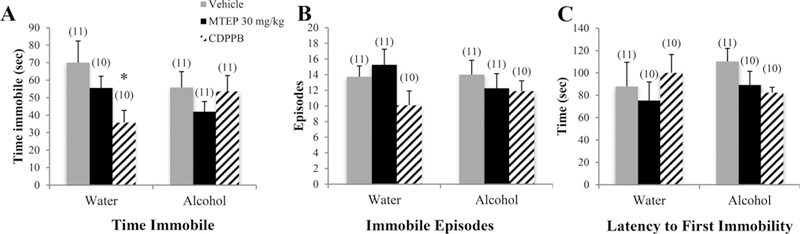
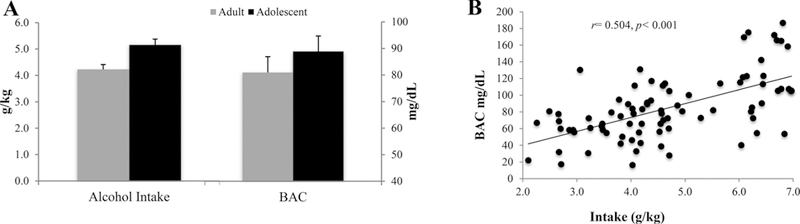
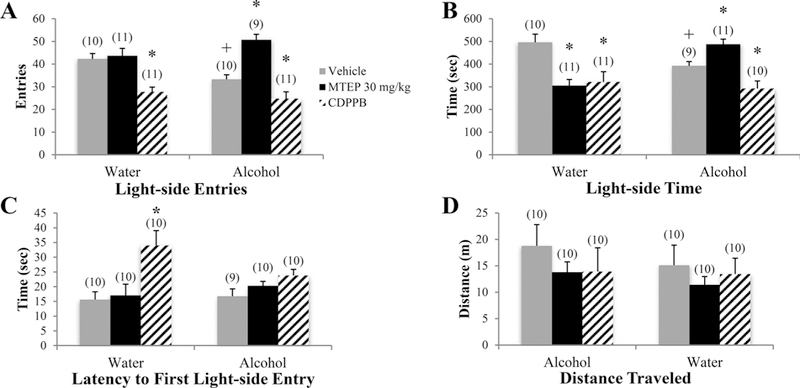
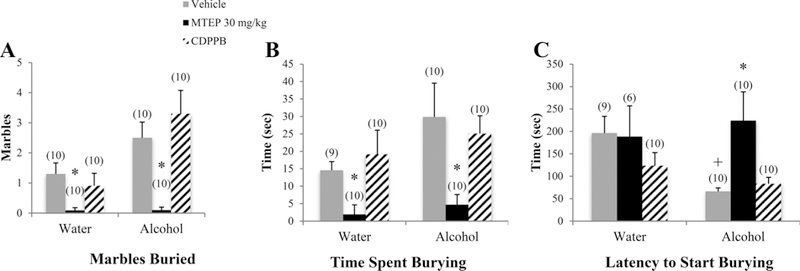
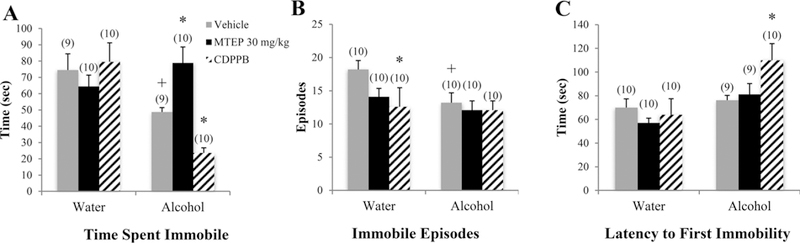
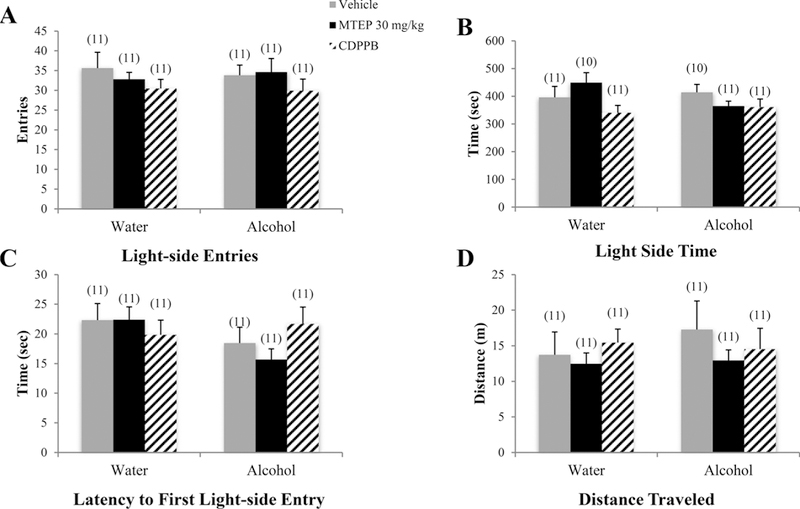
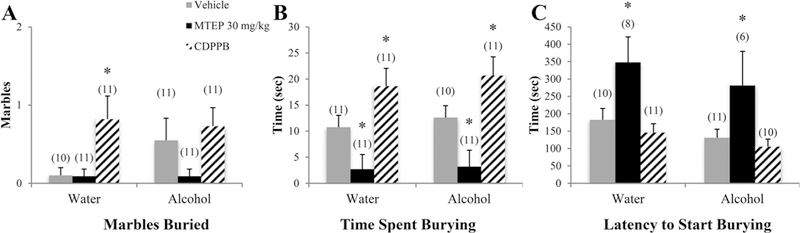
Binge alcohol-drinking elicits symptoms of negative affect such as anxiety upon cessation, which is a source of negative reinforcement for perpetuating this pattern of alcohol abuse. Binge-induced anxiety during early (24 h) withdrawal is associated with increased expression of metabotropic glutamate receptor 5 (mGlu5) within the nucleus accumbens shell (AcbSh) of adult male mice, but was unchanged in anxiety-resilient adolescents. Herein, we determined the role of mGlu5 signaling in withdrawal-induced anxiety via pharmacological manipulation using the mGlu5 negative allosteric modulator MTEP and the positive allosteric modulator CDPPB. Adult (PND 56) and adolescent (PND 28) male C57BL/6J mice binge-drank for 14 days under 3-bottle-choice procedures for 2 h/day; control animals drank water only. Approximately 24 h following the final alcohol presentation, animals were treated with 30 mg/kg IP MTEP, CDPPB, or vehicle and then tested, thirty minutes later, for behavioral signs of anxiety. Vehicle-treated binge-drinking adults exhibited hyperanxiety in all paradigms, while vehicle-treated binge-drinking adolescents did not exhibit withdrawal-induced anxiety. In adults, 30 mg/kg MTEP decreased alcohol-induced anxiety across paradigms, while 3 mg/kg MTEP was anxiolytic in adult water controls. CDPPB was modestly anxiogenic in both alcohol- and water-drinking mice. Adolescent animals showed minimal response to either CDPPB or MTEP, suggesting that anxiety in adolescence may be mGlu5-independent. These results demonstrate a causal role for mGlu5 in withdrawal-induced anxiety in adults and suggest age-related differences in the behavioral pharmacology of the negative reinforcing properties of alcohol.
binge 饮酒会在停止饮酒时引发负面情绪症状,如焦虑,这是促使这种酗酒模式持续下去的负面强化因素。在早期(24 小时)戒断期间, binge 引起的焦虑与成年雄性小鼠伏隔核壳(AcbSh)中代谢型谷氨酸受体 5(mGlu5)的表达增加有关,但在焦虑抵抗的青少年中没有变化。在此,我们通过使用 mGlu5 负变构调节剂 MTEP 和正变构调节剂 CDPPB 进行药理学操作,确定了 mGlu5 信号在戒断引起的焦虑中的作用。成年(PND 56)和青少年(PND 28)雄性 C57BL/6J 小鼠在 3 瓶选择程序下 binge 饮酒 14 天,每天 2 小时;对照动物只喝水。在最后一次酒精呈现后大约 24 小时,用 30mg/kg IP MTEP、CDPPB 或载体处理动物,然后在 30 分钟后测试它们的焦虑行为迹象。在所有范式中,用载体处理的 binge 饮酒成年动物表现出过度焦虑,而用载体处理的 binge 饮酒青少年动物则没有表现出戒断引起的焦虑。在成年动物中,30mg/kg MTEP 降低了所有范式中的酒精引起的焦虑,而 3mg/kg MTEP 在成年水对照中具有抗焦虑作用。CDPPB 在饮酒和饮水小鼠中均适度致焦虑。青少年动物对 CDPPB 或 MTEP 的反应都很小,这表明青少年时期的焦虑可能与 mGlu5 无关。这些结果表明 mGlu5 在成年戒断引起的焦虑中起因果作用,并表明与年龄相关的酒精负强化特性的行为药理学差异。