Bao Xueliang, Zhou Yuxuan, Wang Yunlong, Zhang Jianjun, Lü Xiaoying, Wang Zhigong
State Key Laboratory of Bioelectronics, Southeast University, Nanjing, People's Republic of China.
Co-innovation Center of Neuroregeneration, Nantong University, Nantong, People's Republic of China.
PLoS One. 2018 Jan 11;13(1):e0190936. doi: 10.1371/journal.pone.0190936. eCollection 2018.
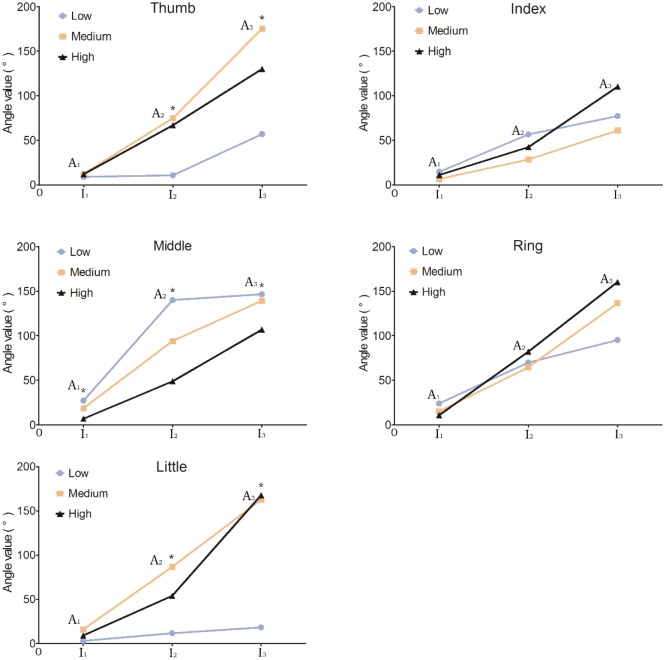
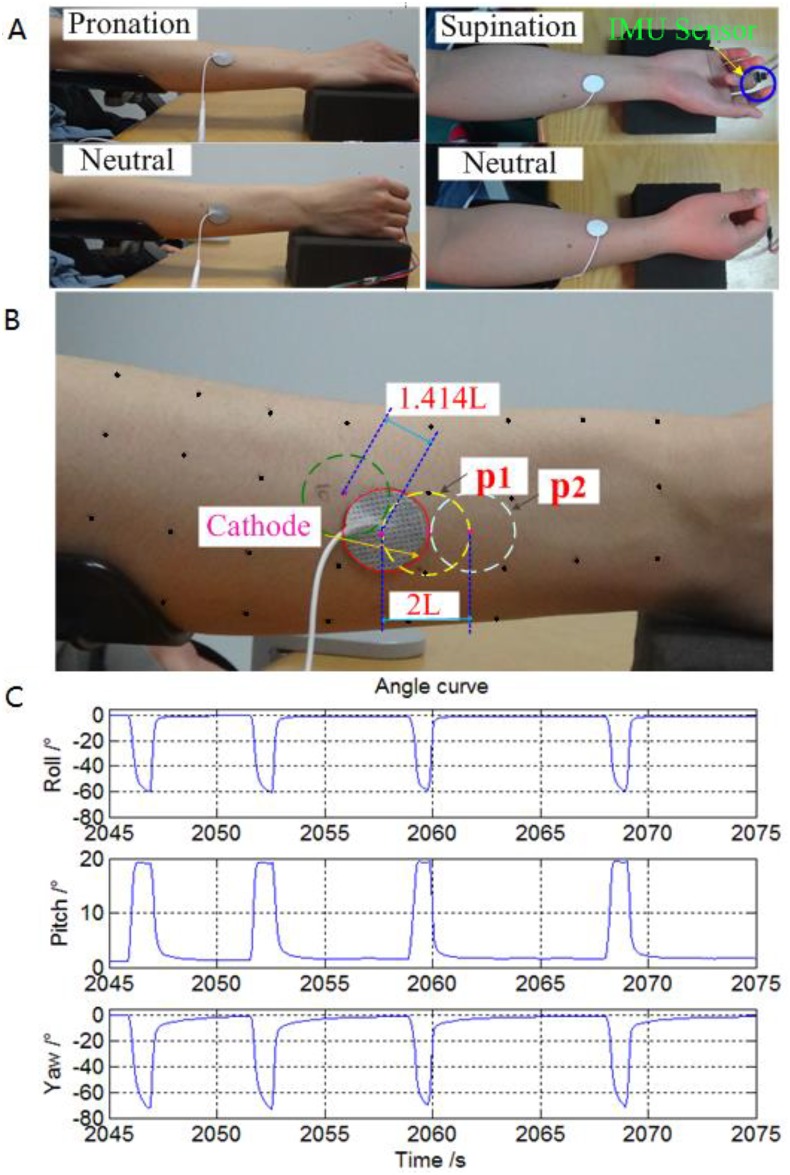
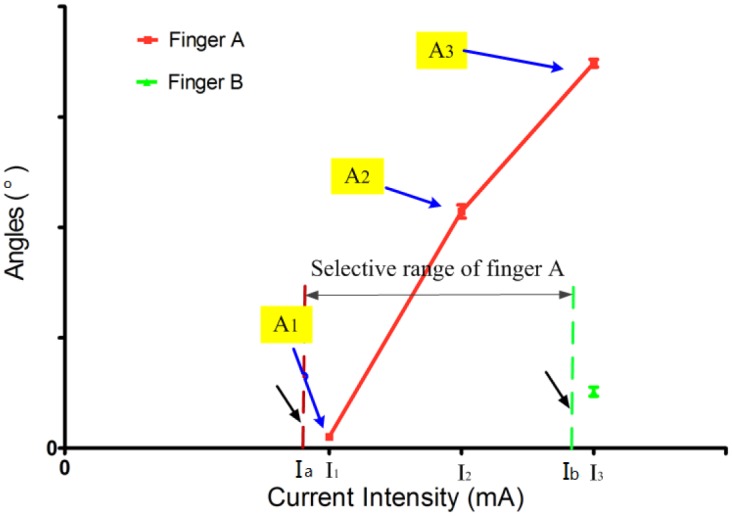
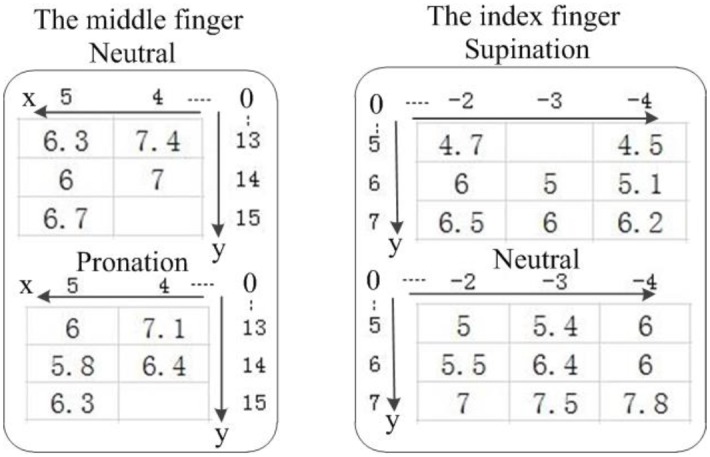
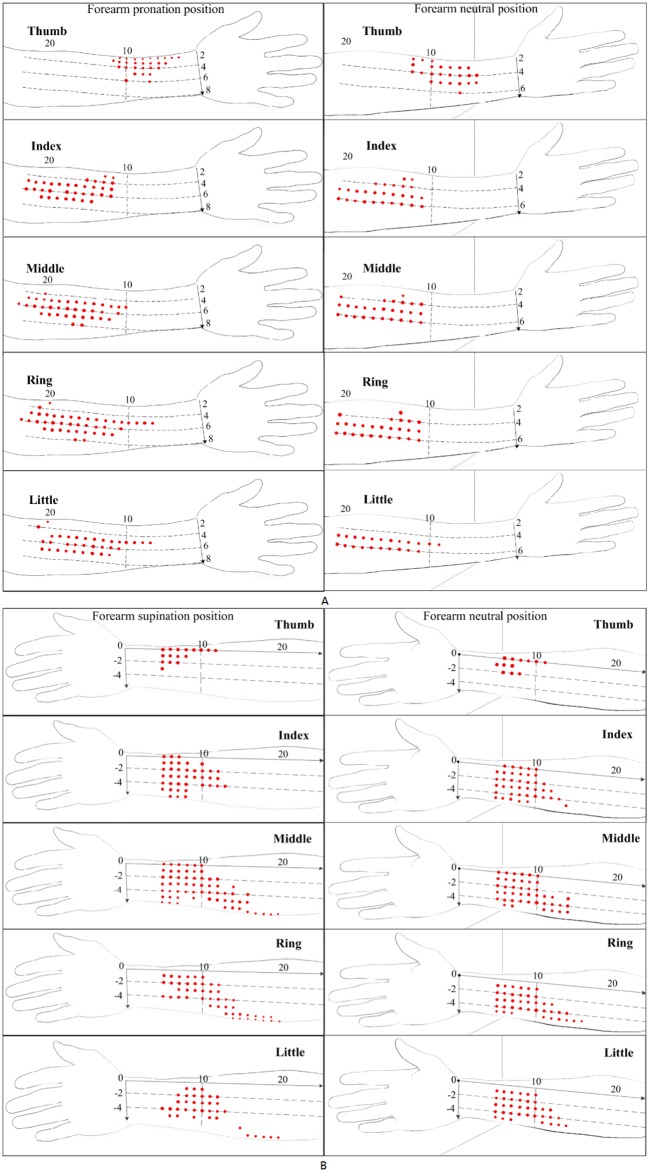
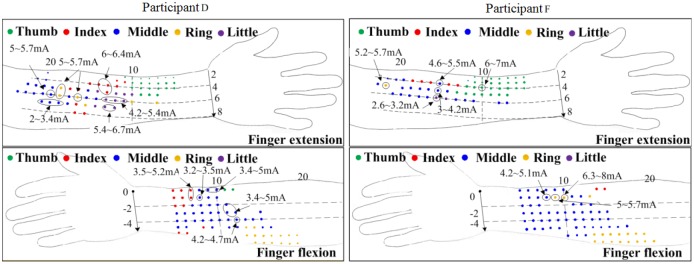
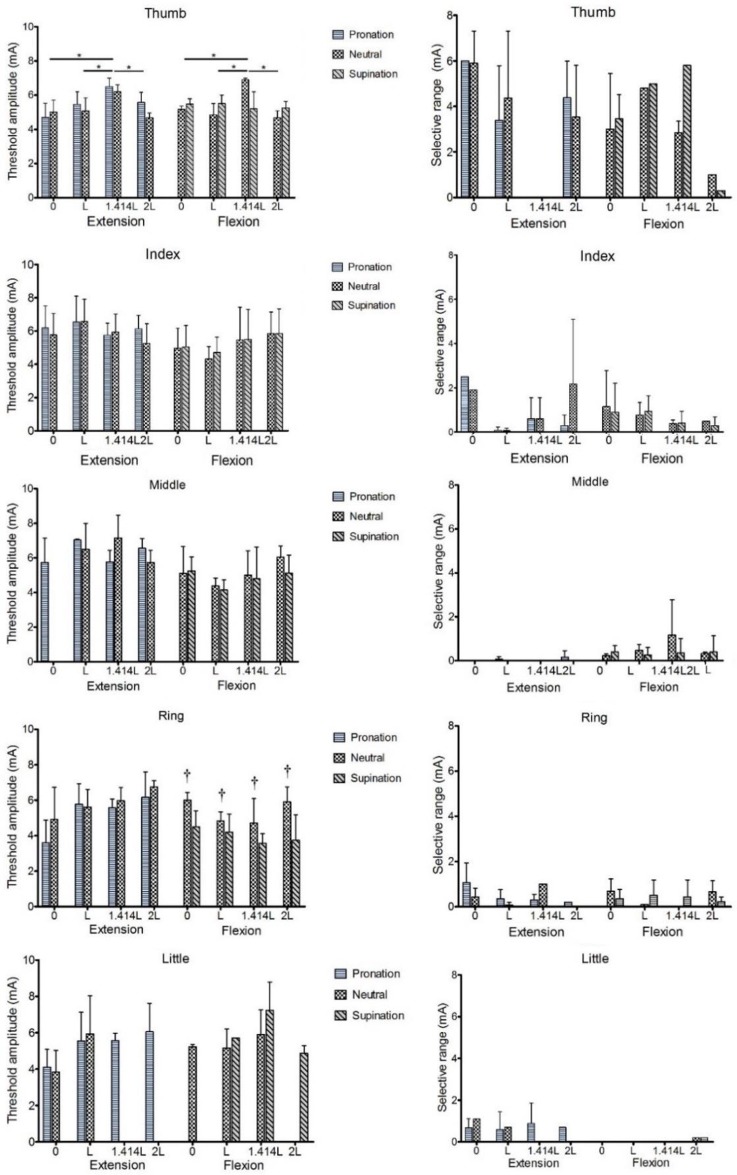
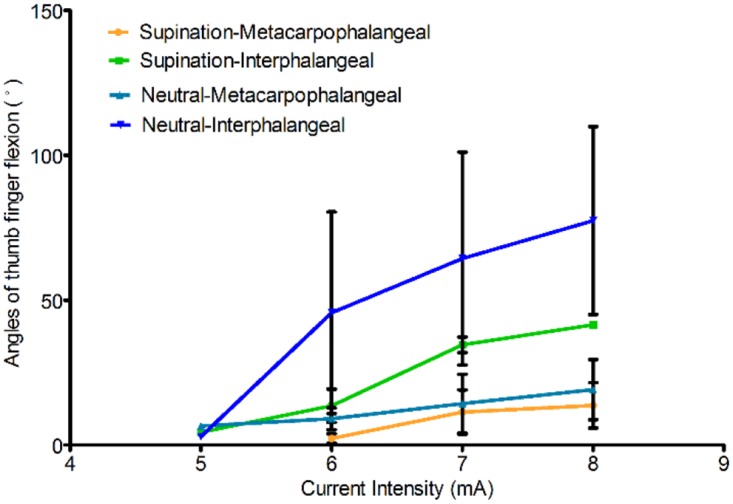
It is still challenging to achieve a complex grasp or fine finger control by using surface functional electrical stimulation (FES), which usually requires a precise electrode configuration under laboratory or clinical settings. The goals of this study are as follows: 1) to study the possibility of selectively activating individual fingers; 2) to investigate whether the current activation threshold and selective range of individual fingers are affected by two factors: changes in the electrode position and forearm rotation (pronation, neutral and supination); and 3) to explore a theoretical model for guidance of the electrode placement used for selective activation of individual fingers. A coordinate system with more than 400 grid points was established over the forearm skin surface. A searching procedure was used to traverse all grid points to identify the stimulation points for finger extension/flexion by applying monophasic stimulation pulses. Some of the stimulation points for finger extension and flexion were selected and tested in their respective two different forearm postures according to the number and the type of the activated fingers and the strength of finger action response to the electrical stimulation at the stimulation point. The activation thresholds and current ranges of the selectively activated finger at each stimulation point were determined by visual analysis. The stimulation points were divided into three groups ("Low", "Medium" and "High") according to the thresholds of the 1st activated fingers. The angles produced by the selectively activated finger within selective current ranges were measured and analyzed. Selective stimulation of extension/flexion is possible for most fingers. Small changes in electrode position and forearm rotation have no significant effect on the threshold amplitude and the current range for the selective activation of most fingers (p > 0.05). The current range is the largest (more than 2 mA) for selective activation of the thumb, followed by those for the index, ring, middle and little fingers. The stimulation points in the "Low" group for all five fingers lead to noticeable finger angles at low current intensity, especially for the index, middle, and ring fingers. The slopes of the finger angle variation in the "Low" group for digits 2~4 are inversely proportional to the current intensity, whereas the slopes of the finger angle variation in other groups and in all groups for the thumb and little finger are proportional to the current intensity. It is possible to selectively activate the extension/flexion of most fingers by stimulating the forearm muscles. The physiological characteristics of each finger should be considered when placing the negative electrode for selective stimulation of individual fingers. The electrode placement used for the selective activation of individual fingers should not be confined to the location with the lowest activation threshold.
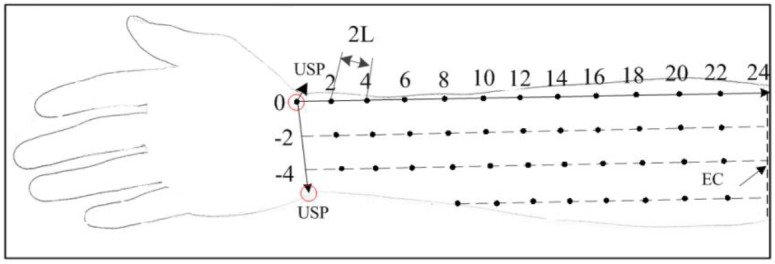
通过使用表面功能性电刺激(FES)来实现复杂抓握或精细手指控制仍然具有挑战性,这通常需要在实验室或临床环境下进行精确的电极配置。本研究的目标如下:1)研究选择性激活单个手指的可能性;2)研究单个手指当前的激活阈值和选择范围是否受两个因素影响:电极位置的变化和前臂旋转(旋前、中立和旋后);3)探索一个理论模型,以指导用于选择性激活单个手指的电极放置。在前臂皮肤表面建立了一个具有400多个网格点的坐标系。使用搜索程序遍历所有网格点,通过施加单相刺激脉冲来识别手指伸展/屈曲的刺激点。根据激活手指的数量和类型以及刺激点处手指动作对电刺激的反应强度,选择一些手指伸展和屈曲的刺激点,并在其各自的两种不同前臂姿势下进行测试。通过视觉分析确定每个刺激点处选择性激活手指的激活阈值和电流范围。根据第一个激活手指的阈值,将刺激点分为三组(“低”、“中”和“高”)。测量并分析在选择性电流范围内选择性激活手指产生的角度。大多数手指都可以实现伸展/屈曲的选择性刺激。电极位置和前臂旋转的微小变化对大多数手指选择性激活的阈值幅度和电流范围没有显著影响(p>0.05)。选择性激活拇指的电流范围最大(超过2 mA),其次是食指、无名指、中指和小指。所有五个手指“低”组中的刺激点在低电流强度下会导致明显的手指角度,特别是食指、中指和无名指。2至4指“低”组中手指角度变化的斜率与电流强度成反比,而其他组以及拇指和小指所有组中手指角度变化的斜率与电流强度成正比。通过刺激前臂肌肉可以选择性地激活大多数手指的伸展/屈曲。在放置负极以选择性刺激单个手指时,应考虑每个手指的生理特征。用于选择性激活单个手指的电极放置不应局限于激活阈值最低的位置。