Tsai Hsiu-Pei, Huang Shiang-Fu, Li Chien-Fan, Chien Huei-Tzu, Chen Shin-Cheh
Graduate Institute of Clinical Medical Sciences, Chang Gung University, Gueishan, Taoyuan, Taiwan.
Department of General Surgery, Chang Gung Memorial Hospital, Gueishan, Taoyuan, Taiwan.
PLoS One. 2018 Jan 11;13(1):e0191195. doi: 10.1371/journal.pone.0191195. eCollection 2018.
The lower breast cancer incidence in Asian populations compared with Western populations has been speculated to be caused by environmental and genetic variation. Early-onset breast cancer occupies a considerable proportion of breast cancers in Asian populations, but the reason for this is unclear. We aimed to examine miRNA expression profiles in different age-onset groups and pathological subtypes in Asian breast cancer.
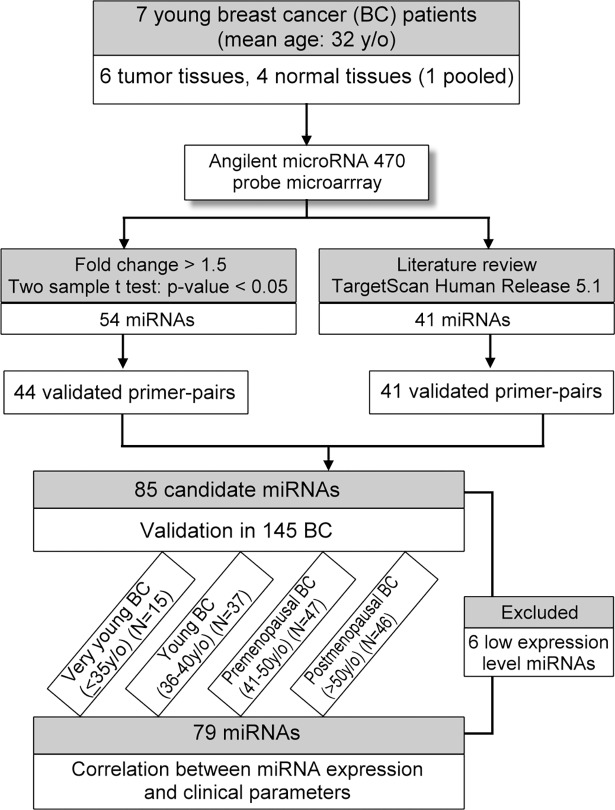
At the first stage, 10 samples (tumor: n = 6, normal tissue: n = 4) were analyzed with an Agilent microRNA 470 probe microarray. Candidate miRNAs with expression levels that were significantly altered in breast cancer samples or selected from a literature review were further validated by quantitative real-time PCR (qPCR) of 145 breast cancer samples at the second stage of the process. Correlations between clinicopathological parameters of breast cancer patients from different age groups and candidate miRNA expression were elucidated.
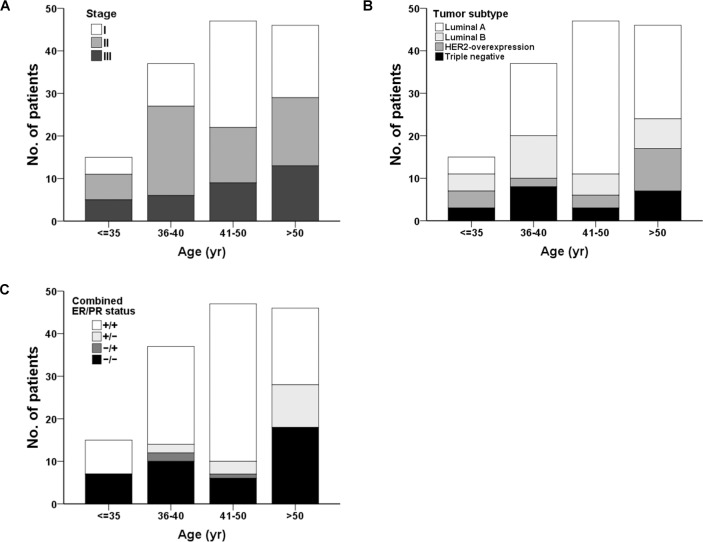
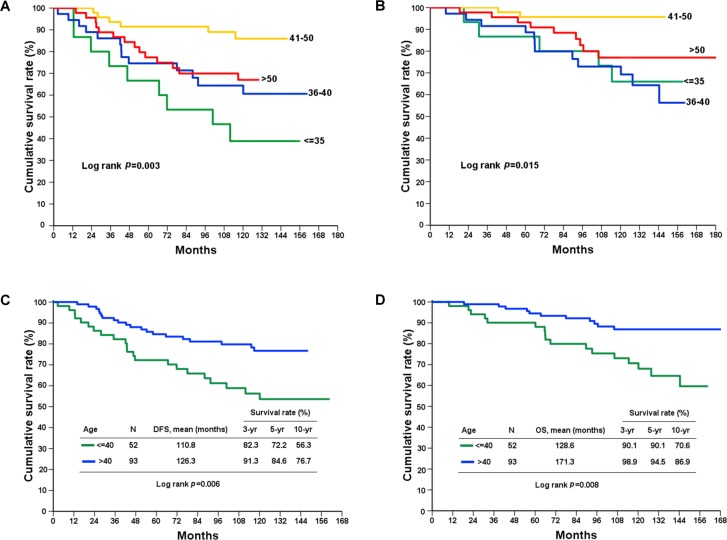
In the present study, the tumor subtypes were significantly different in each age group, and an onset age below 40 had poor disease-free and overall survival rates. For all breast cancer patients, miR-335 and miR-145 were down-regulated, and miR-21, miR-200a, miR-200c, and miR-141 were up-regulated. In very young patients (age < 35 y/o), the expression of 3 and 8 specific miRNAs were up- and down-regulated, respectively. In young patients (36-40 y/o), 3 and 3 specific miRNAs were up- and down-regulated, respectively. miR-532-5p was up-regulated in triple-negative breast cancer.
Differential miRNA expressions between normal and tumor tissues were observed in different age groups and tumor subtypes. Evolutionarily conserved miRNA clusters, which initiate malignancy transformation, were up-regulated in the breast cancers of very young patients. None of the significantly altered miRNAs were observed in postmenopausal patients.
与西方人群相比,亚洲人群乳腺癌发病率较低,据推测这是由环境和基因变异导致的。早发性乳腺癌在亚洲人群的乳腺癌中占相当比例,但其原因尚不清楚。我们旨在研究亚洲乳腺癌不同年龄发病组和病理亚型中的微小RNA(miRNA)表达谱。
在第一阶段,使用安捷伦微RNA 470探针微阵列分析10个样本(肿瘤:n = 6,正常组织:n = 4)。在该过程的第二阶段,通过对145个乳腺癌样本进行定量实时聚合酶链反应(qPCR),进一步验证在乳腺癌样本中表达水平显著改变或从文献综述中选择的候选miRNA。阐明了不同年龄组乳腺癌患者的临床病理参数与候选miRNA表达之间的相关性。
在本研究中,各年龄组的肿瘤亚型存在显著差异,发病年龄低于40岁的患者无病生存率和总生存率较差。对于所有乳腺癌患者,miR-335和miR-145表达下调,而miR-21、miR-200a、miR-200c和miR-141表达上调。在非常年轻的患者(年龄<35岁)中,分别有3种和8种特定miRNA的表达上调和下调。在年轻患者(36 - 40岁)中,分别有3种和3种特定miRNA的表达上调和下调。miR-532-5p在三阴性乳腺癌中表达上调。
在不同年龄组和肿瘤亚型中观察到正常组织与肿瘤组织之间miRNA表达存在差异。启动恶性转化的进化保守miRNA簇在非常年轻患者的乳腺癌中表达上调。在绝经后患者中未观察到显著改变的miRNA。