Ricci-Azevedo Rafael, Roque-Barreira Maria-Cristina, Gay Nicholas J
Laboratory of Immunochemistry and Glycobiology, Department of Cell and Molecular Biology and Pathogenic Bioagents, Ribeirão Preto Medical School, University of São Paulo, Ribeirão Preto, Brazil.
Department of Biochemistry, University of Cambridge, Cambridge, United Kingdom.
Front Immunol. 2017 Dec 18;8:1820. doi: 10.3389/fimmu.2017.01820. eCollection 2017.
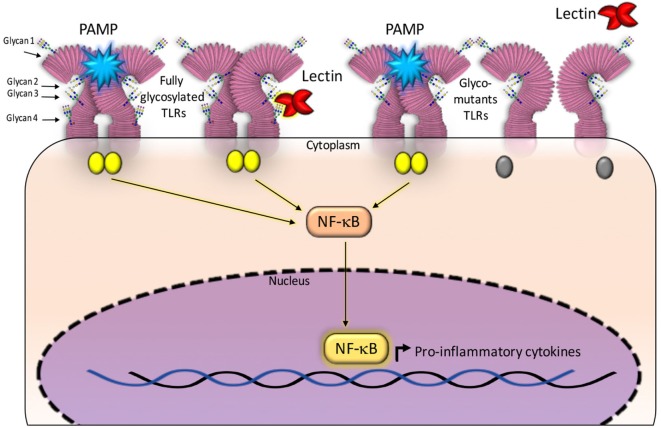
We have reported that some lectins act as agonists of toll-like receptors (TLRs) and have immunomodulatory properties. The plant lectin ArtinM, for example, interacts with N-glycans of TLR2, whereas other lectins of microbial origin interact with TLR2 and TLR4. Expression of the receptors on the surface of antigen-presenting cells exposes N-glycans that may be targeted by lectins of different structures, specificities, and origins. , these interactions trigger cell signaling that leads to NF-κB activation and production of the Th1 polarizing cytokine IL-12. , a same sequence of events follows the administration of an active lectin to mice infected with an intracellular pathogen, conferring resistance to the pathogen. The lectins of the human pathogens (Paracoccin), by recognition and activation of TLR2 and TLR4, induce cell events and effects comparable to the promoted by the plant lectin ArtinM. In this article, we highlight these two distinct mechanisms for activating antigen-presenting cells. On the one hand, TLRs act as sensors for the presence of conventional pathogen-associated molecular patterns, such as microbial lipids. On the other hand, we showed that TLR-mediated cell activation might be triggered by an alternative way, in which lectins bind to TLRs N-glycans and stimulate cells to increase the expression of pro-inflammatory cytokines. This process may lead to the development of new pharmaceutical tools that promote protective immune responses directed against intracellular pathogens and tumors.
我们曾报道,一些凝集素可作为 Toll 样受体(TLR)的激动剂,具有免疫调节特性。例如,植物凝集素 ArtinM 与 TLR2 的 N -聚糖相互作用,而其他微生物来源的凝集素则与 TLR2 和 TLR4 相互作用。抗原呈递细胞表面受体的表达会暴露出可能被不同结构、特异性和来源的凝集素靶向的 N -聚糖。这些相互作用触发细胞信号传导,导致 NF -κB 激活和 Th1 极化细胞因子 IL -12 的产生。同样,向感染细胞内病原体的小鼠施用活性凝集素后也会发生一系列相同的事件,使小鼠对病原体产生抗性。人类病原体(副球孢子菌素)的凝集素通过识别和激活 TLR2 和 TLR4,诱导细胞事件和产生与植物凝集素 ArtinM 促进的作用相当的效应。在本文中,我们重点介绍了激活抗原呈递细胞的这两种不同机制。一方面,TLR 作为传统病原体相关分子模式(如微生物脂质)存在的传感器。另一方面,我们表明 TLR 介导的细胞激活可能由另一种方式触发,即凝集素与 TLR 的 N -聚糖结合并刺激细胞增加促炎细胞因子的表达。这一过程可能会促成新的药物工具的开发,这些工具可促进针对细胞内病原体和肿瘤的保护性免疫反应。