Jiang Mengmeng, Chen Jieying, Zhang Wenwen, Zhang Rui, Ye Yingnan, Liu Pengpeng, Yu Wenwen, Wei Feng, Ren Xiubao, Yu Jinpu
Cancer Molecular Diagnostics Core, Tianjin Medical University Cancer Institute and Hospital, National Clinical Research Center for Cancer, Key Laboratory of Cancer Prevention and Therapy, Tianjin's Clinical Research Center for Cancer, Tianjin, China.
Department of Immunology, Tianjin Medical University Cancer Institute and Hospital, National Clinical Research Center for Cancer, Key Laboratory of Cancer Immunology and Biotherapy, Tianjin's Clinical Research Center for Cancer, Tianjin, China.
Front Immunol. 2017 Dec 15;8:1840. doi: 10.3389/fimmu.2017.01840. eCollection 2017.
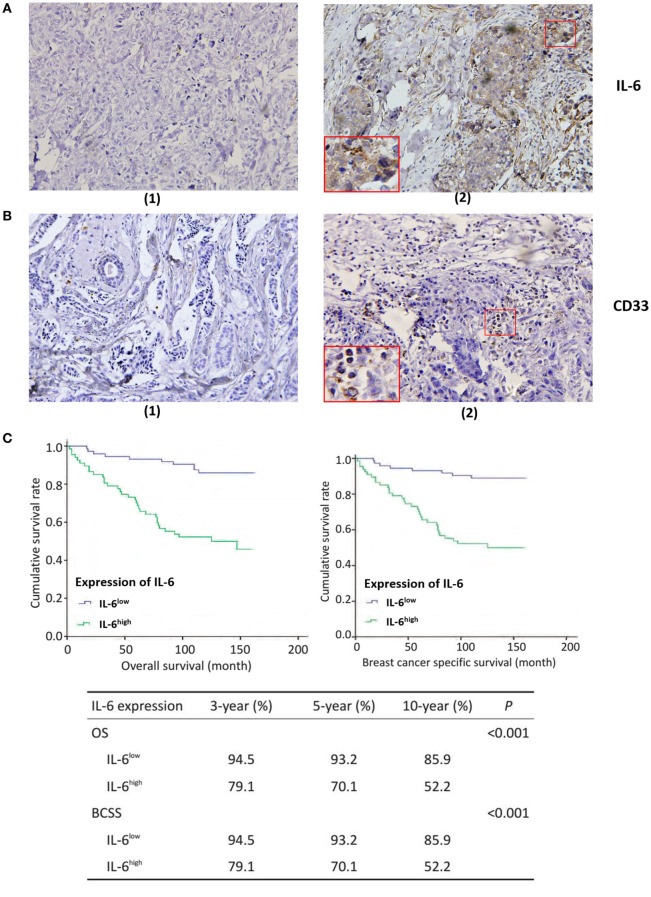
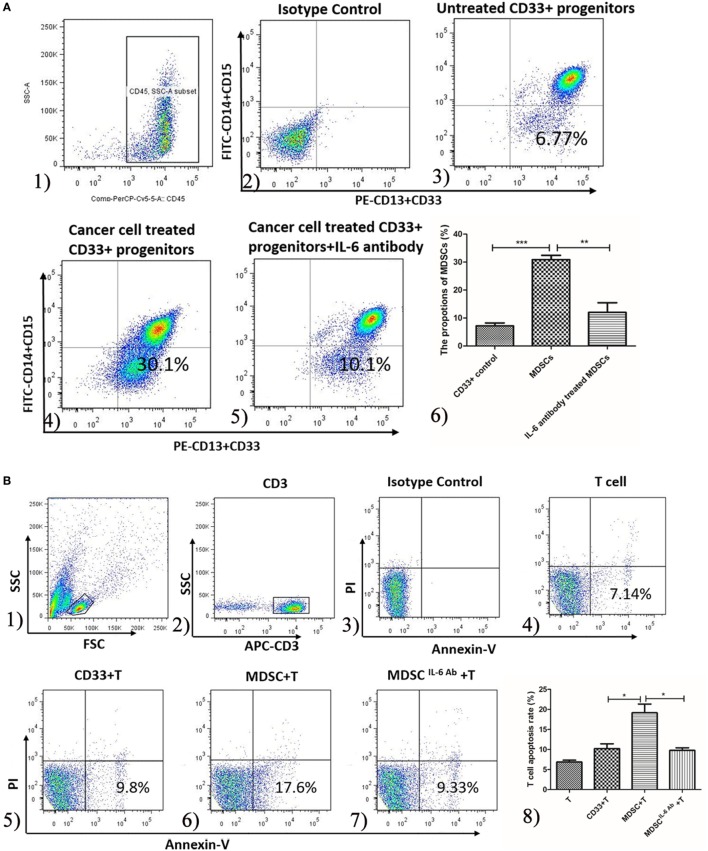
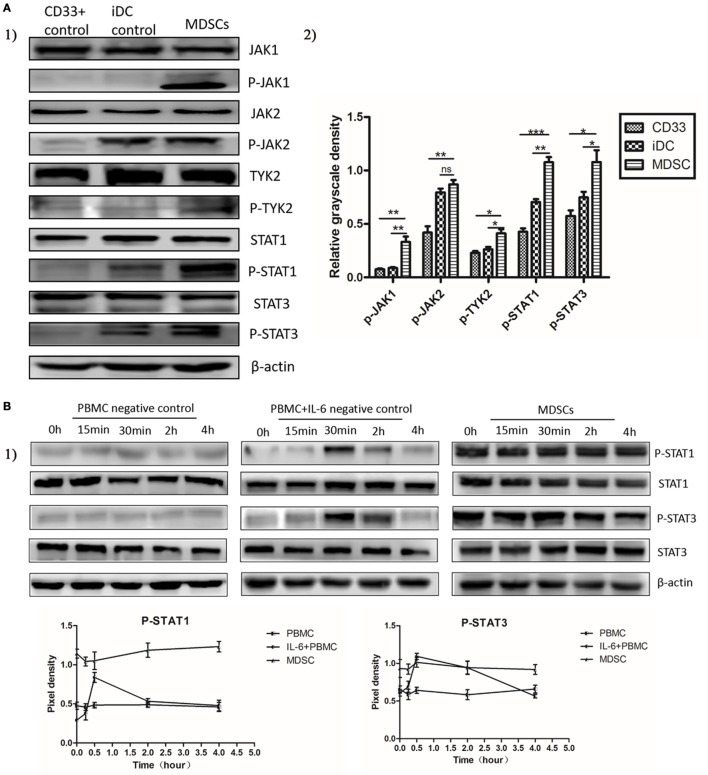
Interleukin-6 (IL-6) has been reported to stimulate myeloid-derived suppressor cells (MDSCs) in multiple cancers, but the molecular events involved in this process are not completely understood. We previously found that cancer-derived IL-6 induces T cell suppression of MDSCs the activation of STAT3/IDO signaling pathway. In this study, we aimed to elucidate the underlying mechanisms. We found that in primary breast cancer tissues, cancer-derived IL-6 was positively correlated with infiltration of MDSCs , which was accompanied by more aggressive tumor phenotypes and worse clinical outcomes IL-6 stimulated the amplification of MDSCs and promoted their T cell suppression ability, which were fully inhibited by an IL-6-specific blocking antibody. Our results demonstrate that IL-6-dependent suppressor of cytokine signaling 3 (SOCS3) suppression in MDSCs induced phosphorylation of the JAK1, JAK2, TYK2, STAT1, and STAT3 proteins, which was correlated with T cell suppression of MDSCs . Therefore, dysfunction in the SOCS feedback loop promoted long-term activation of the JAK/STAT signaling pathway and predominantly contributed to IL-6-mediated effects on MDSCs. Furthermore, IL-6-induced inhibition of SOCS3 and activation of the JAK/STAT pathway was correlated with an elevated expression of IL-6 receptor α (CD126), in which the soluble CD126-mediated IL-6 -signaling pathway significantly regulated IL-6-mediated effects on MDSCs. Finally, IL-6-induced SOCS3 dysfunction and sustained activation of the JAK/STAT signaling pathway promoted the amplification and immunosuppressive function of breast cancer MDSCs and , and thus blocking the IL-6 signaling pathway is a promising therapeutic strategy for eliminating and inhibiting MDSCs to improve prognosis.
据报道,白细胞介素-6(IL-6)在多种癌症中可刺激髓源性抑制细胞(MDSC),但该过程涉及的分子事件尚未完全明确。我们之前发现,癌症来源的IL-6通过激活STAT3/吲哚胺2,3-双加氧酶(IDO)信号通路诱导MDSC对T细胞的抑制作用。在本研究中,我们旨在阐明其潜在机制。我们发现,在原发性乳腺癌组织中,癌症来源的IL-6与MDSC浸润呈正相关,同时伴有更具侵袭性的肿瘤表型和更差的临床预后。IL-6刺激MDSC扩增并增强其对T细胞的抑制能力,而IL-6特异性阻断抗体可完全抑制这些作用。我们的结果表明,MDSC中细胞因子信号转导抑制因子3(SOCS3)的抑制导致JAK1、JAK2、TYK2、STAT1和STAT3蛋白磷酸化,这与MDSC对T细胞的抑制作用相关。因此,SOCS反馈环功能障碍促进了JAK/STAT信号通路的长期激活,并主要导致IL-6对MDSC的作用。此外,IL-6诱导的SOCS3抑制和JAK/STAT通路激活与IL-6受体α(CD126)表达升高相关,其中可溶性CD126介导的IL-6信号通路显著调节IL-6对MDSC的作用。最后,IL-6诱导的SOCS3功能障碍和JAK/STAT信号通路的持续激活促进了乳腺癌MDSC的扩增和免疫抑制功能,因此阻断IL-6信号通路是消除和抑制MDSC以改善预后的一种有前景的治疗策略。