Vinhas Raquel, Mendes Rita, Fernandes Alexandra R, Baptista Pedro V
UCIBIO, Departamento de Ciências da Vida, Faculdade de Ciências e Tecnologia, Universidade NOVA de Lisboa, Caparica, Portugal.
Front Bioeng Biotechnol. 2017 Dec 18;5:79. doi: 10.3389/fbioe.2017.00079. eCollection 2017.
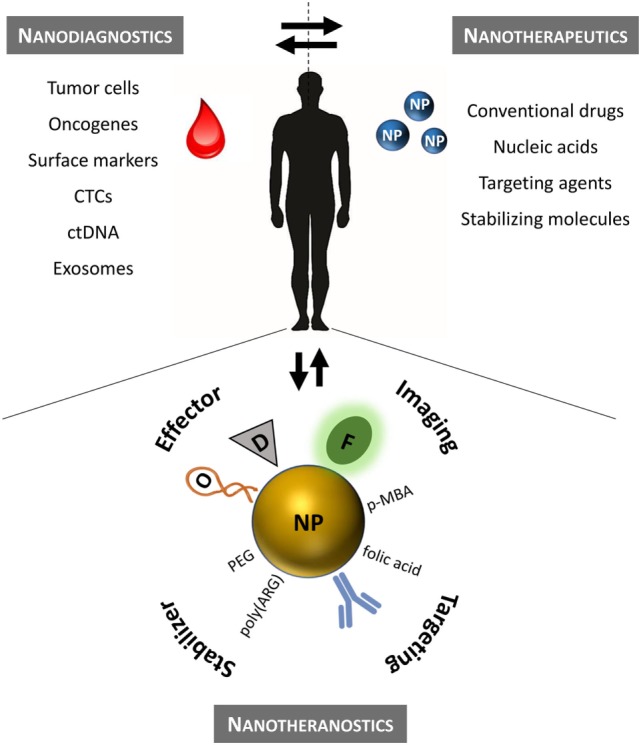
Nanotechnology has become a powerful approach to improve the way we diagnose and treat cancer. In particular, nanoparticles (NPs) possess unique features for enhanced sensitivity and selectivity for earlier detection of circulating cancer biomarkers. , NPs enhance the therapeutic efficacy of anticancer agents when compared with conventional chemotherapy, improving vectorization and delivery, and helping to overcome drug resistance. Nanomedicine has been mostly focused on solid cancers due to take advantage from the enhanced permeability and retention (EPR) effect experienced by tissues in the close vicinity of tumors, which enhance nanomedicine's accumulation and, consequently, improve efficacy. Nanomedicines for leukemia and lymphoma, where EPR effect is not a factor, are addressed differently from solid tumors. Nevertheless, NPs have provided innovative approaches to simple and non-invasive methodologies for diagnosis and treatment in liquid tumors. In this review, we consider the state of the art on different types of nanoconstructs for the management of liquid tumors, from preclinical studies to clinical trials. We also discuss the advantages of nanoplatforms for theranostics and the central role played by NPs in this combined strategy.
纳米技术已成为改善我们诊断和治疗癌症方式的有力方法。特别是,纳米颗粒(NPs)具有独特的特性,可提高对循环癌症生物标志物早期检测的灵敏度和选择性。与传统化疗相比,纳米颗粒可提高抗癌药物的治疗效果,改善载体化和递送,并有助于克服耐药性。由于利用了肿瘤附近组织所经历的增强渗透和滞留(EPR)效应,纳米医学大多聚焦于实体癌,这种效应增强了纳米医学的积累,从而提高了疗效。对于白血病和淋巴瘤,由于不存在EPR效应,其纳米药物的处理方式与实体瘤不同。尽管如此,纳米颗粒为液体肿瘤的诊断和治疗提供了简单且非侵入性方法的创新途径。在本综述中,我们考虑了从临床前研究到临床试验,用于液体肿瘤管理的不同类型纳米构建体的现状。我们还讨论了纳米平台在诊疗一体化中的优势以及纳米颗粒在这种联合策略中所起的核心作用。