Gazan Rozenn, Vieux Florent, Darmon Nicole, Maillot Matthieu
MS-Nutrition, Marseille, France.
UMR NORT (Unité Mixte de Recherche - Nutrition, Obesity and Risk of Thrombosis), Aix-Marseille Université, INSERM, INRA 1260, Marseille, France.
Front Nutr. 2017 Dec 20;4:62. doi: 10.3389/fnut.2017.00062. eCollection 2017.
Food frequency questionnaires (FFQs) are used to estimate the usual food and nutrient intakes over a period of time. Such estimates can suffer from measurement errors, either due to bias induced by respondent's answers or to errors induced by the structure of the questionnaire (e.g., using a limited number of food items and an aggregated food database with average portion sizes). The "structural validation" presented in this study aims to isolate and quantify the impact of the inherent structure of a FFQ on the estimation of food and nutrient intakes, independently of respondent's perception of the questionnaire.
A semi-quantitative FFQ ( = 94 items, including 50 items with questions on portion sizes) and an associated aggregated food composition database (named the item-composition database) were developed, based on the self-reported weekly dietary records of 1918 adults (18-79 years-old) in the French Individual and National Dietary Survey 2 (INCA2), and the French CIQUAL 2013 food-composition database of all the foods ( = 1342 foods) declared as consumed in the population. Reference intakes of foods ("REF_FOOD") and nutrients ("REF_NUT") were calculated for each adult using the food-composition database and the amounts of foods self-reported in his/her dietary record. Then, answers to the FFQ were simulated for each adult based on his/her self-reported dietary record. "FFQ_FOOD" and "FFQ_NUT" intakes were estimated using the simulated answers and the item-composition database. Measurement errors (in %), spearman correlations and cross-classification were used to compare "REF_FOOD" with "FFQ_FOOD" and "REF_NUT" with "FFQ_NUT".
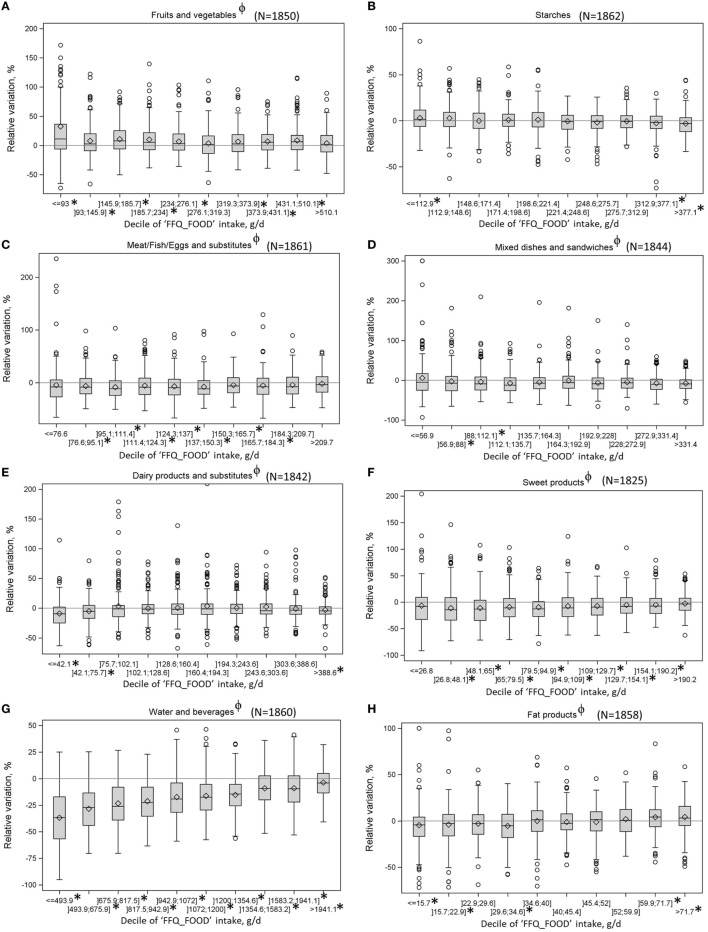
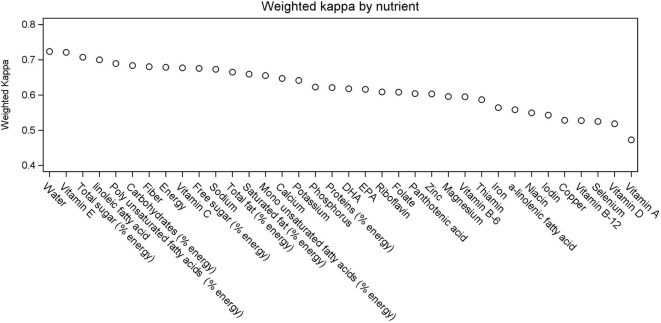
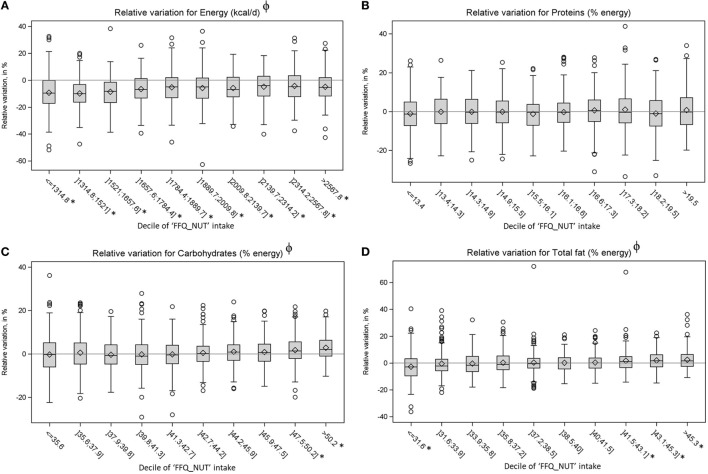
Compared to "REF_NUT," "FFQ_NUT" total quantity and total energy intake were underestimated on average by 198 g/day and 666 kJ/day, respectively. "FFQ_FOOD" intakes were well estimated for starches, underestimated for most of the subgroups, and overestimated for some subgroups, in particular vegetables. Underestimation were mainly due to the use of portion sizes, leading to an underestimation of most of nutrients, except free sugars which were overestimated.
The "structural validation" by simulating answers to a FFQ based on a reference dietary survey is innovative and pragmatic and allows quantifying the error induced by the simplification of the method of collection.
食物频率问卷(FFQ)用于估计一段时间内的日常食物和营养摄入量。此类估计可能会受到测量误差的影响,这可能是由于受访者回答引起的偏差,也可能是由于问卷结构导致的误差(例如,使用有限数量的食物项目以及包含平均份量的汇总食物数据库)。本研究中提出的“结构验证”旨在独立于受访者对问卷的认知,分离并量化FFQ固有结构对食物和营养摄入量估计的影响。
基于法国个人与国家饮食调查2(INCA2)中1918名成年人(18 - 79岁)的自我报告每周饮食记录,以及法国CIQUAL 2013食物成分数据库(涵盖人群中宣称食用的所有食物,共1342种食物),开发了一份半定量FFQ(共94项,其中50项涉及份量问题)以及一个相关的汇总食物成分数据库(称为项目成分数据库)。使用食物成分数据库以及每个成年人在其饮食记录中自我报告的食物量,计算出每个成年人的食物参考摄入量(“REF_FOOD”)和营养素参考摄入量(“REF_NUT”)。然后,根据每个成年人的自我报告饮食记录模拟其对FFQ的回答。使用模拟回答和项目成分数据库估计“FFQ_FOOD”和“FFQ_NUT”摄入量。通过测量误差(以百分比表示)、斯皮尔曼相关性和交叉分类来比较“REF_FOOD”与“FFQ_FOOD”以及“REF_NUT”与“FFQ_NUT”。
与“REF_NUT”相比,“FFQ_NUT”的总量和总能量摄入量平均分别低估了198克/天和666千焦/天。“FFQ_FOOD”对淀粉类食物的摄入量估计良好,对大多数亚组食物的摄入量低估,对一些亚组食物,特别是蔬菜的摄入量高估。低估主要是由于份量的使用,导致除游离糖被高估外的大多数营养素被低估。
基于参考饮食调查模拟FFQ回答进行的“结构验证”具有创新性和实用性,能够量化因收集方法简化而导致的误差。