Kroese L F, Sneiders D, Kleinrensink G J, Muysoms F, Lange J F
Department of Surgery, Erasmus MC, University Medical Center Rotterdam, Room Ee-173, PO BOX 2040, 3000 CA, Rotterdam, The Netherlands.
Department of Neuroscience, Erasmus University Medical Center Rotterdam, Rotterdam, The Netherlands.
Hernia. 2018 Apr;22(2):229-242. doi: 10.1007/s10029-017-1725-5. Epub 2018 Jan 11.
Incisional hernia (IH) is the most frequent complication after abdominal surgery. The diagnostic modality, observer, definition, and diagnostic protocol used for the diagnosis of IH potentially influence the reported prevalence. The objective of this systematic review is to evaluate the diagnostic accuracy of different modalities used to identify IH.
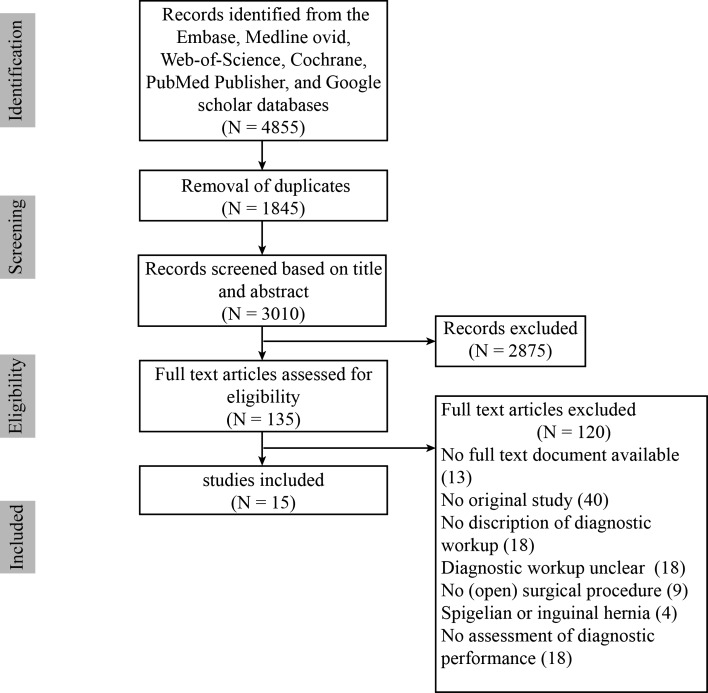
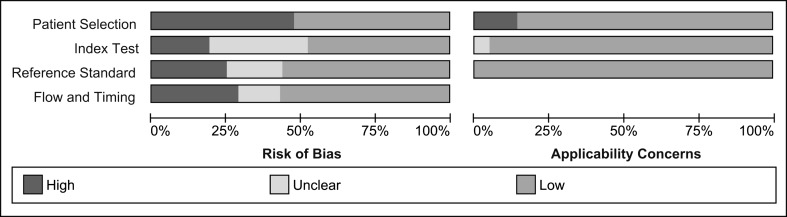
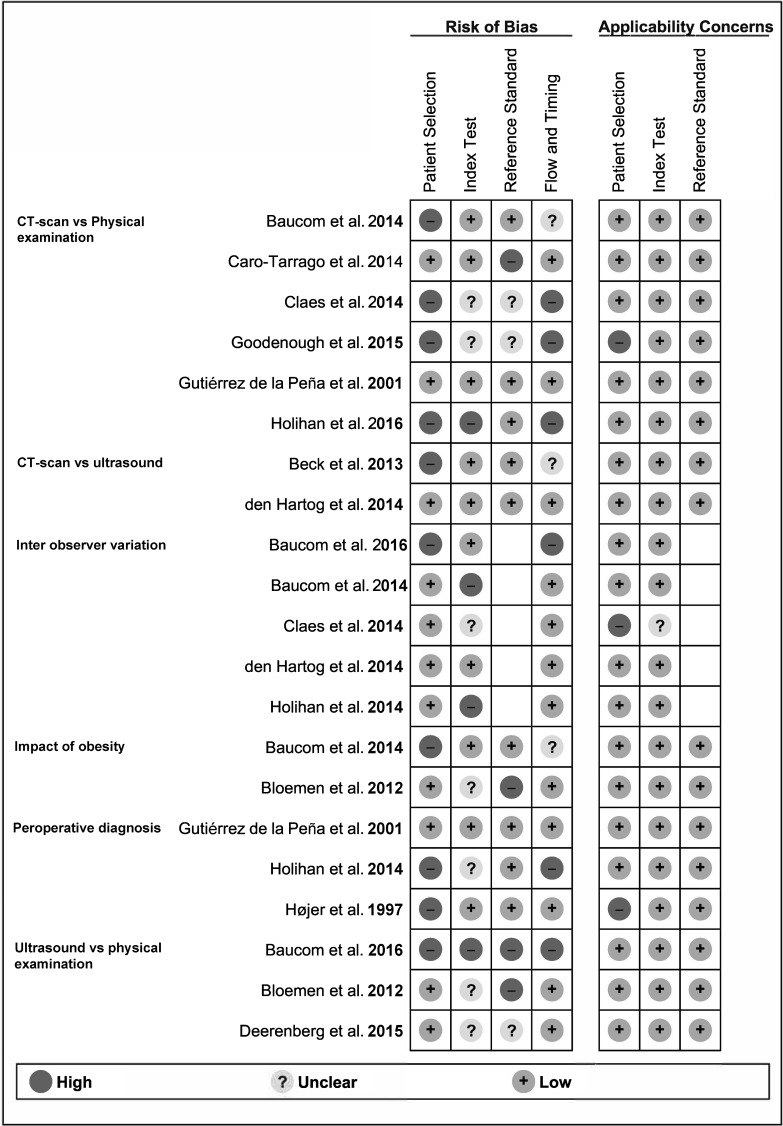
Embase, MEDLINE OvidSP, Web of Science, Google Scholar, and Cochrane databases were searched to identify studies diagnosing IH. Studies comparing the IH detection rate of two different diagnostic modalities or inter-observer variability of one modality were included. Quality assessment of studies was done by Cochrane Collaboration's tool. Article selection and data collection were performed independently by two researchers. PROSPERO registration: CRD42017062307.
Fifteen studies representing a total of 2986 patients were included. Inter-observer variation for CT-scan ranged from 11.2 to 69% (n = 678). Disagreement between ultrasound and CT-scan ranged between 6.6 and 17% (n = 221). Ten studies compared physical examination to CT-scan or ultrasound. Disagreement between physical examination and imaging ranged between 7.6 and 39% (n = 1602). Between 15 and 58% of IHs were solely detected by imaging (n = 483). Relative increase in IH prevalence for imaging compared to physical examination ranged from 0.92 to 2.4 (n = 1922).
Ultrasound or CT-scan will result in substantial additional IH diagnosis. Lack of consensus regarding the definition of IH might contribute to the disagreement rates. Both the observer and diagnostic modality used could be additional factors explaining variability in IH prevalence and should be reported in IH research.
切口疝(IH)是腹部手术后最常见的并发症。用于诊断IH的诊断方式、观察者、定义及诊断方案可能会影响所报告的患病率。本系统评价的目的是评估用于识别IH的不同方式的诊断准确性。
检索Embase、MEDLINE OvidSP、Web of Science、谷歌学术和Cochrane数据库,以识别诊断IH的研究。纳入比较两种不同诊断方式的IH检出率或一种方式的观察者间变异性的研究。采用Cochrane协作工具对研究进行质量评估。由两名研究人员独立进行文章筛选和数据收集。PROSPERO注册号:CRD42017062307。
共纳入15项研究,涉及2986例患者。CT扫描的观察者间变异范围为11.2%至69%(n = 678)。超声与CT扫描之间的不一致率在6.6%至17%之间(n = 221)。10项研究将体格检查与CT扫描或超声进行了比较。体格检查与影像学之间的不一致率在7.6%至39%之间(n = 1602)。15%至58%的IH仅通过影像学检查发现(n = 483)。与体格检查相比,影像学检查使IH患病率的相对增加范围为0.92至2.4(n = 1922)。
超声或CT扫描将导致大量额外的IH诊断。关于IH定义缺乏共识可能导致不一致率。所使用的观察者和诊断方式可能是解释IH患病率变异性的其他因素,应在IH研究中予以报告。