Wahn Basil, Czeszumski Artur, König Peter
Institute of Cognitive Science, University of Osnabrück, Osnabrück, Germany.
Department of Neurophysiology and Pathophysiology, Center of Experimental Medicine, University Medical Center Hamburg-Eppendorf, Hamburg, Germany.
PLoS One. 2018 Jan 12;13(1):e0191179. doi: 10.1371/journal.pone.0191179. eCollection 2018.
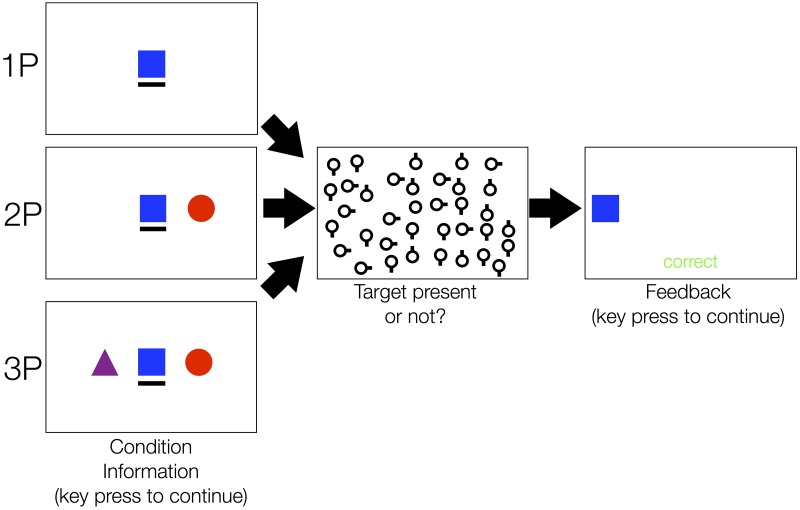
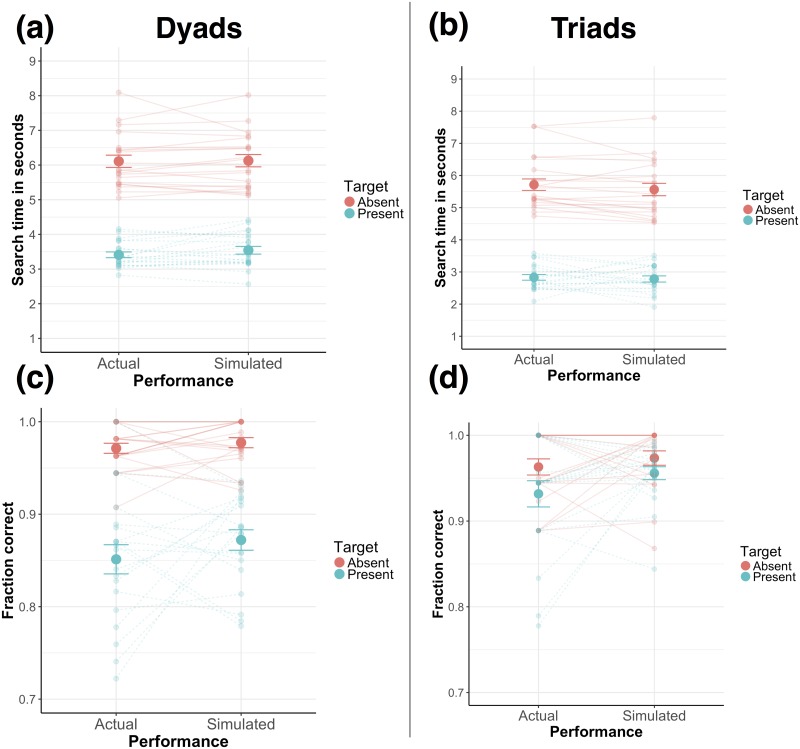
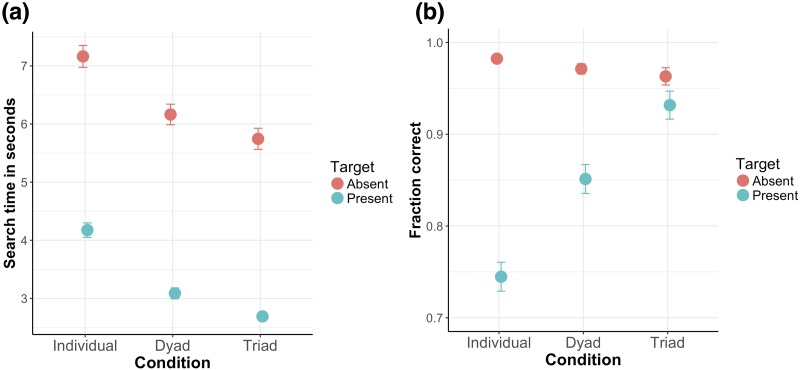
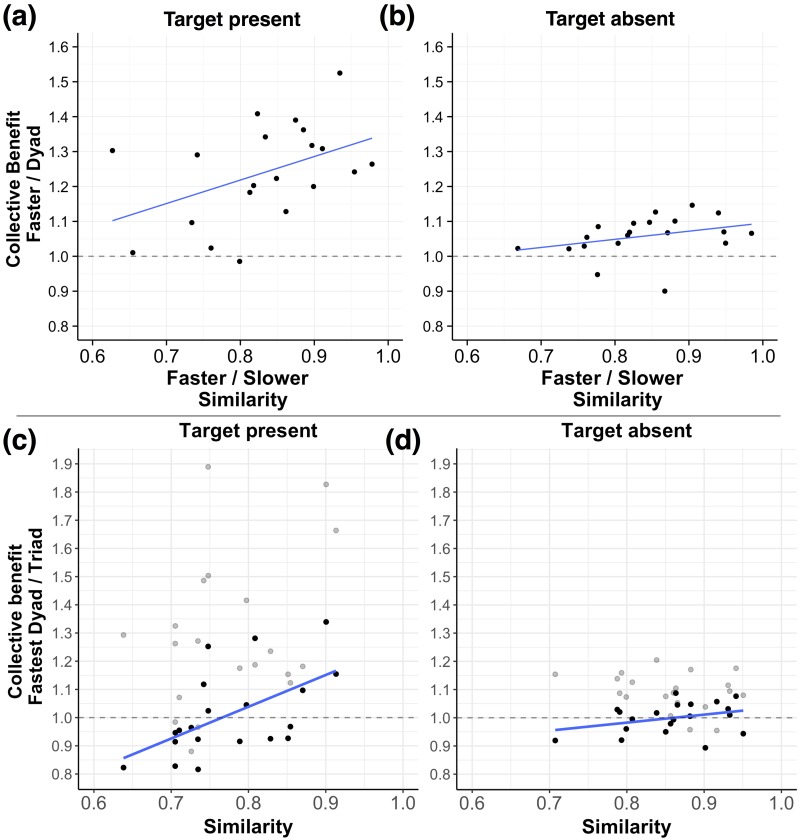
When humans perform tasks together, they may reach a higher performance in comparison to the best member of a group (i.e., a collective benefit). Earlier research showed that interindividual performance similarities predict collective benefits for several joint tasks. Yet, researchers did not test whether this is the case for joint visuospatial tasks. Also, researchers did not investigate whether dyads and triads reach a collective benefit when they are forbidden to exchange any information while performing a visuospatial task. In this study, participants performed a joint visual search task either alone, in dyads, or in triads, and were not allowed to exchange any information while doing the task. We found that dyads reached a collective benefit. Triads did outperform their best individual member and dyads-yet, they did not outperform the best dyad pairing within the triad. In addition, similarities in performance significantly predicted the collective benefit for dyads and triads. Furthermore, we find that the dyads' and triads' search performances closely match a simulated performance based on the individual search performances, which assumed that members of a group act independently. Overall, the present study supports the view that performance similarities predict collective benefits in joint tasks. Moreover, it provides a basis for future studies to investigate the benefits of exchanging information between co-actors in joint visual search tasks.
当人类一起执行任务时,与小组中表现最佳的成员相比,他们可能会达到更高的绩效(即集体效益)。早期研究表明,个体间的绩效相似性能够预测多项联合任务的集体效益。然而,研究人员并未测试在联合视觉空间任务中是否也是如此。此外,研究人员也没有探究在执行视觉空间任务时,二人组和三人组在被禁止交流任何信息的情况下是否能实现集体效益。在本研究中,参与者单独、以二人组或三人组的形式执行一项联合视觉搜索任务,并且在任务过程中不允许交流任何信息。我们发现二人组实现了集体效益。三人组的表现确实优于其最佳个体成员和二人组——然而,他们并没有超过三人组内最佳的二人组组合。此外,绩效的相似性显著预测了二人组和三人组的集体效益。此外,我们发现二人组和三人组的搜索绩效与基于个体搜索绩效模拟的绩效紧密匹配,该模拟假设小组中的成员独立行动。总体而言,本研究支持这样一种观点,即绩效相似性能够预测联合任务中的集体效益。此外,它为未来研究调查联合视觉搜索任务中共同行动者之间信息交流的益处提供了基础。