Wahn Basil, Kingstone Alan, König Peter
Institute of Cognitive Science, Universität OsnabrückOsnabrück, Germany.
Department of Psychology, University of British ColumbiaVancouver, BC, Canada.
Front Psychol. 2017 May 3;8:669. doi: 10.3389/fpsyg.2017.00669. eCollection 2017.
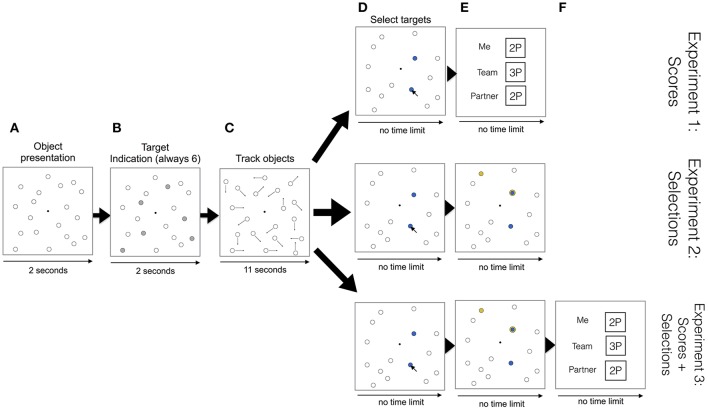
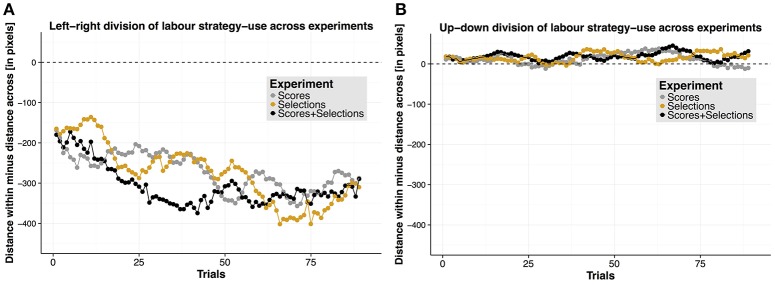
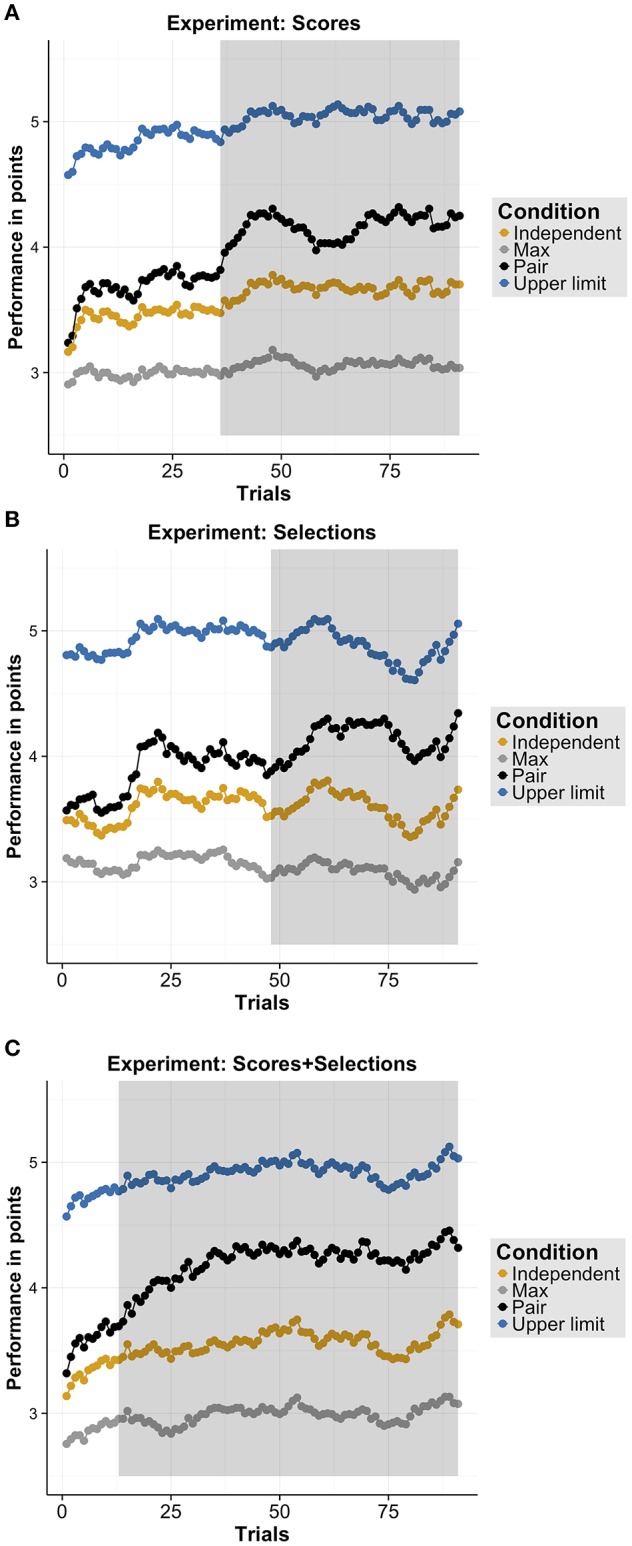
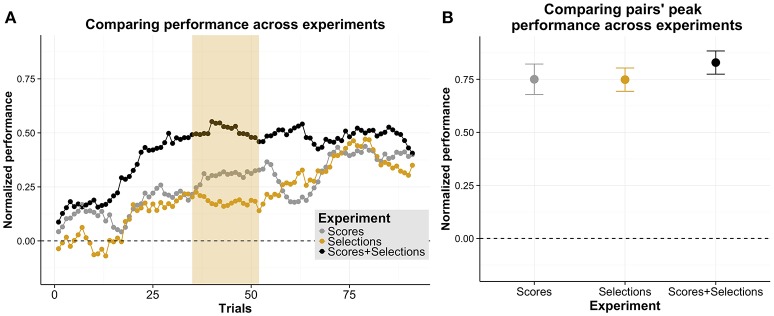
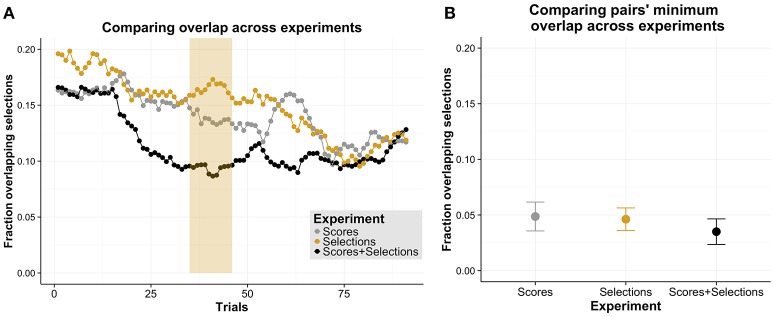
When humans collaborate, they often distribute task demands in order to reach a higher performance compared to performing the same task alone (i.e., a collective benefit). Here, we tested to what extent receiving information about the actions of a co-actor, performance scores, or receiving both types of information impacts the collective benefit in a collaborative multiple object tracking task. In a between-subject design, pairs of individuals jointly tracked a subset of target objects among several moving distractor objects on a computer screen for a 100 trials. At the end of a trial, pairs received performance scores (Experiment 1), information about their partner's target selections (Experiment 2), or both types of information (Experiment 3). In all experiments, the performance of the pair exceeded the individual performances and the simulated performance of two independent individuals combined. Initially, when receiving both types of information (Experiment 3), pairs achieved the highest performance and divided task demands most efficiently compared to the other two experiments. Over time, performances and the ability to divide task demands for pairs receiving a single type of information converged with those receiving both, suggesting that pairs' coordination strategies become equally effective over time across experiments. However, pairs' performances never reached a theoretical limit of performance in all experiments. For distributing task demands, members of a pair predominantly used a left-right division of labor strategy (i.e., the leftmost targets were tracked by one co-actor while the rightmost targets were tracked by the other co-actor). Overall, findings of the present study suggest that receiving information about actions of a co-actor, performance scores, or receiving both enables pairs to devise effective division of labor strategies in a collaborative visuospatial task. However, when pairs had both types of information available, the formation of division of labor strategies was facilitated, indicating that pairs benefited the most from having both types of information available (i.e., actions about the co-actor and performance scores). Findings are applicable to circumstances in which humans need to perform collaborative visuospatial tasks that are time-critical and/or only allow a very limited exchange of information between co-actors.
当人类进行协作时,与独自执行相同任务相比,他们通常会分配任务需求以实现更高的绩效(即集体利益)。在此,我们测试了在协作式多目标跟踪任务中,接收关于共同行动者的行动信息、绩效分数或同时接收这两种信息在多大程度上会影响集体利益。在一项被试间设计中,两人一组在电脑屏幕上的多个移动干扰物体中共同跟踪目标物体的一个子集,共进行100次试验。在一次试验结束时,两人组会收到绩效分数(实验1)、关于其伙伴目标选择的信息(实验2)或两种信息都收到(实验3)。在所有实验中,两人组的表现均超过了个体表现以及两个独立个体组合的模拟表现。最初,在同时收到两种信息时(实验3),与其他两个实验相比,两人组实现了最高绩效且最有效地分配了任务需求。随着时间的推移,接收单一类型信息的两人组在绩效和分配任务需求的能力方面与接收两种信息的两人组趋于一致,这表明随着时间的推移,跨实验来看两人组的协调策略变得同样有效。然而,在所有实验中,两人组的表现从未达到理论上的绩效极限。对于分配任务需求,两人组的成员主要采用左右分工策略(即最左边的目标由一个共同行动者跟踪,而最右边的目标由另一个共同行动者跟踪)。总体而言,本研究结果表明,接收关于共同行动者的行动信息、绩效分数或同时接收这两种信息,能使两人组在协作视觉空间任务中设计出有效的分工策略。然而,当两人组同时拥有这两种信息时,分工策略的形成会更容易,这表明两人组从同时拥有这两种信息(即关于共同行动者的行动和绩效分数)中受益最大。这些发现适用于人类需要执行对时间要求严格和/或共同行动者之间信息交换非常有限的协作视觉空间任务的情况。