Faculty of Caring Science, Work Life and Social Welfare, University of Borås, S-501 90, Borås, Sweden.
Institute of Health and Care Sciences, The Sahlgrenska Academy at University of Gothenburg, Box 457, -405 30, Gothenburg, SE, Sweden.
BMC Pregnancy Childbirth. 2018 Jan 12;18(1):28. doi: 10.1186/s12884-018-1659-7.
Fear of Childbirth (FOC) is a common problem affecting women's health and wellbeing, and a common reason for requesting caesarean section. The aims of this review were to summarise published research on prevalence of FOC in childbearing women and how it is defined and measured during pregnancy and postpartum, and to search for useful measures of FOC, for research as well as for clinical settings.
Five bibliographic databases in March 2015 were searched for published research on FOC, using a protocol agreed a priori. The quality of selected studies was assessed independently by pairs of authors. Prevalence data, definitions and methods of measurement were extracted independently from each included study by pairs of authors. Finally, some of the country rates were combined and compared.
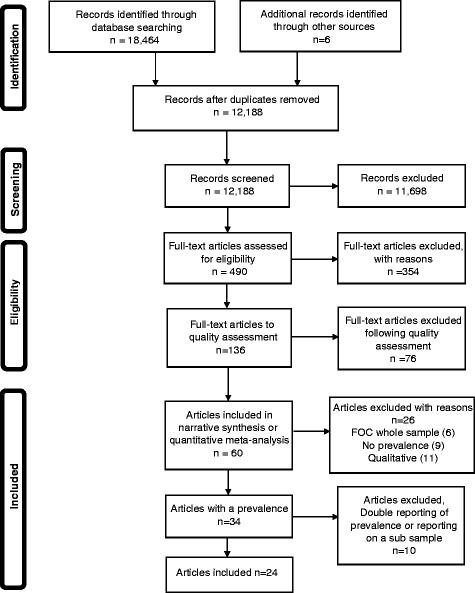
In total, 12,188 citations were identified and screened by title and abstract; 11,698 were excluded and full-text of 490 assessed for analysis. Of these, 466 were excluded leaving 24 papers included in the review, presenting prevalence of FOC from nine countries in Europe, Australia, Canada and the United States. Various definitions and measurements of FOC were used. The most frequently-used scale was the W-DEQ with various cut-off points describing moderate, severe/intense and extreme/phobic fear. Different 3-, 4-, and 5/6 point scales and visual analogue scales were also used. Country rates (as measured by seven studies using W-DEQ with ≥85 cut-off point) varied from 6.3 to 14.8%, a significant difference (chi-square = 104.44, d.f. = 6, p < 0.0001).
Rates of severe FOC, measured in the same way, varied in different countries. Reasons why FOC might differ are unknown, and further research is necessary. Future studies on FOC should use the W-DEQ tool with a cut-off point of ≥85, or a more thoroughly tested version of the FOBS scale, or a three-point scale measurement of FOC using a single question as 'Are you afraid about the birth?' In this way, valid comparisons in research can be made. Moreover, validation of a clinical tool that is more focussed on FOC alone, and easier than the longer W-DEQ, for women to fill in and clinicians to administer, is required.
分娩恐惧(Fear of Childbirth,FOC)是一种常见的影响女性健康和幸福感的问题,也是要求剖宫产的常见原因。本综述的目的是总结已发表的关于分娩期和产后妇女 FOC 发生率的研究,并探讨 FOC 的定义和测量方法,以便为研究和临床环境寻找有用的 FOC 测量工具。
我们于 2015 年 3 月使用预先商定的方案,对五个文献数据库进行了检索,以寻找有关 FOC 的已发表研究。由两位作者独立评估所选研究的质量。由两位作者分别独立从每个纳入的研究中提取发生率数据、定义和测量方法。最后,对一些国家的发生率进行了合并和比较。
共识别并筛选了 12188 篇标题和摘要,其中 11698 篇被排除,对 490 篇进行了全文评估分析。其中 466 篇被排除,24 篇论文被纳入综述,这些论文来自欧洲、澳大利亚、加拿大和美国的 9 个国家,报告了 FOC 的发生率。FOC 有多种定义和测量方法。最常用的量表是 W-DEQ,有不同的截断点来描述中度、严重/强烈和极度/恐惧症。也使用了不同的 3 分、4 分和 5/6 分量表和视觉模拟量表。7 项使用 W-DEQ 且截断值≥85 的研究报告了不同的国家发生率(6.3%至 14.8%),差异有统计学意义(卡方=104.44,自由度=6,p<0.0001)。
用相同的方法测量的严重 FOC 发生率在不同国家存在差异。FOC 存在差异的原因尚不清楚,需要进一步研究。未来关于 FOC 的研究应使用 W-DEQ 工具,截断值≥85,或 FOBS 量表的更全面测试版本,或使用“您是否担心分娩?”这一单一问题的 3 分 FOC 量表测量。这样可以在研究中进行有效的比较。此外,还需要验证一种针对 FOC 的临床工具,该工具比 W-DEQ 更专注、更简单,以便妇女填写和临床医生管理。