Instituto Maimónides de Investigación Biomédica de Córdoba (IMIBIC), 14004 Avda Menéndez Pidal s/n, Córdoba, Spain.
Centro de Investigación Biomédica en Red de Cáncer (CIBERONC), Madrid, Spain.
BMC Biol. 2018 Jan 10;16(1):3. doi: 10.1186/s12915-017-0472-5.
Nitric oxide (NO) has been highlighted as an important agent in cancer-related events. Although the inducible nitric oxide synthase (iNOS) isoform has received most attention, recent studies in the literature indicate that the endothelial isoenzyme (eNOS) can also modulate different tumor processes including resistance, angiogenesis, invasion, and metastasis. However, the role of eNOS in cancer stem cell (CSC) biology and mesenchymal tumors is unknown.
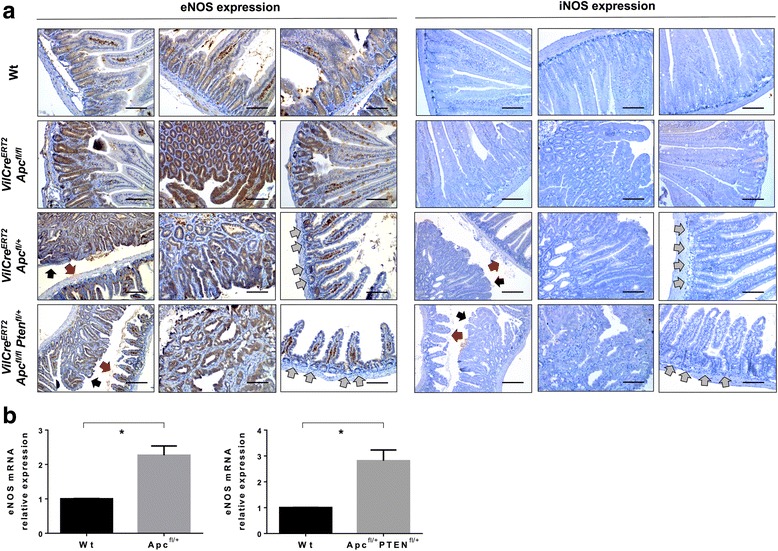
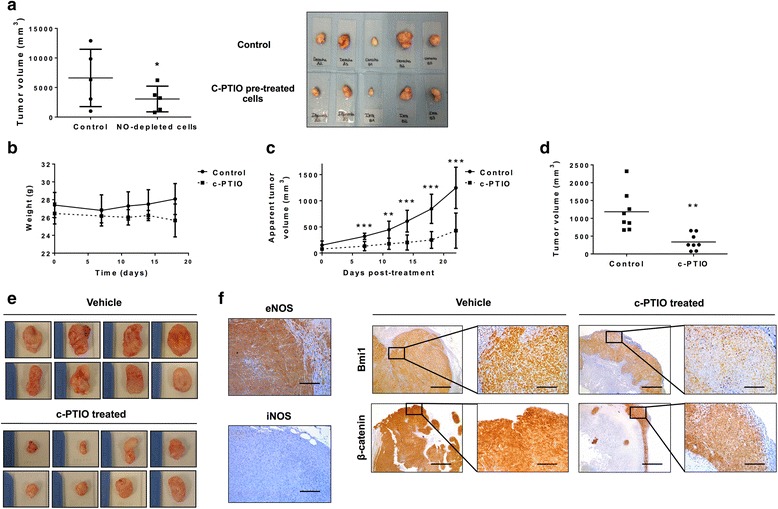
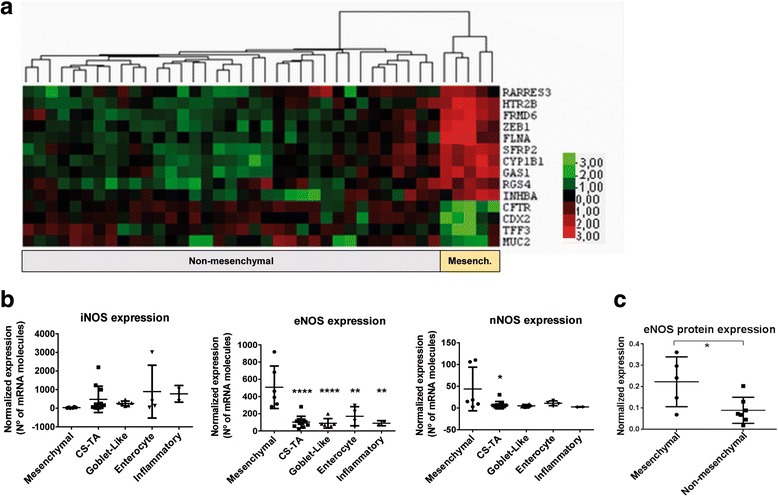
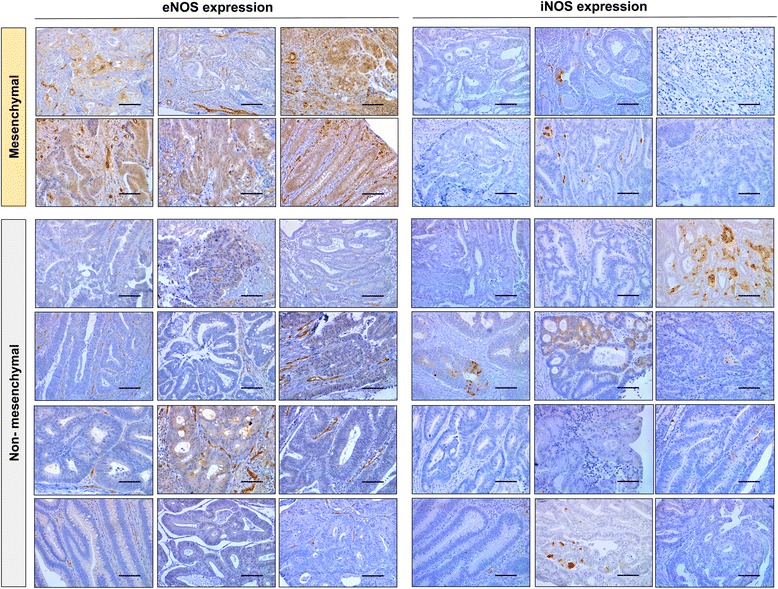
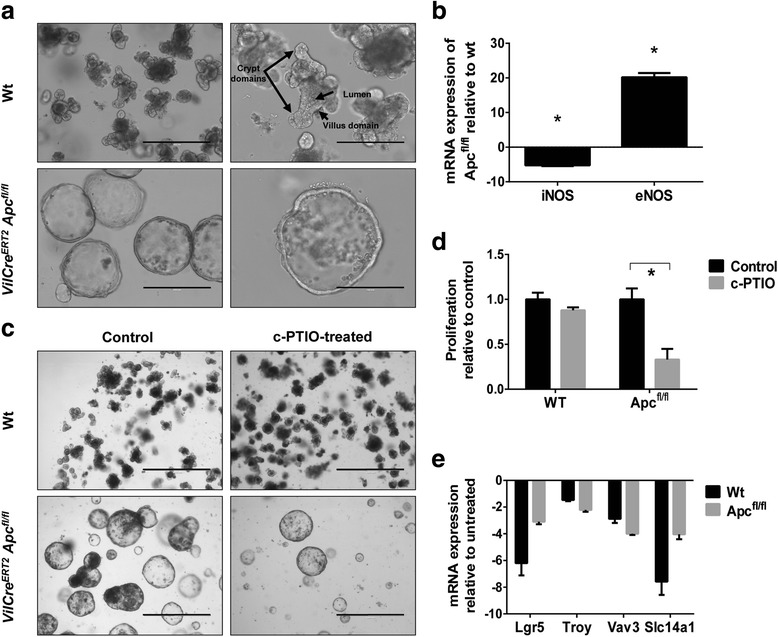
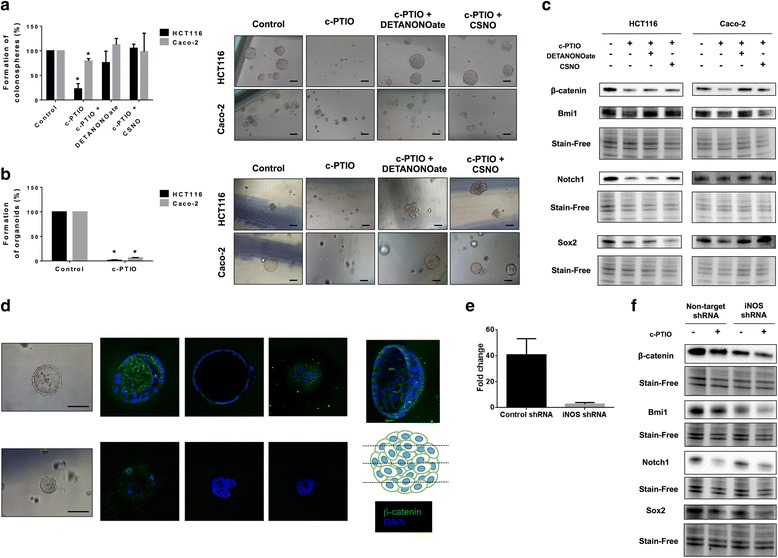
Here, we show that eNOS was significantly upregulated in VilCre Apc and VilCre Apc mouse intestinal tissue, with intense immunostaining in hyperproliferative crypts. Similarly, the more invasive VilCre Apc Pten mouse model showed an overexpression of eNOS in intestinal tumors whereas this isoform was not expressed in normal tissue. However, none of the three models showed iNOS expression. Notably, when 40 human colorectal tumors were classified into different clinically relevant molecular subtypes, high eNOS expression was found in the poor relapse-free and overall survival mesenchymal subtype, whereas iNOS was absent. Furthermore, Apc organoids overexpressed eNOS compared with wild-type organoids and NO depletion with the scavenger carboxy-PTIO (c-PTIO) decreased the proliferation and the expression of stem-cell markers, such as Lgr5, Troy, Vav3, and Slc14a1, in these intestinal organoids. Moreover, specific NO depletion also decreased the expression of CSC-related proteins in human colorectal cancer cells such as β-catenin and Bmi1, impairing the CSC phenotype. To rule out the contribution of iNOS in this effect, we established an iNOS-knockdown colorectal cancer cell line. NO-depleted cells showed a decreased capacity to form tumors and c-PTIO treatment in vivo showed an antitumoral effect in a xenograft mouse model.
Our data support that eNOS upregulation occurs after Apc loss, emerging as an unexpected potential new target in poor-prognosis mesenchymal colorectal tumors, where NO scavenging could represent an interesting therapeutic alternative to targeting the CSC subpopulation.
一氧化氮(NO)已被强调为与癌症相关事件中的重要介质。尽管诱导型一氧化氮合酶(iNOS)同工酶受到了最多的关注,但文献中的最近研究表明,内皮型一氧化氮合酶(eNOS)也可以调节包括耐药性、血管生成、侵袭和转移在内的不同肿瘤过程。然而,eNOS 在癌症干细胞(CSC)生物学和间充质肿瘤中的作用尚不清楚。
在这里,我们表明 eNOS 在 VilCre Apc 和 VilCre Apc 小鼠肠组织中显著上调,在过度增殖的隐窝中免疫染色强烈。同样,侵袭性更强的 VilCre Apc Pten 小鼠模型在肠道肿瘤中表现出 eNOS 的过表达,而这种同工酶在正常组织中不表达。然而,这三个模型均未显示 iNOS 表达。值得注意的是,当将 40 例人类结直肠肿瘤分为不同的具有临床相关性的分子亚型时,在预后不良的无复发生存率和总生存率较低的间充质亚型中发现 eNOS 高表达,而 iNOS 缺失。此外,与野生型类器官相比,Apc 类器官过表达 eNOS,并且用清除剂羧基-PTIO(c-PTIO)耗竭 NO 可降低这些肠道类器官中干细胞标志物(如 Lgr5、Troy、Vav3 和 Slc14a1)的增殖和表达。此外,特异性 NO 耗竭还降低了人结直肠癌细胞中与 CSC 相关的蛋白质(如β-catenin 和 Bmi1)的表达,从而损害了 CSC 表型。为了排除 iNOS 在这种作用中的贡献,我们建立了一个 iNOS 敲低的结直肠癌细胞系。NO 耗竭细胞显示出形成肿瘤的能力降低,并且体内 c-PTIO 处理在异种移植小鼠模型中显示出抗肿瘤作用。
我们的数据支持 Apc 缺失后 eNOS 上调,这在预后不良的间充质结直肠肿瘤中成为一个意外的潜在新靶点,其中 NO 清除可能代表针对 CSC 亚群的一种有前途的治疗替代方法。