Laboratory of Molecular Biology, Research Institute for Health Sciences and Technology, University of Mons, 6, Avenue du Champs de Mars, B-7000, Mons, Belgium.
INSERM U1046, CHU A. de Villeneuve, University of Montpellier, 34295, Montpellier, France.
Skelet Muscle. 2018 Jan 12;8(1):2. doi: 10.1186/s13395-017-0148-4.
Facioscapulohumeral muscular dystrophy (FSHD) is associated with DNA hypomethylation at the 4q35 D4Z4 repeat array. Both the causal gene DUX4 and its homolog DUX4c are induced. DUX4c is immunodetected in every myonucleus of proliferative cells, while DUX4 is present in only 1/1000 of myonuclei where it initiates a gene deregulation cascade. FSHD primary myoblasts differentiate into either atrophic or disorganized myotubes. DUX4 expression induces atrophic myotubes and associated FSHD markers. Although DUX4 silencing normalizes the FSHD atrophic myotube phenotype, this is not the case for the disorganized phenotype. DUX4c overexpression increases the proliferation rate of human TE671 rhabdomyosarcoma cells and inhibits their differentiation, suggesting a normal role during muscle differentiation.
By gain- and loss-of-function experiments in primary human muscle cells, we studied the DUX4c impact on proliferation, differentiation, myotube morphology, and FSHD markers.
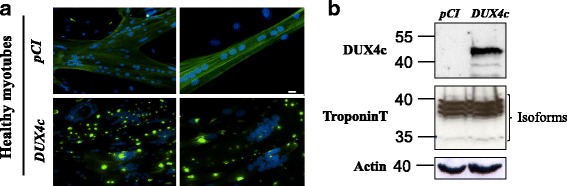
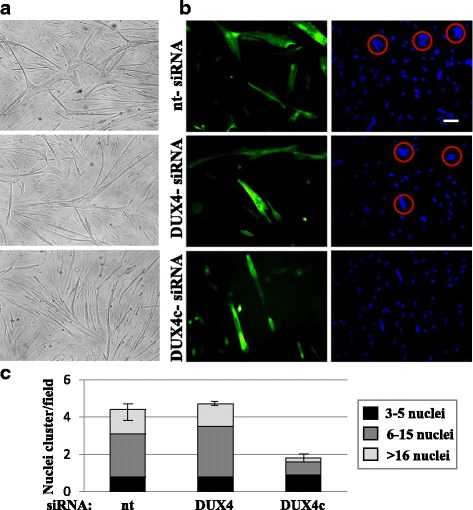
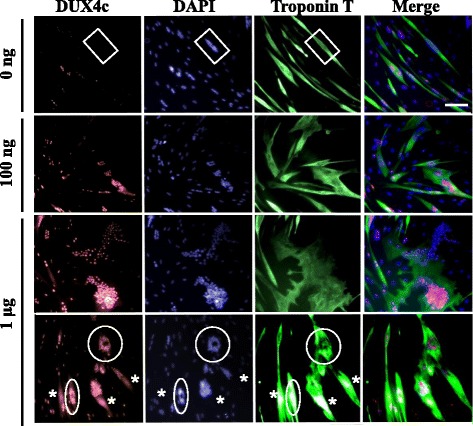
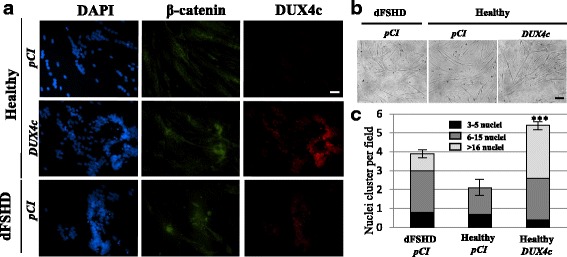
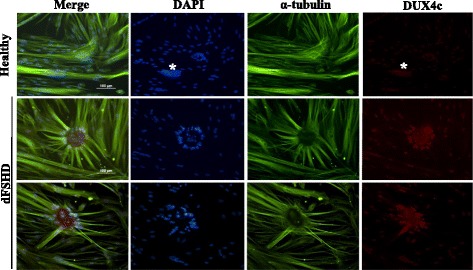
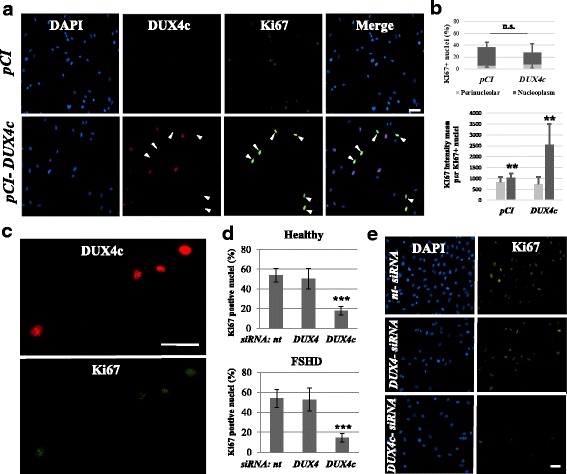
In primary myoblasts, DUX4c overexpression increased the staining intensity of KI67 (a proliferation marker) in adjacent cells and delayed differentiation. In differentiating cells, DUX4c overexpression led to the expression of some FSHD markers including β-catenin and to the formation of disorganized myotubes presenting large clusters of nuclei and cytoskeletal defects. These were more severe when DUX4c was expressed before the cytoskeleton reorganized and myofibrils assembled. In addition, endogenous DUX4c was detected at a higher level in FSHD myotubes presenting abnormal clusters of nuclei and cytoskeletal disorganization. We found that the disorganized FSHD myotube phenotype could be rescued by silencing of DUX4c, not DUX4.
Excess DUX4c could disturb cytoskeletal organization and nuclear distribution in FSHD myotubes. We suggest that DUX4c up-regulation could contribute to DUX4 toxicity in the muscle fibers by favoring the clustering of myonuclei and therefore facilitating DUX4 diffusion among them. Defining DUX4c functions in the healthy skeletal muscle should help to design new targeted FSHD therapy by DUX4 or DUX4c inhibition without suppressing DUX4c normal function.
面肩肱型肌营养不良症(FSHD)与 4q35 处 D4Z4 重复序列的 DNA 低甲基化有关。其致病基因 DUX4 及其同源物 DUX4c 均被诱导。在增殖细胞的每个肌核中均可检测到免疫 DUX4c,但只有 1/1000 的肌核中存在 DUX4,它启动基因失调级联反应。FSHD 原代成肌细胞分化为萎缩或紊乱的肌管。DUX4 的表达诱导萎缩的肌管和相关的 FSHD 标志物。尽管 DUX4 沉默可使 FSHD 萎缩肌管表型正常化,但对紊乱表型则不然。DUX4c 的过表达增加了人 TE671 横纹肌肉瘤细胞的增殖率,并抑制其分化,表明其在肌肉分化过程中发挥正常作用。
通过在原代人肌肉细胞中的增益和失能实验,我们研究了 DUX4c 对增殖、分化、肌管形态和 FSHD 标志物的影响。
在原代成肌细胞中,DUX4c 的过表达增加了相邻细胞中增殖标志物 KI67 的染色强度并延迟了分化。在分化细胞中,DUX4c 的过表达导致了一些 FSHD 标志物的表达,包括β-连环蛋白,并形成了紊乱的肌管,呈现出大核簇和细胞骨架缺陷。当 DUX4c 在细胞骨架重新组织和肌原纤维组装之前表达时,这些缺陷更为严重。此外,在表现出异常核簇和细胞骨架紊乱的 FSHD 肌管中,检测到更高水平的内源性 DUX4c。我们发现,通过沉默 DUX4c 而不是 DUX4,可以挽救紊乱的 FSHD 肌管表型。
过多的 DUX4c 可能会扰乱 FSHD 肌管中的细胞骨架组织和核分布。我们认为,通过促进肌核的聚集,从而促进 DUX4 在其中的扩散,DUX4c 的上调可能有助于肌肉纤维中 DUX4 的毒性。定义 DUX4c 在健康骨骼肌中的功能应有助于通过抑制 DUX4 或 DUX4c 而不抑制 DUX4c 的正常功能来设计针对 FSHD 的新靶向治疗。