Department of Gastroenterological Surgery, Okayama University Graduate School of Medicine, Dentistry and Pharmaceutical Sciences, Okayama, Okayama, 700-8558, Japan.
Department of Clinical Oncology, Kawasaki Medical School, 577 Matsushima, Kurashiki-City, Okayama, 701-0192, Japan.
J Transl Med. 2018 Jan 12;16(1):5. doi: 10.1186/s12967-017-1376-4.
To screen tumors with microsatellite instability (MSI) arising due to DNA mismatch repair deficiency (dMMR), a panel of five quasi-monomorphic mononucleotide-repeat markers amplified in a multiplex PCR (Pentaplex) are commonly used. In spite of its several strengths, the pentaplex assay is not robust at detecting the loss of MSH6-deficiency (dMSH6). In order to overcome this challenge, we designed this study to develop and optimize a panel of four quasi-monomorphic mononucleotide-repeat markers (Tetraplex) for identifying solid tumors with dMMR, especially dMSH6.
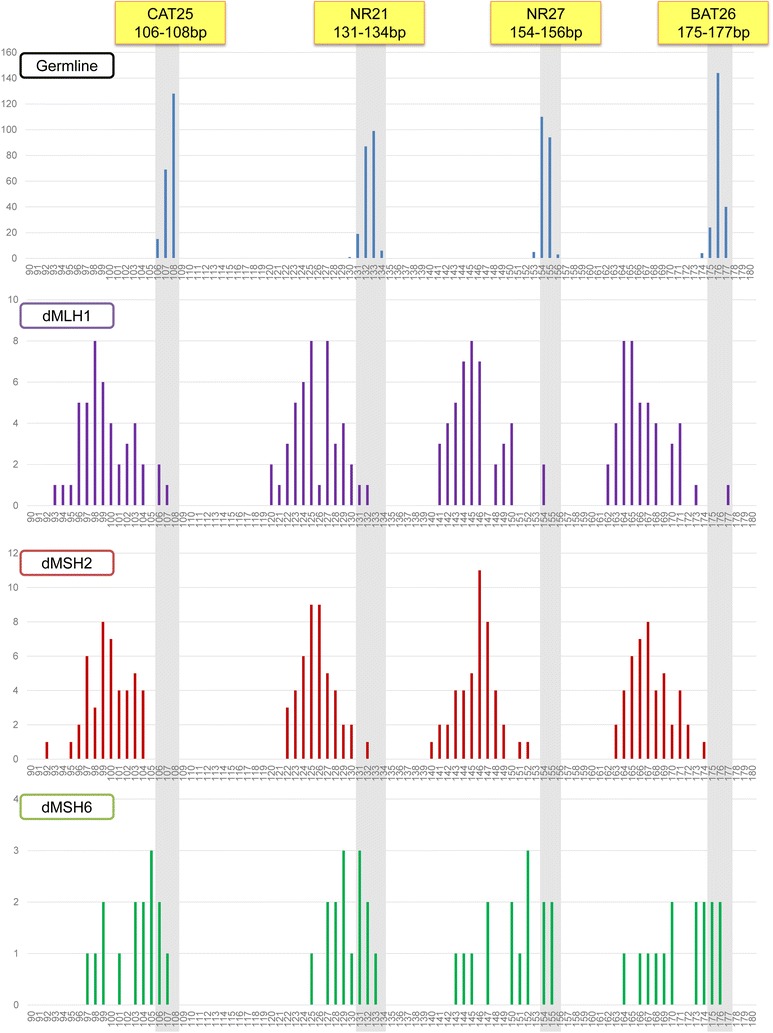
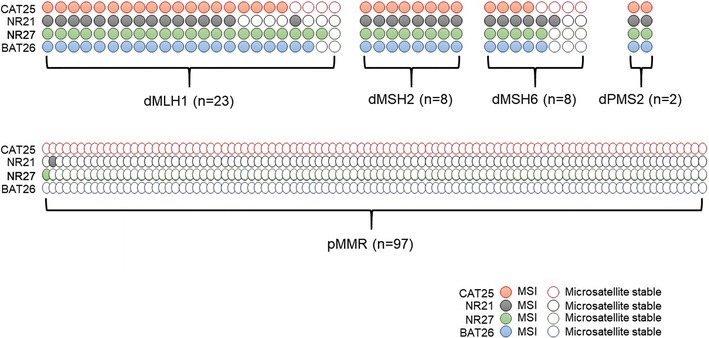
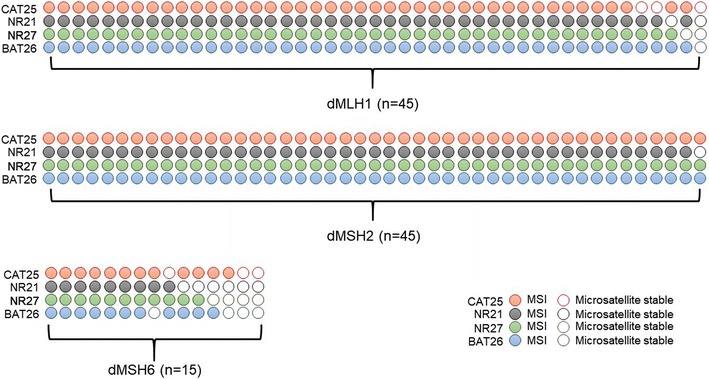
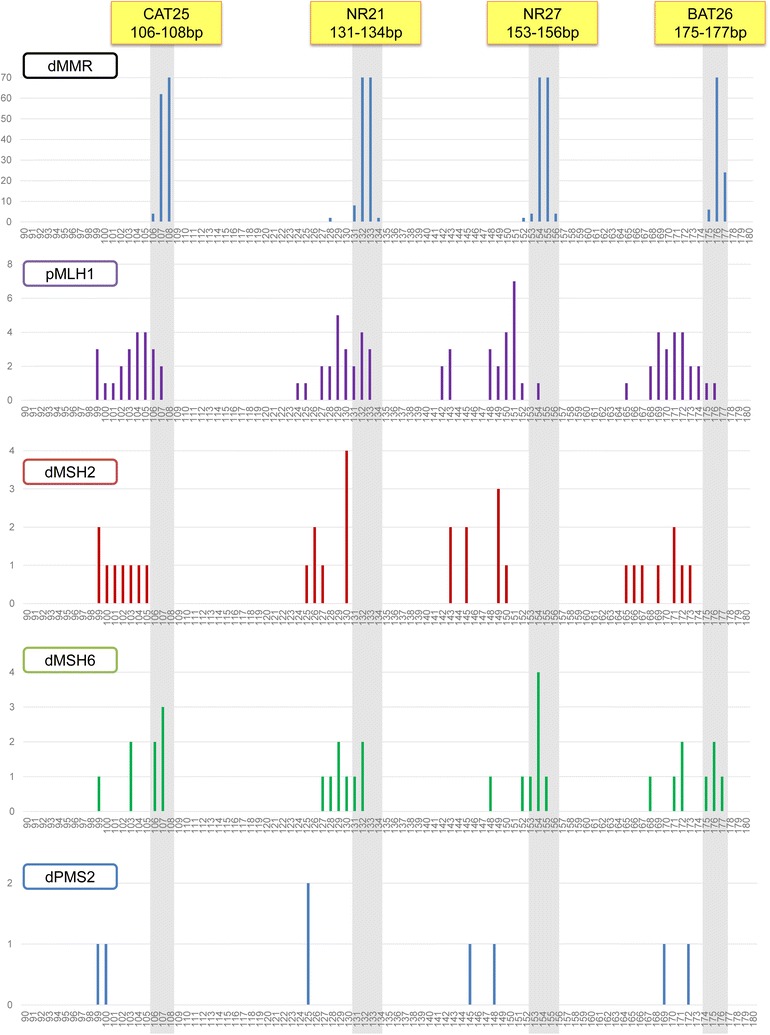
To improve the sensitivity for tumors with dMMR, we established a quasi-monomorphic variant range (QMVR) of 3-4 bp for the four Tetraplex markers. Thereafter, to confirm the accuracy of this assay, we examined 317 colorectal cancer (CRC) specimens, comprising of 105 dMMR [45 MutL homolog (MLH)1-deficient, 45 MutS protein homolog (MSH)2-deficient, and 15 MSH6-deficient tumors] and 212 MMR-proficient (pMMR) tumors as a test set. In addition, we analyzed a cohort of 138 endometrial cancers (EC) by immunohistochemistry to determine MMR protein expression and validation of our new MSI assay.
Using the criteria of ≥ 1 unstable markers as MSI-positive tumor, our assay resulted in a sensitivity of 97.1% [95% confidence interval (CI) = 91.9-99.0%] for dMMR, and a specificity of 95.3% (95% CI = 91.5-97.4%) for pMMR CRC specimens. Among the 138 EC specimens, 41 were dMMR according to immunohistochemistry. Herein, our Tetraplex assay detected dMMR tumors with a sensitivity of 92.7% (95% CI = 80.6-97.5%) and a specificity of 97.9% (95% CI = 92.8-99.4%) for pMMR tumors. With respect to tumors with dMSH6, in the CRC-validation set, Tetraplex detected dMSH6 tumors with a sensitivity of 86.7% (13 of 15 dMSH6 CRCs), which was subsequently validated in the EC test set as well (sensitivity, 75.0%; 6 of 8 dMSH6 ECs).
Our newly optimized Tetraplex system will help offer a robust and highly sensitive assay for the identification of dMMR in solid tumors.
为了筛选由于 DNA 错配修复缺陷(dMMR)而出现的微卫星不稳定(MSI)的肿瘤,通常使用一种在多重 PCR 中扩增的五个准单态单核苷重复标记物的试剂盒(五重试剂盒)。尽管五重试剂盒有几个优点,但它在检测 MSH6 缺陷(dMSH6)的缺失方面不够稳健。为了克服这一挑战,我们设计了本研究,以开发和优化一组用于鉴定具有 dMMR 的实体瘤的四个准单态单核苷重复标记物(四重试剂盒),特别是 dMSH6。
为了提高对 dMMR 肿瘤的敏感性,我们为四个四重试剂盒标记物建立了一个 3-4bp 的准单态变异范围(QMVR)。此后,为了确认该检测的准确性,我们检查了 317 个结直肠癌(CRC)标本,其中包括 105 个 dMMR [45 个 MutL 同源物(MLH)1 缺陷,45 个 MutS 蛋白同源物(MSH)2 缺陷和 15 个 MSH6 缺陷肿瘤]和 212 个 MMR 正常(pMMR)肿瘤作为测试集。此外,我们通过免疫组织化学分析了 138 个子宫内膜癌(EC)队列,以确定 MMR 蛋白表达,并验证我们新的 MSI 检测。
使用≥1 个不稳定标记物作为 MSI 阳性肿瘤的标准,我们的检测对 dMMR 的敏感性为 97.1%(95%置信区间[CI]为 91.9-99.0%),对 pMMR CRC 标本的特异性为 95.3%(95%CI 为 91.5-97.4%)。在 138 个 EC 标本中,根据免疫组织化学,有 41 个为 dMMR。在此,我们的四重试剂盒检测到 dMMR 肿瘤的敏感性为 92.7%(95%CI 为 80.6-97.5%),对 pMMR 肿瘤的特异性为 97.9%(95%CI 为 92.8-99.4%)。对于 dMSH6 肿瘤,在 CRC 验证集中,四重试剂盒检测到 dMSH6 肿瘤的敏感性为 86.7%(15 个 dMSH6 CRC 中的 13 个),随后在 EC 测试集中也得到了验证(敏感性为 75.0%;8 个 dMSH6 EC 中的 6 个)。
我们新优化的四重试剂盒系统将有助于提供一种稳健且高度敏感的检测方法,用于鉴定实体瘤中的 dMMR。