Department of Pediatrics, Vanderbilt University School of Medicine, Nashville, Tenn; Center for Asthma Research, Vanderbilt University School of Medicine, Nashville, Tenn.
Department of Medicine, Vanderbilt University School of Medicine, Nashville, Tenn; Infectious Disease Group, J. Craig Venter Institute, Rockville, Md; Infectious Disease Group, J. Craig Venter Institute, La Jolla, Calif.
J Allergy Clin Immunol. 2018 Nov;142(5):1447-1456.e9. doi: 10.1016/j.jaci.2017.10.049. Epub 2018 Jan 10.
Early life acute respiratory infection (ARI) with respiratory syncytial virus (RSV) has been strongly associated with the development of childhood wheezing illnesses, but the pathways underlying this association are poorly understood.
To examine the role of the nasopharyngeal microbiome in the development of childhood wheezing illnesses following RSV ARI in infancy.
We conducted a nested cohort study of 118 previously healthy, term infants with confirmed RSV ARI by RT-PCR. We used next-generation sequencing of the V4 region of the 16S ribosomal RNA gene to characterize the nasopharyngeal microbiome during RSV ARI. Our main outcome of interest was 2-year subsequent wheeze.
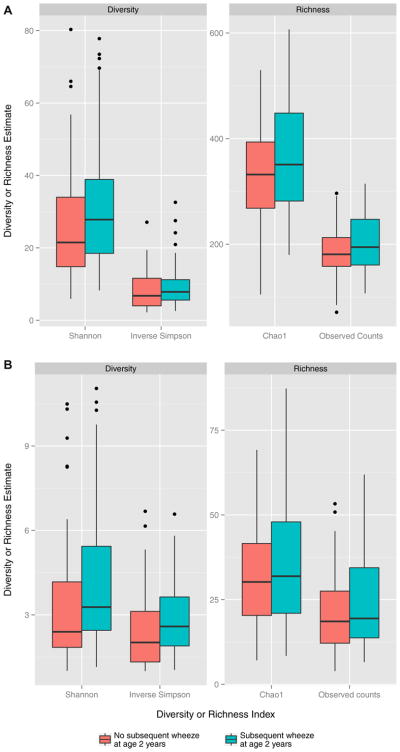
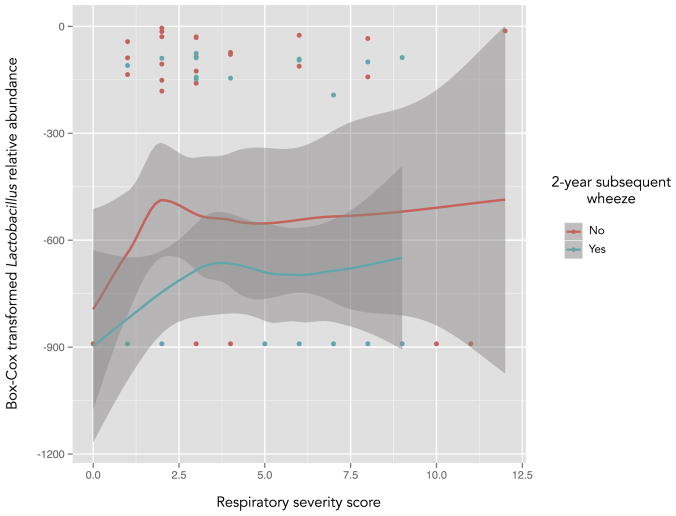
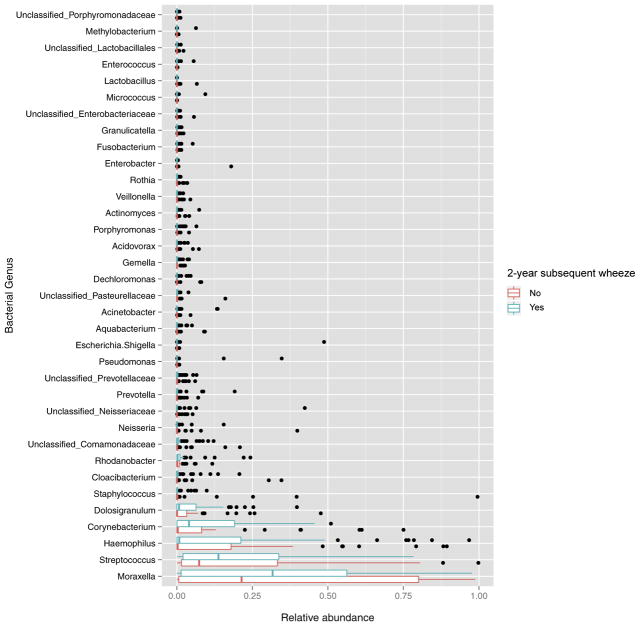
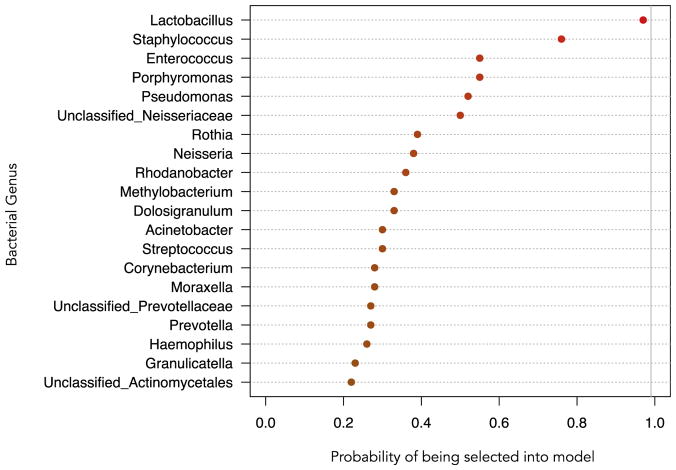
Of the 118 infants, 113 (95.8%) had 2-year outcome data. Of these, 46 (40.7%) had parental report of subsequent wheeze. There was no association between the overall taxonomic composition, diversity, and richness of the nasopharyngeal microbiome during RSV ARI with the development of subsequent wheeze. However, the nasopharyngeal detection and abundance of Lactobacillus was consistently higher in infants who did not develop this outcome. Lactobacillus also ranked first among the different genera in a model distinguishing infants with and without subsequent wheeze.
The nasopharyngeal detection and increased abundance of Lactobacillus during RSV ARI in infancy are associated with a reduced risk of childhood wheezing illnesses at age 2 years.
早期生命急性呼吸道感染(ARI)与呼吸道合胞病毒(RSV)的强烈关联与儿童喘息疾病的发展有关,但这种关联的途径尚不清楚。
研究鼻咽微生物组在婴儿期 RSV ARI 后儿童喘息疾病发展中的作用。
我们对 118 名先前健康、足月的婴儿进行了一项嵌套队列研究,这些婴儿通过 RT-PCR 确诊为 RSV ARI。我们使用 16S 核糖体 RNA 基因 V4 区的下一代测序来描述 RSV ARI 期间鼻咽微生物组。我们感兴趣的主要结果是 2 岁时的后续喘息。
在 118 名婴儿中,有 113 名(95.8%)有 2 年的结果数据。其中,46 名(40.7%)有父母报告随后出现喘息。RSV ARI 期间鼻咽微生物组的总体分类组成、多样性和丰富度与随后喘息的发展之间没有关联。然而,在没有发生这种结果的婴儿中,鼻咽检测到的和丰富的乳杆菌始终更高。乳杆菌在区分有无后续喘息的婴儿的不同属中也排名第一。
在婴儿期 RSV ARI 期间,鼻咽检测到和增加的乳杆菌丰度与 2 岁时儿童喘息疾病的风险降低有关。