Fang Dingqiang, Lengronne Armelle, Shi Di, Forey Romain, Skrzypczak Magdalena, Ginalski Krzysztof, Yan Changhui, Wang Xiaoke, Cao Qinhong, Pasero Philippe, Lou Huiqiang
State Key Laboratory of Agro-Biotechnology, Beijing Advanced Innovation Center for Food Nutrition and Human Health, College of Biological Sciences, China Agricultural University, Beijing 100193, China.
Institute of Human Genetics, Centre National de la Recherche Scientifique, University of Montpellier, Equipe Labellisée Ligue Contre le Cancer, F-34396 Montpellier Cedex 5, France.
Genes Dev. 2017 Dec 1;31(23-24):2405-2415. doi: 10.1101/gad.306571.117. Epub 2018 Jan 12.
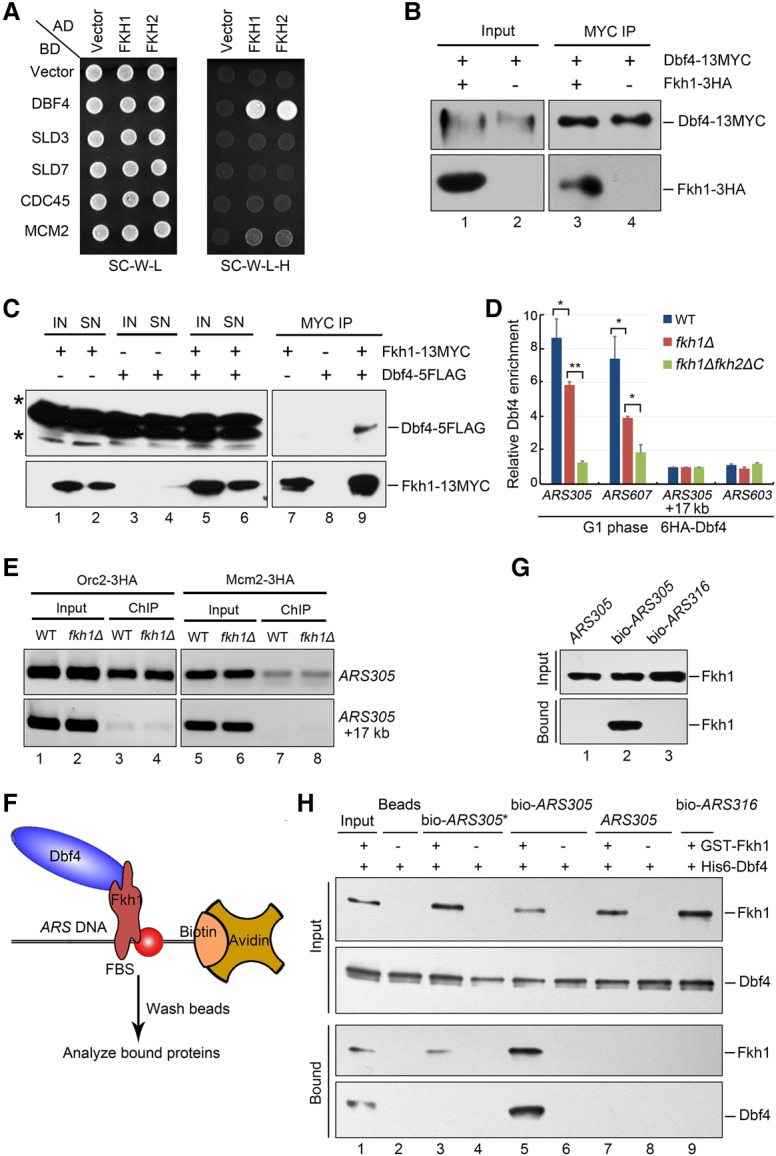
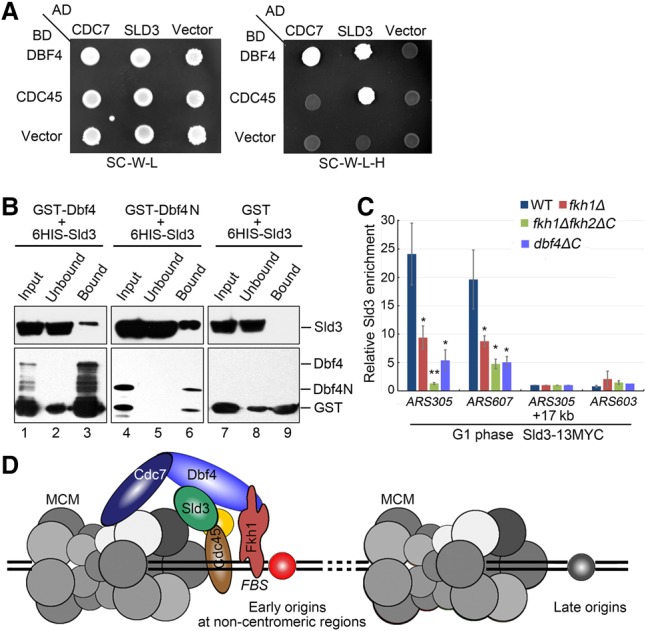
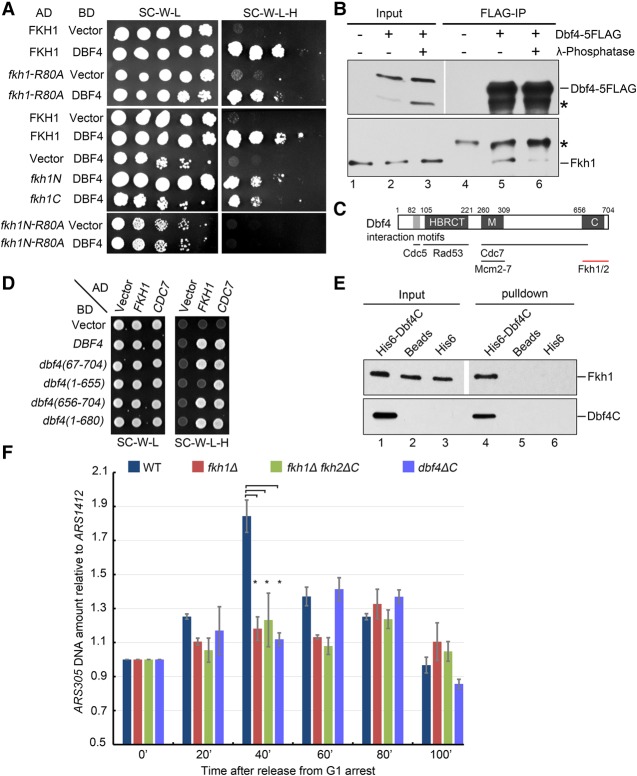
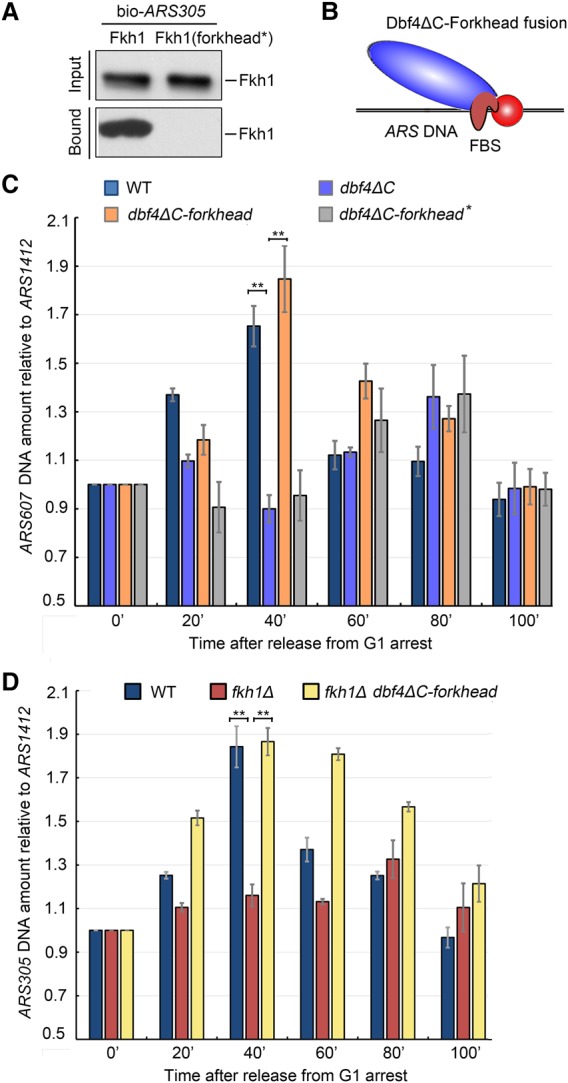
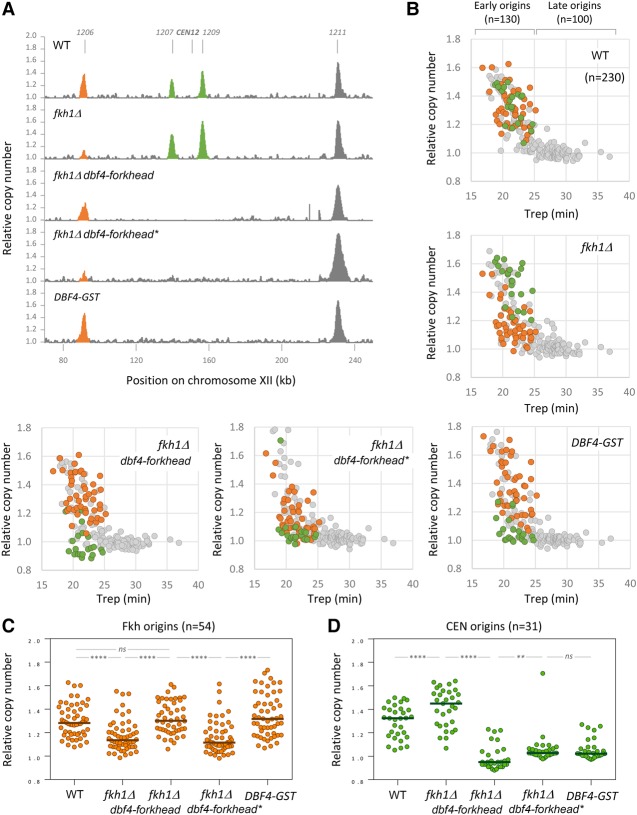
Initiation of eukaryotic chromosome replication follows a spatiotemporal program. The current model suggests that replication origins compete for a limited pool of initiation factors. However, it remains to be answered how these limiting factors are preferentially recruited to early origins. Here, we report that Dbf4 is enriched at early origins through its interaction with forkhead transcription factors Fkh1 and Fkh2. This interaction is mediated by the Dbf4 C terminus and was successfully reconstituted in vitro. An interaction-defective mutant, , phenocopies alleles in terms of origin firing. Remarkably, genome-wide replication profiles reveal that the direct fusion of the DNA-binding domain (DBD) of Fkh1 to Dbf4 restores the Fkh-dependent origin firing but interferes specifically with the pericentromeric origin activation. Furthermore, Dbf4 interacts directly with Sld3 and promotes the recruitment of downstream limiting factors. These data suggest that Fkh1 targets Dbf4 to a subset of noncentromeric origins to promote early replication in a manner that is reminiscent of the recruitment of Dbf4 to pericentromeric origins by Ctf19.
真核染色体复制的起始遵循时空程序。目前的模型表明,复制起点竞争有限的起始因子池。然而,这些限制因子如何优先被招募到早期起点仍有待解答。在此,我们报告Dbf4通过与叉头转录因子Fkh1和Fkh2相互作用而在早期起点富集。这种相互作用由Dbf4的C末端介导,并在体外成功重建。一个相互作用缺陷突变体在起点激活方面模拟了 等位基因。值得注意的是,全基因组复制图谱显示,Fkh1的DNA结合结构域(DBD)与Dbf4的直接融合恢复了Fkh依赖的起点激活,但特异性地干扰了着丝粒周围起点的激活。此外,Dbf4直接与Sld3相互作用,并促进下游限制因子的招募。这些数据表明,Fkh1将Dbf4靶向非着丝粒起点的一个子集,以一种让人联想到Ctf19将Dbf4招募到着丝粒周围起点的方式促进早期复制。