CNR-IOM-Democritos c/o International School for Advanced Studies (SISSA), via Bonomea 265, 34136, Trieste, Italy.
Fondazione IRCSS Istituto Nazionale dei Tumori, via Amadeo 42, 20113, Milano, Italy.
Sci Rep. 2018 Jan 12;8(1):649. doi: 10.1038/s41598-017-17364-4.
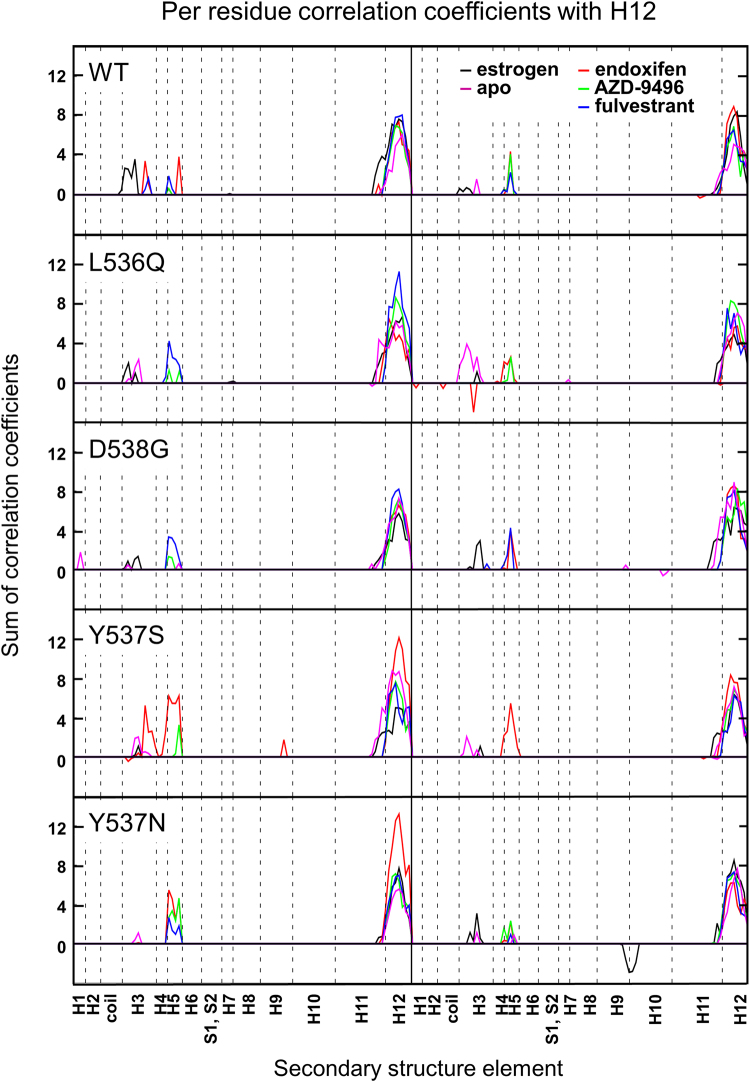
Somatic mutations of the Estrogen Receptor α (ERα) occur with an up to 40% incidence in ER sensitive breast cancer (BC) patients undergoing prolonged endocrine treatments. These polymorphisms are implicated in acquired resistance, disease relapse, and increased mortality rates, hence representing a current major clinical challenge. Here, multi-microseconds (12.5 µs) molecular dynamics simulations revealed that recurrent ERα polymorphisms (i. e. L536Q, Y537S, Y537N, D538G) (mERα) are constitutively active in their apo form and that they prompt the selection of an agonist (active)-like conformation even upon antagonists binding. Interestingly, our simulations rationalize, for the first time, the efficacy profile of (pre)clinically used Selective Estrogen Receptor Modulators/Downregulators (SERMs/SERDs) against these variants, enlightening, at atomistic level of detail, the key common structural traits needed by drugs able to effectively fight refractory BC types. This knowledge represents a key advancement for mechanism-based therapeutics targeting resistant ERα isoforms, potentially allowing the community to move a step closer to 'precision medicine' calibrated on patients' genetic profiles and disease progression.
在接受长期内分泌治疗的雌激素受体 α (ERα) 敏感型乳腺癌 (BC) 患者中,多达 40%的患者发生 ERα 体细胞突变。这些多态性与获得性耐药、疾病复发和死亡率增加有关,因此代表了当前的主要临床挑战。在这里,多微秒 (12.5 μs) 分子动力学模拟表明,反复出现的 ERα 多态性 (即 L536Q、Y537S、Y537N、D538G) (mERα) 在其无配体形式下呈组成性激活,并且即使在拮抗剂结合后,它们也会促使选择激动剂 (活性) 样构象。有趣的是,我们的模拟首次合理地解释了临床上使用的选择性雌激素受体调节剂/下调剂 (SERMs/SERDs) 对这些变体的疗效概况,从原子水平详细阐明了能够有效对抗难治性 BC 类型的药物所需的关键共同结构特征。这一知识为针对耐药性 ERα 异构体的基于机制的治疗方法提供了重要进展,可能使研究人员能够更接近针对患者遗传特征和疾病进展的“精准医学”。