Ahn Sung Gwe, Bae Soong June, Kim Yoonjung, Ji Jung Hwan, Chu Chihhao, Kim Dooreh, Lee Janghee, Cha Yoon Jin, Lee Kyung-A, Jeong Joon
Department of Surgery, Gangnam Severance Hospital, Yonsei University College of Medicine, Seoul, Republic of Korea.
Institute for Breast Cancer Precision Medicine, Yonsei University College of Medicine, Seoul, Republic of Korea.
NPJ Breast Cancer. 2022 May 2;8(1):58. doi: 10.1038/s41523-022-00424-y.
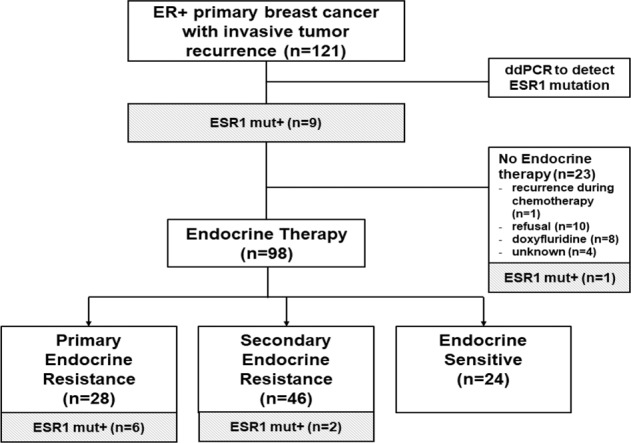
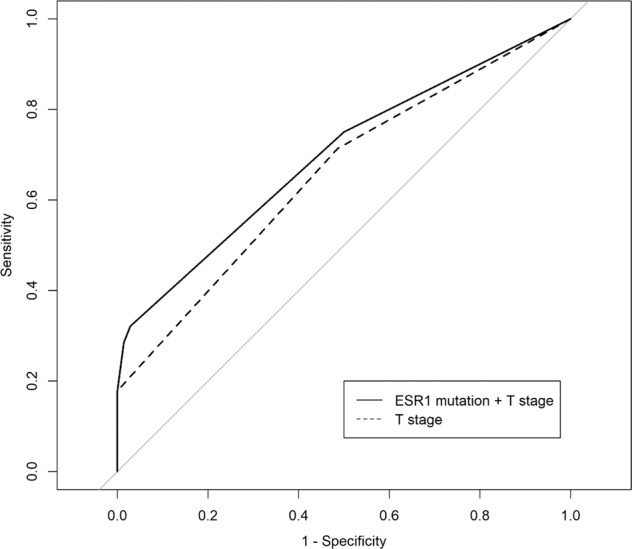
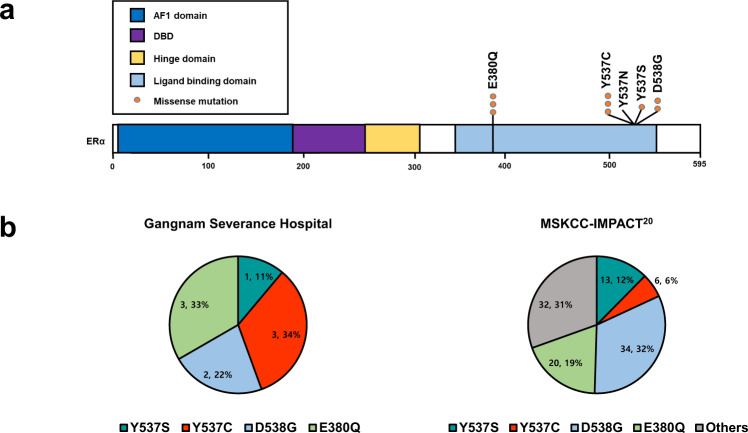
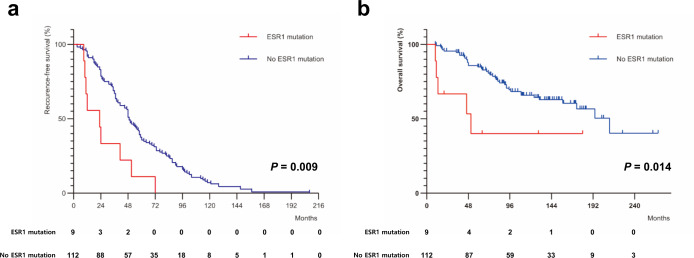
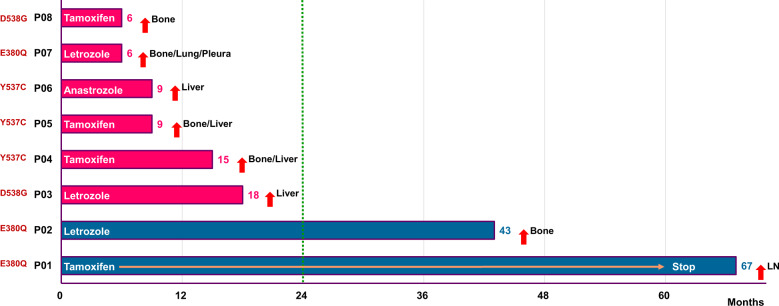
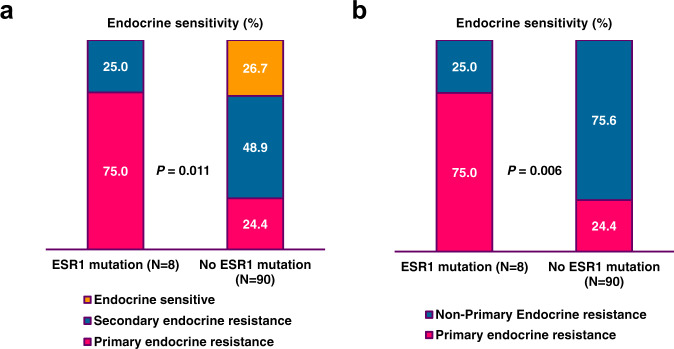
We investigated the patterns of recurrence and primary endocrine resistance according to estrogen receptor (ER) alpha gene (ESR1) mutations, as assessed by digital droplet (dd) PCR, in patients with non-metastatic ER+ breast cancer. We collected 121 formalin-fixed paraffin-embedded (FFPE) surgical specimens from ER+ breast cancer patients who had relapsed after surgery. Genomic DNA was extracted from the FFPE samples and ESR1 mutations were evaluated using ddPCR. ESR1 mutations were detected in 9 (7.4%) of 121 primary breast cancer specimens. The median recurrence-free interval and overall survival were significantly lower in patients with ESR1 mutations than in those without. Of the patients treated with ET (N = 98), eight had ESR1 mutations. Of these, six (75.0%) had primary endocrine resistance and two (25.0%) had secondary endocrine resistance. By contrast, only 22 of 90 (24.4%) patients without ESR1 mutations had primary endocrine resistance. A multivariable model showed that an ESR1 mutation is a significant risk factor for primary endocrine resistance. Our findings provide clinical evidence that the presence of rare ESR1 mutant clones identified by ddPCR in primary tumors is associated with primary endocrine resistance in an adjuvant setting.
我们根据通过数字液滴(dd)PCR评估的雌激素受体(ER)α基因(ESR1)突变,研究了非转移性ER +乳腺癌患者的复发模式和原发性内分泌抵抗情况。我们收集了121例手术后复发的ER +乳腺癌患者的福尔马林固定石蜡包埋(FFPE)手术标本。从FFPE样本中提取基因组DNA,并使用ddPCR评估ESR1突变。在121例原发性乳腺癌标本中,有9例(7.4%)检测到ESR1突变。ESR1突变患者的无复发生存期和总生存期的中位数显著低于无突变患者。在接受内分泌治疗(ET)的患者(N = 98)中,有8例存在ESR1突变。其中,6例(75.0%)有原发性内分泌抵抗,2例(25.0%)有继发性内分泌抵抗。相比之下,在90例无ESR1突变的患者中,只有22例(24.4%)有原发性内分泌抵抗。多变量模型显示,ESR1突变是原发性内分泌抵抗的一个重要危险因素。我们的研究结果提供了临床证据,即在辅助治疗中,通过ddPCR在原发性肿瘤中鉴定出的罕见ESR1突变克隆与原发性内分泌抵抗相关。