Section of Surgical Oncology, Department of General Surgery, Wake Forest Baptist Health, Winston-Salem, NC.
Section of Surgical Oncology, Department of General Surgery, Wake Forest Baptist Health, Winston-Salem, NC.
J Am Coll Surg. 2018 Apr;226(4):434-443. doi: 10.1016/j.jamcollsurg.2017.12.027. Epub 2018 Jan 10.
Appendiceal cancer is a rare disease that has proven difficult to study in prospective trials. Cytoreductive surgery with hyperthermic intraperitoneal chemotherapy (HIPEC) is an established therapy for peritoneal dissemination from appendiceal cancer. The optimal chemotherapeutic agent to use in the HIPEC is not clear. Mitomycin has long been used, however, our previous phase I experience and European retrospective studies suggest oxaliplatin as an alternative. Therefore, we initiated a multicenter randomized trial to compare mitomycin with oxaliplatin HIPEC for appendiceal cancer.
Patients with mucinous appendiceal neoplasms with evidence of peritoneal dissemination underwent cytoreductive surgery and HIPEC using a closed technique for 120 minutes. Patients were randomized intraoperatively to HIPEC using mitomycin (40 mg) or oxaliplatin (200 mg/M). Follow-up included daily blood counts and toxicity assessments.
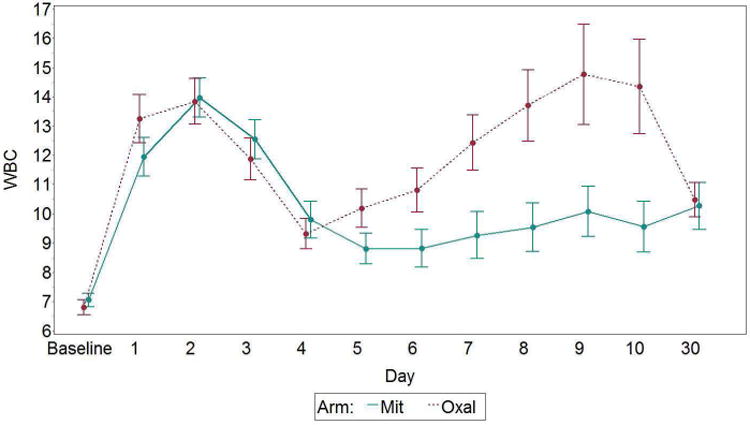
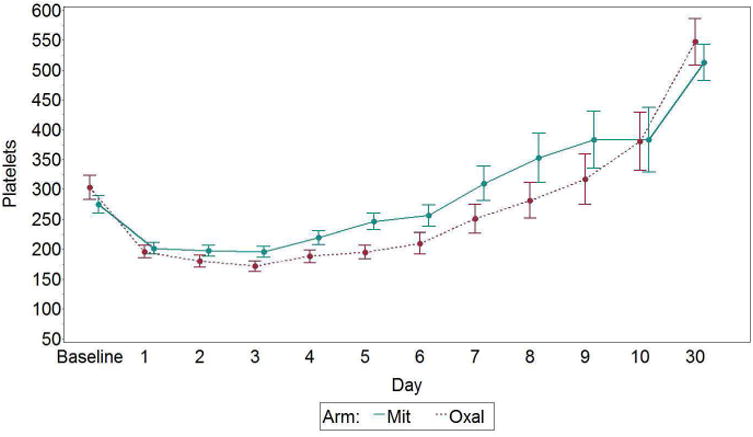
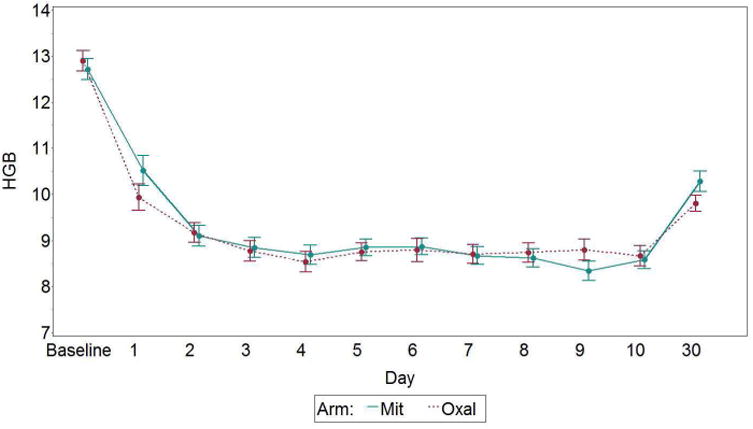
One hundred and twenty-one analytic patients were accrued to the trial during 6 years at 3 sites. The patients were 57% female, with a mean age of 55.3 years (range 22 to 82 years). The disease was low grade in 77% and high grade in 23%. There were no significant differences in hemoglobin or platelet counts. The WBC was significantly lower in the mitomycin group between postoperative days 5 and 10. Overall and disease-free survival rates at 3 years were similar at 83.7% and 66.8% for mitomycin and 86.9% and 64.8% for oxaliplatin.
This represents the first completed prospective randomized trial for cancer of the appendix, and shows that multicenter trials for this disease are feasible. Both mitomycin and oxaliplatin are associated with minor hematologic toxicity. However, mitomycin has slightly higher hematologic toxicity and lower quality of life than oxaliplatin in HIPEC. Consequently, oxaliplatin might be preferred in patients with leukopenia and mitomycin preferred in patients with thrombocytopenia due to earlier chemotherapy.
阑尾癌是一种罕见的疾病,在前瞻性试验中难以研究。细胞减灭术联合腹腔热灌注化疗(HIPEC)是治疗阑尾癌腹膜播散的一种既定疗法。HIPEC 中使用的最佳化疗药物尚不清楚。丝裂霉素长期以来一直被使用,但我们之前的 I 期经验和欧洲回顾性研究表明奥沙利铂是一种替代药物。因此,我们启动了一项多中心随机试验,比较丝裂霉素与奥沙利铂 HIPEC 治疗阑尾癌。
有腹膜播散证据的黏液性阑尾肿瘤患者接受细胞减灭术和 HIPEC,采用封闭技术持续 120 分钟。患者在术中随机接受 HIPEC 治疗,使用丝裂霉素(40mg)或奥沙利铂(200mg/M)。随访包括每天的血细胞计数和毒性评估。
在 3 个地点的 6 年期间,该试验共纳入了 121 名可分析患者。患者中 57%为女性,平均年龄为 55.3 岁(范围 22 至 82 岁)。77%的疾病为低级别,23%为高级别。血红蛋白或血小板计数无显著差异。丝裂霉素组术后第 5 至 10 天白细胞计数显著降低。3 年时的总生存率和无病生存率在丝裂霉素组分别为 83.7%和 66.8%,奥沙利铂组分别为 86.9%和 64.8%。
这是首例完成的阑尾癌前瞻性随机试验,表明针对这种疾病的多中心试验是可行的。丝裂霉素和奥沙利铂均与轻微的血液学毒性相关。然而,在 HIPEC 中,丝裂霉素的血液学毒性略高于奥沙利铂,生活质量也略低于奥沙利铂。因此,白细胞减少症患者可能更倾向于使用奥沙利铂,血小板减少症患者可能更倾向于使用丝裂霉素。