Seo Hyun-Jung, Lee Pureun-Haneul, Kim Byeong-Gon, Lee Sun-Hye, Park Jong-Sook, Lee Junehyuck, Park Sung-Woo, Kim Do-Jin, Park Choon-Sik, Jang An-Soo
Department of Internal Medicine, Soonchunhyang University Bucheon Hospital, Bucheon, Korea.
Korean J Intern Med. 2018 Jul;33(4):807-814. doi: 10.3904/kjim.2017.043. Epub 2018 Jan 17.
BACKGROUND/AIMS: The methacholine bronchial provocation test (MBPT) is used to detect and quantify airway hyper-responsiveness (AHR). Since improvements in the severity of asthma are associated with improvements in AHR, clinical studies of asthma therapies routinely use the change of airway responsiveness as an objective outcome. The aim of this study was to assess the relationship between serial MBPT and clinical profiles in patients with asthma.
A total of 323 asthma patients were included in this study. The MBPT was performed on all patients beginning at their initial diagnosis until asthma was considered controlled based on the Global Initiative for Asthma guidelines. A responder was defined by a decrease in AHR while all other patients were considered non-responders.
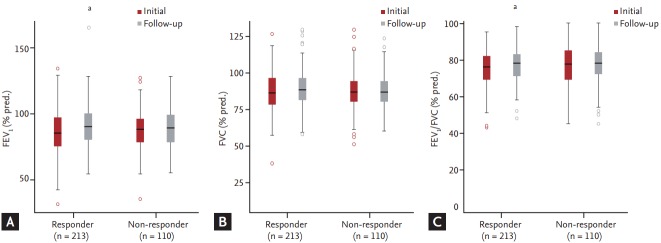
A total of 213 patients (66%) were responders, while 110 patients (34%) were non-responders. The responder group had a lower initial PC20 (provocative concentration of methacholine required to decrease the forced expiratory volume in 1 second by 20%) and longer duration compared to the non-responder group. Members of the responder group also had superior qualities of life, compared to members of the non-responder group. Whole blood cell counts were not related to differences in PC20; however, eosinophil concentration was. No differences in sex, age, body mass index, smoking history, serum immunoglobulin E, or frequency of acute exacerbation were observed between responders and non-responders.
The initial PC20, the duration of asthma, eosinophil concentrations, and quality-of-life may be useful variables to identify improvements in AHR in asthma patients.
背景/目的:乙酰甲胆碱支气管激发试验(MBPT)用于检测和量化气道高反应性(AHR)。由于哮喘严重程度的改善与AHR的改善相关,哮喘治疗的临床研究通常将气道反应性的变化作为客观结果。本研究的目的是评估哮喘患者连续MBPT与临床特征之间的关系。
本研究共纳入323例哮喘患者。从初始诊断开始对所有患者进行MBPT,直至根据全球哮喘防治创议指南认为哮喘得到控制。AHR降低者定义为反应者,其他所有患者视为无反应者。
共有213例患者(66%)为反应者,110例患者(34%)为无反应者。与无反应者组相比,反应者组的初始PC20(使1秒用力呼气量降低20%所需的乙酰甲胆碱激发浓度)较低,且病程较长。与无反应者组的成员相比,反应者组的成员生活质量也更高。全血细胞计数与PC20的差异无关;然而,嗜酸性粒细胞浓度与PC20的差异有关。反应者和无反应者在性别、年龄、体重指数、吸烟史、血清免疫球蛋白E或急性加重频率方面未观察到差异。
初始PC20、哮喘病程、嗜酸性粒细胞浓度和生活质量可能是识别哮喘患者AHR改善情况的有用变量。