Department of Kinesiology and Nutrition, University of Illinois at Chicago, 1919 W Taylor St, Chicago, IL, 60612, USA.
Institute for Health Research and Policy, University of Illinois at Chicago, 1747 W Roosevelt Rd, Chicago, IL, 60608, USA.
Int J Behav Nutr Phys Act. 2018 Jan 15;15(1):5. doi: 10.1186/s12966-018-0645-9.
The quality of most Americans' diets is far from optimal. Given that many Americans consume a significant portion of calories in the home, intervening in this setting could be beneficial. However, the relationship between the home food environment and diet quality is not well understood. This study examined the relationship between diet quality at the individual level with home-level diet quality using an index that measures compliance with federal dietary guidance.
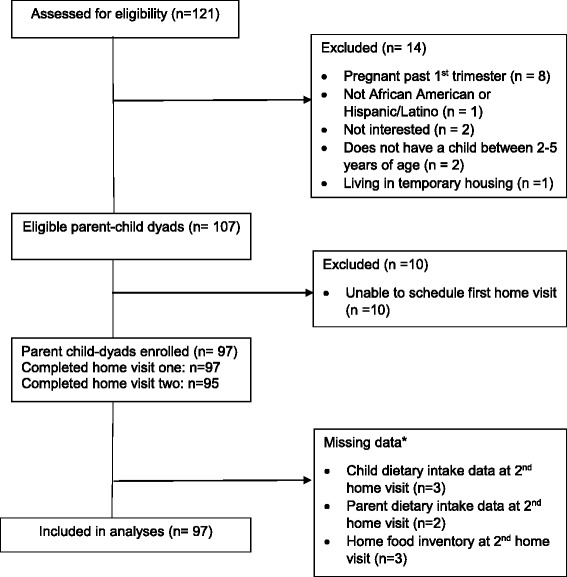
This was a cross sectional study that enrolled 97 African American and Hispanic/Latino low-income parent-child dyads. Diet quality at the individual level was assessed through two 24-h dietary recalls collected for parents and children, respectively. Diet quality at the home level was assessed with two home food inventories conducted in participants' homes. Diet quality scores at the home and individual levels were computed by applying the Healthy Eating Index-2010 (HEI-2010) to these data. Linear models adjusted for potential confounding factors were used to examine the relationship between diet quality at the home and individual levels.
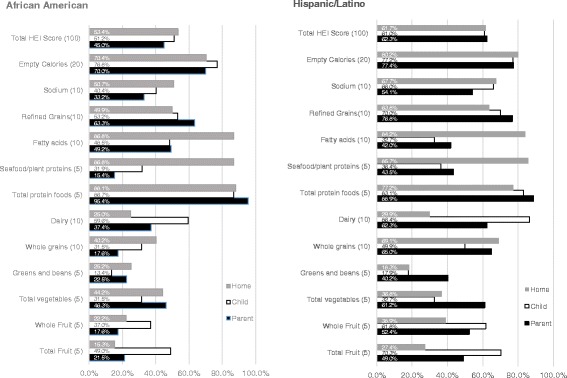
Total HEI-2010 scores from parents and children's diets were positively associated with HEI-2010 scores based on home food inventories (parent diet: β: 0.36, 95% CI: 012-0.60; child diet: 0.38 95% CI: 013-0.62). Positive associations were also observed between individual level and home level subcomponent HEI-2010 scores for total fruit (parent: 0.55 95% CI: 0.16-0.94; child: 0.49 95% CI: 0.03-0.94), whole fruit (parent only: 0.41 95% CI: 0.07-0.74), greens and beans (parent only: 0.39 95% CI: 0.05-0.74), and whole grain (children only: 0.33 95% CI: 0.04-0.63).
This study demonstrated that individual level diet quality was positively associated with home-level diet quality. Findings from this study can help us to address modifiable targets of intervention in the home to improve diet quality.
大多数美国人的饮食质量远非理想。考虑到许多美国人在家中摄入了大量的卡路里,因此在这种环境下进行干预可能是有益的。然而,家庭饮食环境与饮食质量之间的关系尚未得到充分理解。本研究使用一种衡量符合联邦饮食指导方针的指数,从个体层面和家庭层面评估了饮食质量之间的关系。
这是一项横断面研究,共纳入 97 对非裔美国人和西班牙裔/拉丁裔低收入父母-子女二元组。分别通过对父母和孩子进行两次 24 小时膳食回忆来评估个体层面的饮食质量。通过在参与者家中进行两次家庭食品库存调查来评估家庭层面的饮食质量。通过应用健康饮食指数-2010(HEI-2010)对这些数据进行计算,得出家庭和个体层面的饮食质量得分。采用线性模型调整潜在混杂因素,以检验家庭和个体层面饮食质量之间的关系。
父母和孩子饮食的总 HEI-2010 评分与基于家庭食品清单的 HEI-2010 评分呈正相关(父母饮食:β:0.36,95%置信区间:012-0.60;儿童饮食:0.38,95%置信区间:013-0.62)。个体层面和家庭层面的总水果(父母:0.55,95%置信区间:0.16-0.94;儿童:0.49,95%置信区间:0.03-0.94)、全水果(仅父母:0.41,95%置信区间:0.07-0.74)、绿色蔬菜和豆类(仅父母:0.39,95%置信区间:0.05-0.74)和全谷物(仅儿童:0.33,95%置信区间:0.04-0.63)的子成分 HEI-2010 评分也呈正相关。
本研究表明,个体层面的饮食质量与家庭层面的饮食质量呈正相关。本研究的结果可以帮助我们确定家庭中可干预的目标,以改善饮食质量。