Mishra Pankaj Kumar, Luckraz Heyman, Nandi Jayanta, Nevill Alan, Giri Ramesh, Panayiotou Andrew, Nicholas Johann
Department of Cardiothoracic Surgery, Heart and Lung Centre, Wolverhampton WV10 0QP, UK.
University of Wolverhampton, Wolverhampton WS1 3BD, UK.
Ann Card Anaesth. 2018 Jan-Mar;21(1):41-45. doi: 10.4103/aca.ACA_104_17.
Acute renal failure after cardiac surgery is known to be associated with significant short-term morbidity and mortality. There have as yet been no major reports on long-term quality of life (QOL). This study assessed the impact of acute kidney injury (AKI) and renal replacement therapy (RRT) on long-term survival and QOL after cardiac surgery. The need for long-term RRT is also assessed.
Patients who underwent cardiac surgery between 2005 and 2011 (n = 6087) and developed AKI (RIFLE criteria, n = 570) were included. They were propensity-matched 1:1 to patients without renal impairment (control). Data were prospectively collected, and health-related QOL questionnaire was sent to patients who were alive at least 1-year postoperatively at the time of the study.
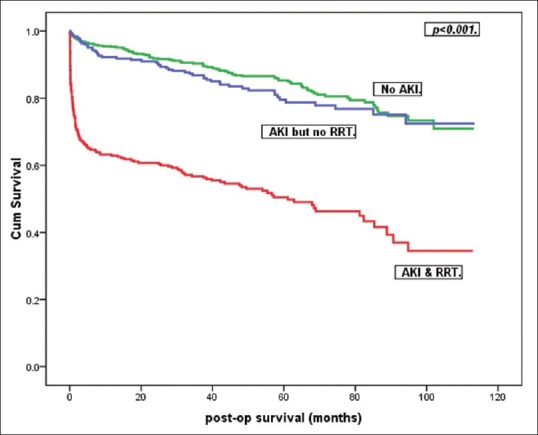
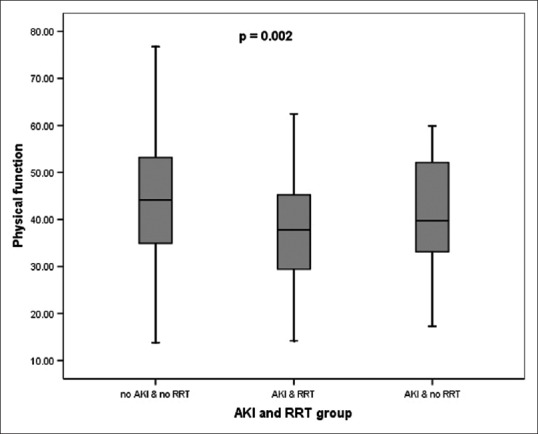
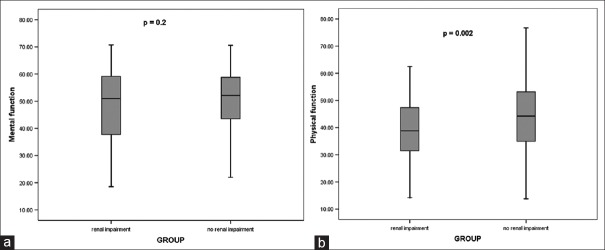
There was no significant difference in the preoperative characteristics between the two groups (age, gender, left ventricular ejection fraction, procedure, urgency, logistic Euroscore), respectively. Median follow-up was 52 months. Survival data were available in all patients. Questionnaires were returned in 64% of eligible patients. Long-term survival was significantly lower, and QOL, in particular the physical aspect, was significantly worse for the AKI group as compared to non-AKI group (38.8 vs. 44.2, P = 0.002), especially so in patients who required RRT. In alive respondents, despite an 18% (66/359) incidence of ongoing renal follow-up, the need for late RRT was only in 1.1% (4/359).
AKI and especially the need for RRT following cardiac surgery are associated with increased long-term mortality as well as worse quality of life in a propensity-matched control group.
心脏手术后的急性肾衰竭与显著的短期发病率和死亡率相关。目前尚无关于长期生活质量(QOL)的主要报告。本研究评估了急性肾损伤(AKI)和肾脏替代治疗(RRT)对心脏手术后长期生存和生活质量的影响。还评估了长期RRT的需求。
纳入2005年至2011年间接受心脏手术且发生AKI(根据RIFLE标准,n = 570)的患者。将他们与无肾功能损害的患者(对照组)按1:1进行倾向匹配。前瞻性收集数据,并向研究时术后至少存活1年的患者发送与健康相关的QOL问卷。
两组患者术前特征(年龄、性别、左心室射血分数、手术、紧急程度、逻辑欧洲评分)分别无显著差异。中位随访时间为52个月。所有患者均有生存数据。64%的符合条件患者返回了问卷。与非AKI组相比,AKI组的长期生存率显著较低,生活质量,尤其是身体方面,显著较差(38.8对44.2,P = 0.002),在需要RRT的患者中尤其如此。在存活的受访者中,尽管有18%(66/359)的患者正在接受肾脏随访,但晚期RRT的需求仅为1.1%(4/359)。
在倾向匹配的对照组中,AKI尤其是心脏手术后对RRT的需求与长期死亡率增加以及生活质量较差有关。