Skjeie Holgeir, Skonnord Trygve, Brekke Mette, Klovning Atle, Fetveit Arne, Landgren Kajsa, Hallström Inger Kristensson, Brurberg Kjetil Gundro
a Department of General Practice , Institute of Health and Society University of Oslo , Oslo , Norway.
b Faculty of Medicine Department of Health Sciences , Lund University , Lund , Sweden.
Scand J Prim Health Care. 2018 Mar;36(1):56-69. doi: 10.1080/02813432.2018.1426146. Epub 2018 Jan 17.
Needle acupuncture in small children has gained some acceptance in Western medicine. It is controversial, as infants and toddlers are unable to consent to treatment. We aimed to assess its efficacy for treating infantile colic.
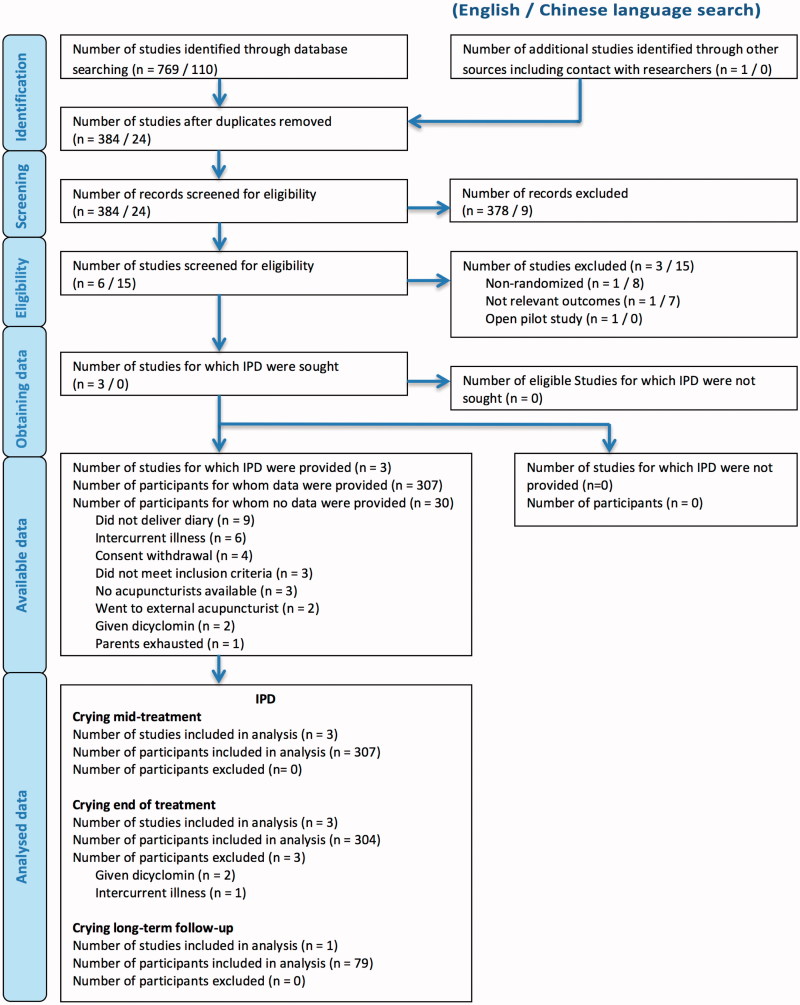
A systematic review and a blinding-test validation based on individual patient data from randomised controlled trials. Primary end-points were crying time at mid-treatment, at the end of treatment and at a 1-month follow-up. A 30-min mean difference (MD) in crying time between acupuncture and control was predefined as a clinically important difference. Pearson's chi-squared test and the James and Bang indices were used to test the success of blinding of the outcome assessors [parents]. Eligibility criteria and data sources: We included randomised controlled trials of acupuncture treatments of infantile colic. Systematic searches were conducted in Cochrane CENTRAL, MEDLINE, EMBASE, CINAHL and AMED, and in the Chinese language databases CNKI, VIP, Wang fang, SinoMed and Chinese Clinical Trial Registry.
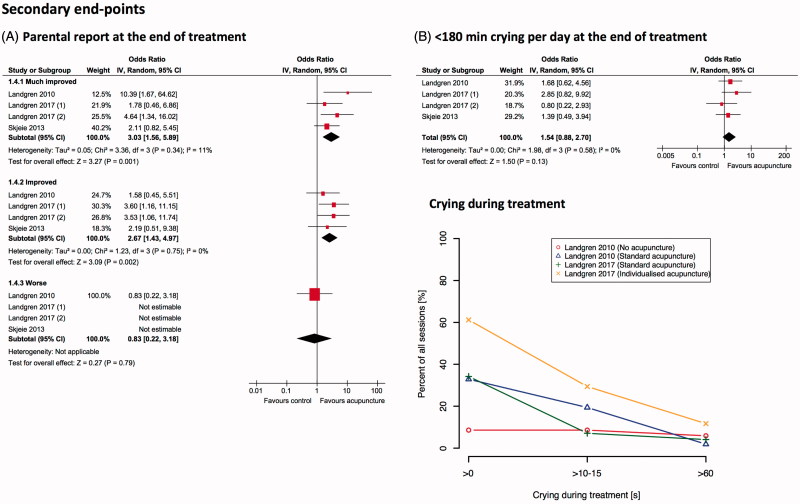
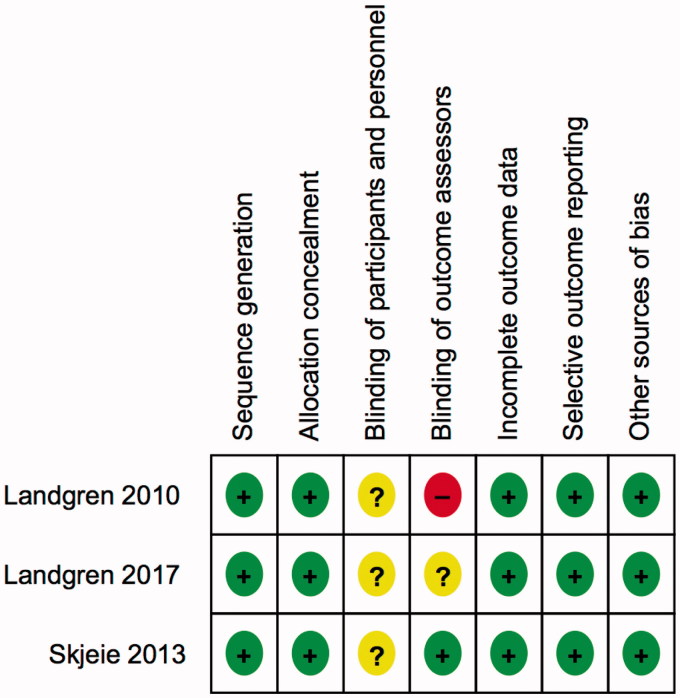
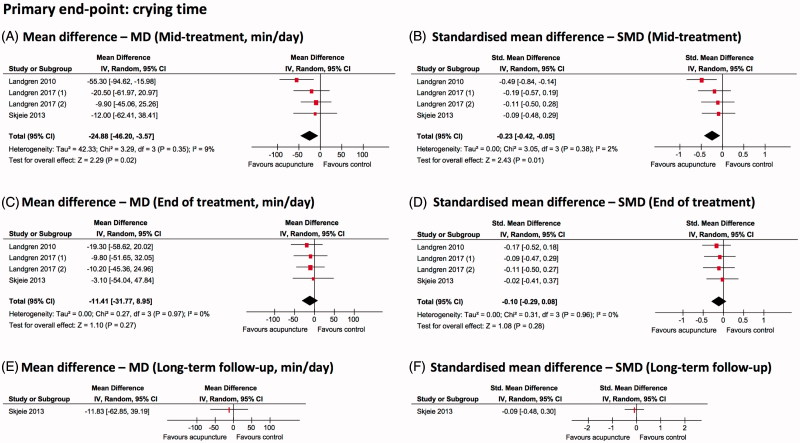
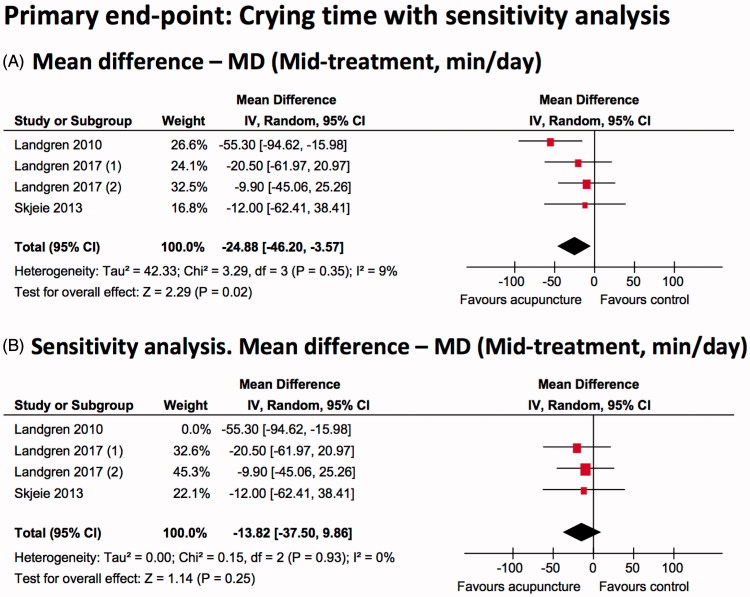
We included three randomised controlled trials with data from 307 participants. Only one of the included trials obtained a successful blinding of the outcome assessors in both the acupuncture and control groups. The MD in crying time between acupuncture intervention and no acupuncture control was -24.9 min [95% confidence interval, CI -46.2 to -3.6; three trials] at mid-treatment, -11.4 min [95% CI -31.8 to 9.0; three trials] at the end of treatment and -11.8 min [95% CI -62.9 to 39.2; one trial] at the 4-week follow-up. The corresponding standardised mean differences [SMDs] were -0.23 [95% CI -0.42 to -0.06], -0.10 [95% CI -0.29 to 0.08] and -0.09 [95% CI -0.48 to 0.30]. The heterogeneity was negligible in all analyses. The statistically significant result at mid-treatment was lost when excluding the apparently unblinded study in a sensitivity analysis: MD -13.8 min [95%CI -37.5 to 9.9] and SMD -0.13 [95%CI -0.35 to 0.09]. The registration of crying during treatment suggested more crying during acupuncture [odds ratio 7.7; 95% CI 2.7-20.6; one trial]. GRADE-Moderate quality evidence.
Percutaneous needle acupuncture treatments should not be recommended for infantile colic on a general basis. Systematic review registration: PROSPERO 2015:CRD42015023253 Key points The role of acupuncture in the treatment of infantile colic is controversial. Available trials are small and present conflicting results. There were no clinically important differences between infants receiving acupuncture and no acupuncture control in this IPD meta-analysis of randomised controlled trials. The data indicate that acupuncture induces some treatment pain in many of the children. The study results indicate that percutaneous needle acupuncture should not be recommended for treatment of infantile colic on a general basis.
小儿针刺疗法在西方医学中已获得一定程度的认可。由于婴幼儿无法对治疗表示同意,该疗法存在争议。我们旨在评估其治疗婴儿腹绞痛的疗效。
基于随机对照试验的个体患者数据进行系统评价和盲法试验验证。主要终点为治疗中期、治疗结束时及1个月随访时的哭闹时间。针刺组与对照组哭闹时间的平均差值(MD)为30分钟被预先定义为具有临床意义的差异。采用Pearson卡方检验以及James和Bang指数来检验结果评估者(父母)的盲法是否成功。纳入标准和数据来源:我们纳入了针刺治疗婴儿腹绞痛的随机对照试验。在Cochrane CENTRAL、MEDLINE、EMBASE、CINAHL和AMED以及中文数据库CNKI、VIP、万方、中国生物医学文献数据库和中国临床试验注册中心进行了系统检索。
我们纳入了三项随机对照试验,共307名参与者的数据。纳入的试验中只有一项在针刺组和对照组均成功实现了结果评估者的盲法。针刺干预组与非针刺对照组在治疗中期哭闹时间的MD为-24.9分钟[95%置信区间(CI)-46.2至-3.6;三项试验],治疗结束时为-11.4分钟[95%CI -31.8至9.0;三项试验],4周随访时为-11.8分钟[95%CI -62.9至39.2;一项试验]。相应的标准化平均差值(SMD)分别为-0.23[95%CI -0.42至-0.06]、-0.10[95%CI -0.29至0.08]和-0.09[95%CI -0.48至0.30]。所有分析中的异质性可忽略不计。在敏感性分析中排除明显未设盲的研究后,治疗中期具有统计学意义的结果消失:MD为-13.8分钟[95%CI -37.5至9.9],SMD为-0.13[95%CI -0.35至0.09]。治疗期间哭闹情况的记录显示针刺过程中哭闹更多[比值比7.�;[95%CI 2.7 - 20.6;一项试验]。证据质量等级:中等质量证据。
一般情况下,不建议将经皮针刺疗法用于婴儿腹绞痛的治疗。系统评价注册号:PROSPERO 2015:CRD42015023253要点针刺疗法在治疗婴儿腹绞痛中的作用存在争议。现有试验规模较小且结果相互矛盾。在这项随机对照试验的个体患者数据荟萃分析中,接受针刺治疗的婴儿与未接受针刺治疗的对照组之间没有具有临床意义的差异。数据表明针刺会使许多儿童产生一定的治疗疼痛。研究结果表明,一般情况下不建议采用经皮针刺疗法治疗婴儿腹绞痛。