Key Laboratory of Carcinogenesis and Cancer Invasion, Ministry of Education, Shanghai, 200032, China.
Liver Cancer Institute, Zhongshan Hospital, Fudan University, Shanghai, 200032, China.
World J Surg Oncol. 2018 Jan 16;16(1):9. doi: 10.1186/s12957-018-1312-y.
M2-polarized macrophages are tumor-associated-macrophages (TAMs), which are important contents of tumor-infiltrating immune cells. Toll-like receptor 4 (TLR4) is a molecular biomarker of tumor aggressiveness and poor prognosis. Toll-like receptors (TLRs) have important roles in the immune system and M2-polarized macrophages. However, the effects of TLR4 on M2-polarized macrophages in hepatocellular carcinoma (HCC) are unknown. Here, TLR4 expressed on HCC cells mediates the pro-tumor effects and mechanisms of M2-polarized macrophages.
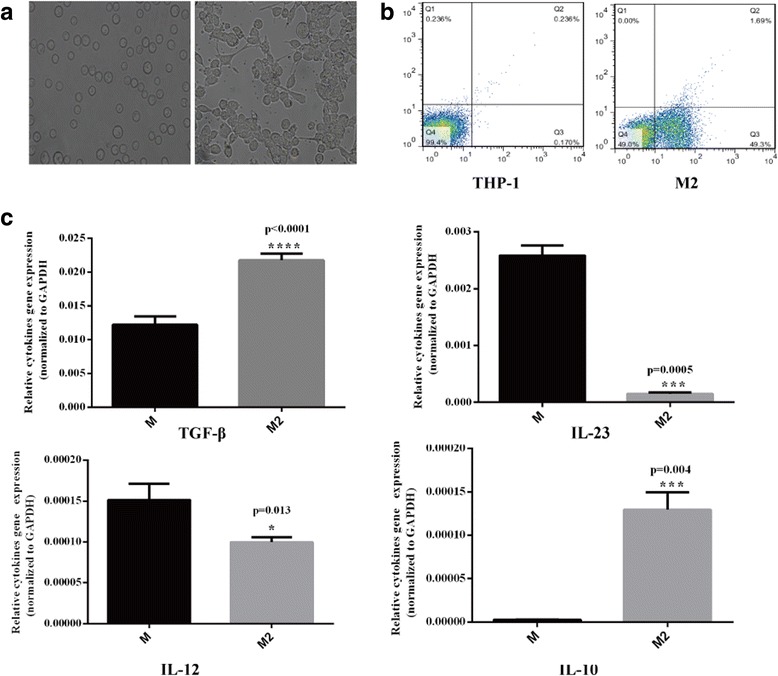
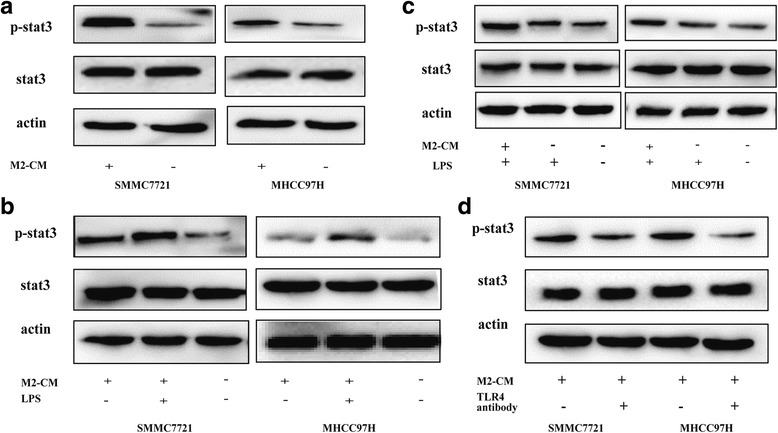
THP-1 cells were induced to differentiate into M2-like macrophages through treatments with IL-4, IL-13, and phorbol myristate acetate (PMA). We used the HCC cell lines SMMC-7721 and MHCC97-H cultured in conditioned medium from M2-like macrophages (M2-CM) to investigate the migration potential of HCC cells and epithelial-mesenchymal transition (EMT)-associated molecular genetics. Signaling pathways that mediated M2-CM-promoted HCC migration were detected using western blotting.
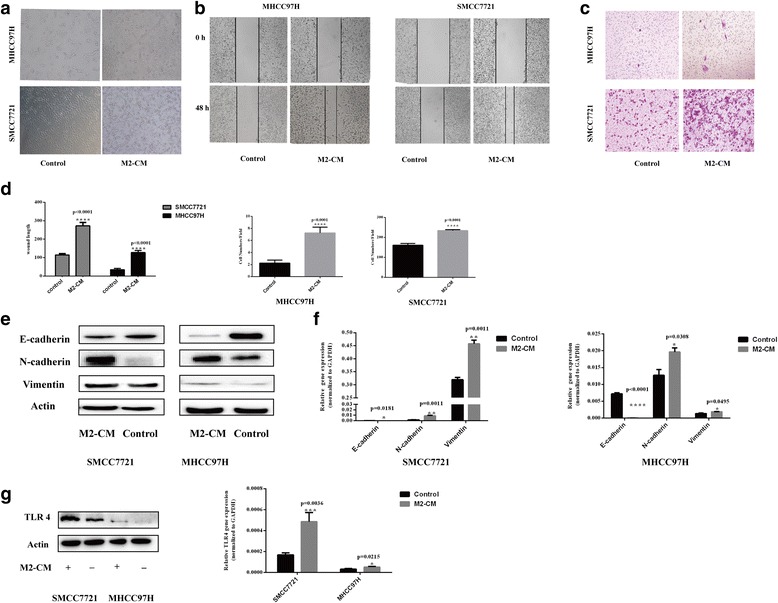
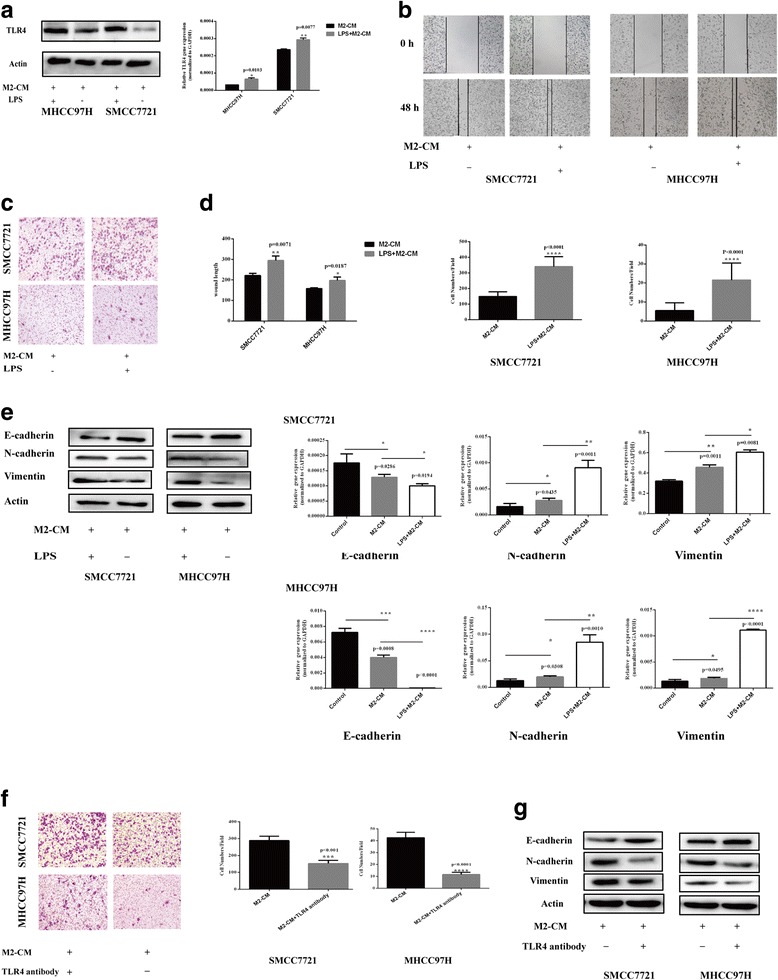
HCC cells cultured with M2-CM displayed a fibroblast-like morphology, an increased metastatic capability, and expression of EMT markers. TLR4 expression was markedly increased in M2-CM-treated HCC cells. TLR4 overexpression promoted HCC cell migration, and a TLR4-neutralizing antibody markedly inhibited HCC EMT in cells cultured with M2-CM. Furthermore, the TLR4/(signal transducer and activator of transcription 3 (STAT3) signaling pathway contributed to the effects of M2-CM on HCC cells.
Taken together, M2-polarized macrophages facilitated the migration and EMT of HCC cells via the TLR4/STAT3 signaling pathway, suggesting that TLR4 may be a novel therapeutic target. These results improve our understanding of M2-polarized macrophages.
M2 极化的巨噬细胞是肿瘤相关巨噬细胞(TAMs),是肿瘤浸润免疫细胞的重要内容。Toll 样受体 4(TLR4)是肿瘤侵袭性和预后不良的分子生物标志物。Toll 样受体(TLRs)在免疫系统和 M2 极化的巨噬细胞中具有重要作用。然而,TLR4 对肝癌(HCC)中 M2 极化的巨噬细胞的影响尚不清楚。在这里,HCC 细胞上表达的 TLR4 介导了 M2 极化的巨噬细胞的促肿瘤作用和机制。
通过用白细胞介素 4(IL-4)、白细胞介素 13(IL-13)和佛波醇肉豆蔻酸酯(PMA)处理 THP-1 细胞,将其诱导分化为 M2 样巨噬细胞。我们使用在 M2 样巨噬细胞(M2-CM)条件培养基中培养的 HCC 细胞系 SMMC-7721 和 MHCC97-H,研究 HCC 细胞的迁移潜力和上皮-间充质转化(EMT)相关的分子遗传学。使用 Western blot 检测介导 M2-CM 促进 HCC 迁移的信号通路。
与 M2-CM 共培养的 HCC 细胞表现出成纤维细胞样形态、迁移能力增强和 EMT 标志物表达增加。M2-CM 处理的 HCC 细胞中 TLR4 的表达明显增加。TLR4 过表达促进 HCC 细胞迁移,用 TLR4 中和抗体抑制 M2-CM 培养的 HCC 细胞中的 HCC EMT。此外,TLR4/(信号转导和转录激活因子 3(STAT3)信号通路有助于 M2-CM 对 HCC 细胞的影响。
总之,M2 极化的巨噬细胞通过 TLR4/STAT3 信号通路促进 HCC 细胞的迁移和 EMT,提示 TLR4 可能是一个新的治疗靶点。这些结果提高了我们对 M2 极化的巨噬细胞的理解。