Chen Fancheng, Huang Xiaowei, Ya Yingsun, Ma Fenfen, Qian Zhi, Shi Jifei, Guo Shuolei, Yu Baoqing
Shanghai Medical College, Fudan University, Shanghai City, China.
Department of Orthopedics, The First Affiliated Hospital of Soochow University, Suzhou, China.
J Orthop Surg Res. 2018 Jan 16;13(1):12. doi: 10.1186/s13018-017-0707-8.
Proximal tibia fractures are one of the most familiar fractures. Surgical approaches are usually needed for anatomical reduction. However, no single treatment method has been widely established as the standard care. Our present study aims to compare the stress and stability of intramedullary nails (IMN) fixation and double locking plate (DLP) fixation in the treatment of extra-articular proximal tibial fractures.
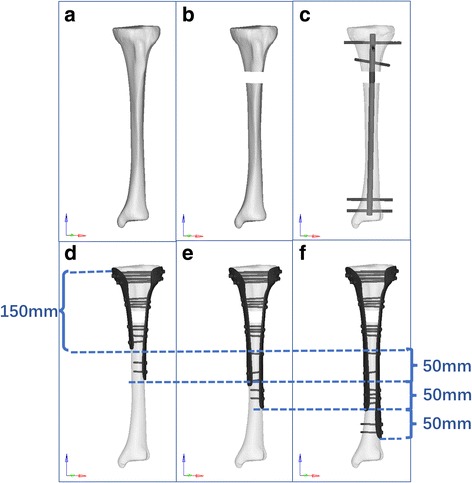
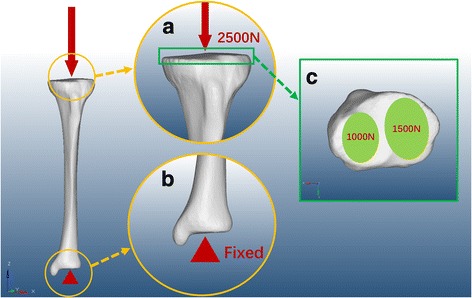
A three-dimensional (3D) finite element model of the extra-articular proximal tibial fracture, whose 2-cm bone gap began 7 cm from the tibial plateau articular surface, was created fixed by different fixation implants. The axial compressive load on an adult knee during single-limb stance was imitated by an axial force of 2500 N with a distribution of 60% to the medial compartment, while the distal end was fixed effectively. The equivalent von Mises stress and displacement of the model was used as the output measures for analysis.
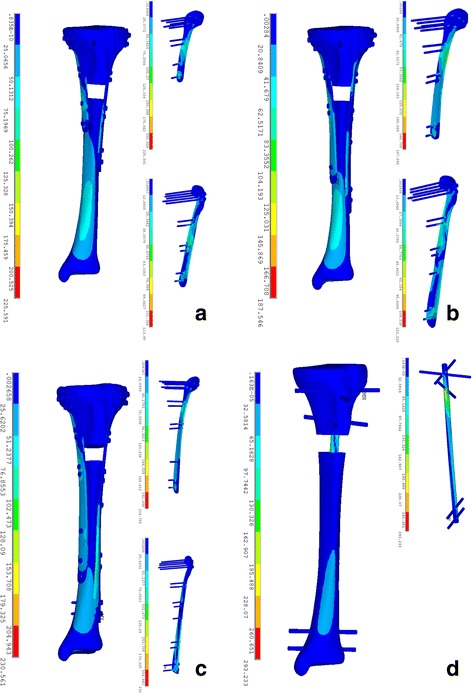
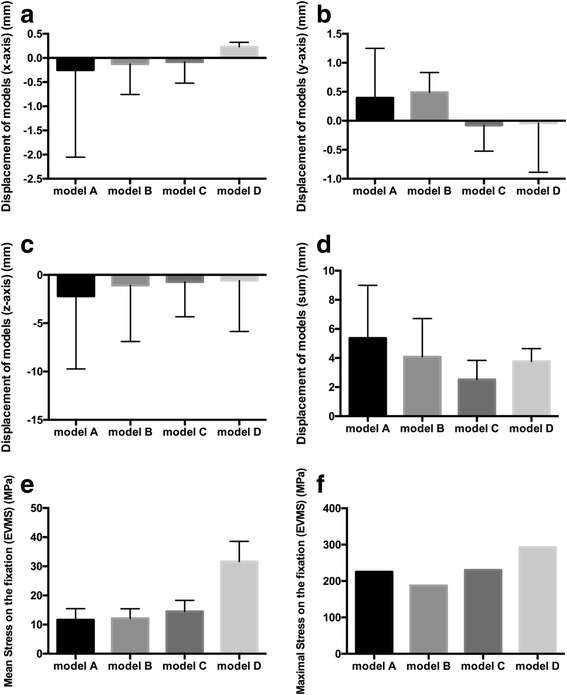
The maximal equivalent von Mises stress value of the system in the IMN model was 293.23 MPa, which was higher comparing against that in the DLP fixation model (147.04 MPa). And the mean stress of the model in the IMN model (9.25 MPa) was higher than that of the DLP fixation system in terms of equivalent von Mises stress (EVMS) (P < 0.0001). The maximal value of displacement (sum) in the IMN system was 8.82 mm, which was lower than that in the DLP fixation system (9.48 mm).
This study demonstrated that the stability provided by the locking plate fixation system was superior to the intramedullary nails fixation system and served as an alternative fixation for the extra-articular proximal tibial fractures of young patients.
胫骨近端骨折是最常见的骨折之一。通常需要手术入路进行解剖复位。然而,尚无单一治疗方法被广泛确立为标准治疗方案。我们目前的研究旨在比较髓内钉(IMN)固定和双锁定钢板(DLP)固定在治疗胫骨近端关节外骨折时的应力和稳定性。
创建一个胫骨近端关节外骨折的三维(3D)有限元模型,其2厘米的骨间隙从胫骨平台关节面开始7厘米处,通过不同的固定植入物进行固定。在单腿站立时,通过2500 N的轴向力模拟成人膝关节上的轴向压缩载荷,其中60%分布在内侧间室,同时有效地固定远端。将模型的等效冯·米塞斯应力和位移用作分析的输出指标。
IMN模型中系统的最大等效冯·米塞斯应力值为293.23 MPa,与DLP固定模型(147.04 MPa)相比更高。就等效冯·米塞斯应力(EVMS)而言,IMN模型中模型的平均应力(9.25 MPa)高于DLP固定系统(P < 0.0001)。IMN系统中的最大位移(总和)值为8.82毫米,低于DLP固定系统(9.48毫米)。
本研究表明,锁定钢板固定系统提供的稳定性优于髓内钉固定系统,可作为年轻患者胫骨近端关节外骨折的替代固定方法。