Department of General Surgery, Zhongshan Hospital of Fudan University, 180 Fenglin Road, Shanghai, 200032, People's Republic of China.
Lipids Health Dis. 2018 Jan 16;17(1):14. doi: 10.1186/s12944-018-0657-0.
Cancer cachexia is a progressive and multi-factorial metabolic syndrome characterized by loss of adipose tissue and skeletal muscle. White adipose tissue (WAT) lipolysis and white-to-brown transdifferentiation of WAT (WAT browning) are proposed to contribute to WAT atrophy in cancer cachexia. Chronic inflammation, mediated by cytokines such as tumor necrosis factor alpha (TNF-α) and interleukin-6 (IL-6), has been reported to promote cancer cachexia. However, whether chronic inflammation promotes cancer cachexia by regulating WAT metabolism and the underlying mechanism remains unclear.
In this study, we first analyzed the association between chronic inflammation and WAT metabolism in gastric and colorectal cancer cachectic patients. In cachectic mice treated with anti-IL-6 receptor antibody, we clarified whether WAT lipolysis and browning were regulated by IL-6.
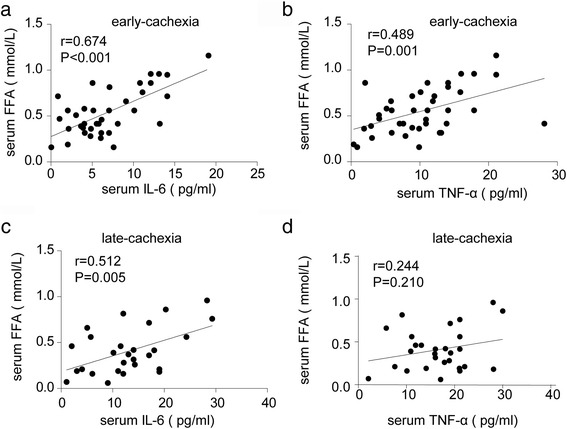
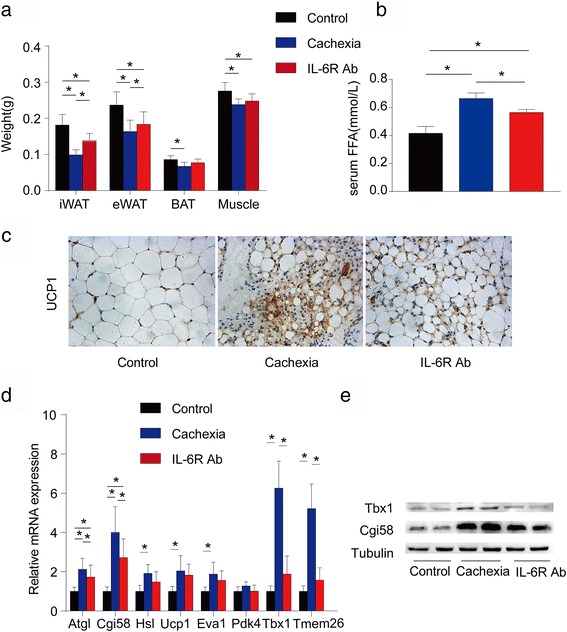
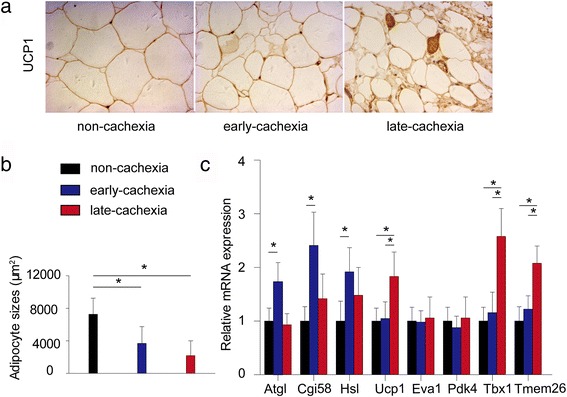
Clinical analyses showed positive significant association between serum IL-6 and free fatty acid (FFA) both in early- and late-stage cancer cachexia. However, serum TNF-α was positively associated with serum FFA in the early- but not late-stage cachexia. WAT lipolysis was increased in early- and late-stage cachexia, while WAT browning was detected only in late-stage cachexia. Anti-IL-6 receptor antibody inhibited WAT lipolysis and browning in cachectic mice.
Based on these findings, we conclude that chronic inflammation (especially that mediated by IL-6) might promote cancer cachexia by regulating WAT lipolysis in early-stage cachexia and browning in late-stage cachexia.
癌症恶病质是一种进行性的、多因素的代谢综合征,其特征是脂肪组织和骨骼肌的丧失。据推测,白色脂肪组织(WAT)的脂解作用和 WAT 的白色到棕色转化(WAT 棕色化)有助于癌症恶病质中 WAT 的萎缩。据报道,由肿瘤坏死因子-α(TNF-α)和白细胞介素-6(IL-6)等细胞因子介导的慢性炎症促进了癌症恶病质。然而,慢性炎症是否通过调节 WAT 代谢来促进癌症恶病质以及潜在机制仍不清楚。
在这项研究中,我们首先分析了慢性炎症与胃癌和结直肠癌恶病质患者 WAT 代谢之间的关联。在接受抗 IL-6 受体抗体治疗的恶病质小鼠中,我们阐明了 IL-6 是否调节 WAT 脂解和棕色化。
临床分析显示,血清 IL-6 与游离脂肪酸(FFA)在癌症恶病质的早期和晚期均呈正显著相关。然而,血清 TNF-α仅在早期恶病质中与血清 FFA 呈正相关,而在晚期恶病质中则无相关性。WAT 脂解在早期和晚期恶病质中均增加,而 WAT 棕色化仅在晚期恶病质中检测到。抗 IL-6 受体抗体抑制了恶病质小鼠的 WAT 脂解和棕色化。
基于这些发现,我们得出结论,慢性炎症(特别是由 IL-6 介导的炎症)可能通过调节早期恶病质中的 WAT 脂解作用和晚期恶病质中的 WAT 棕色化来促进癌症恶病质。