Centre for Endocrinology, Barts and The London School of Medicine, Queen Mary University of London, EC1M 6BQ London, United Kingdom.
Institute of Biomedical and Clinical Science, University of Exeter Medical School, EX2 5DW Exeter, United Kingdom.
Proc Natl Acad Sci U S A. 2018 Jan 30;115(5):1027-1032. doi: 10.1073/pnas.1712262115. Epub 2018 Jan 16.
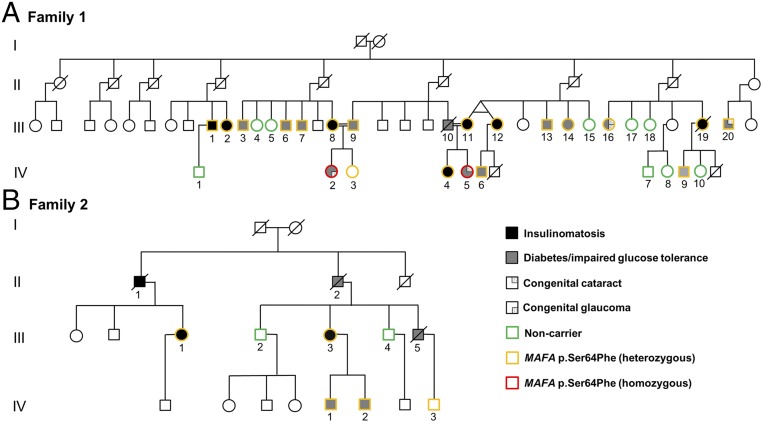
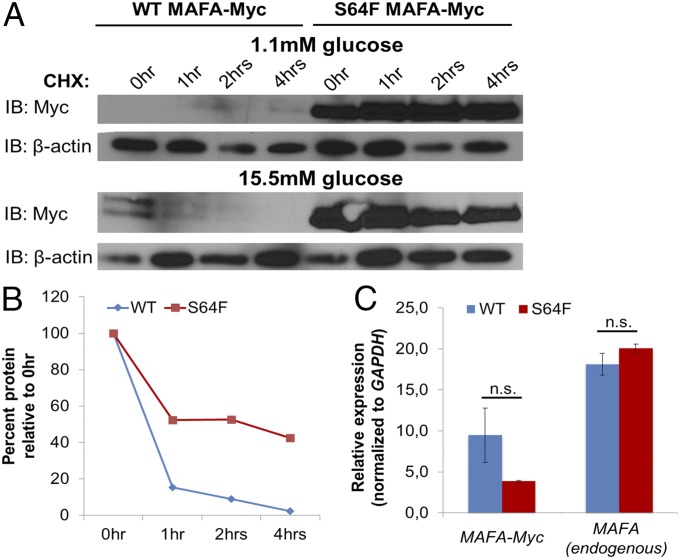
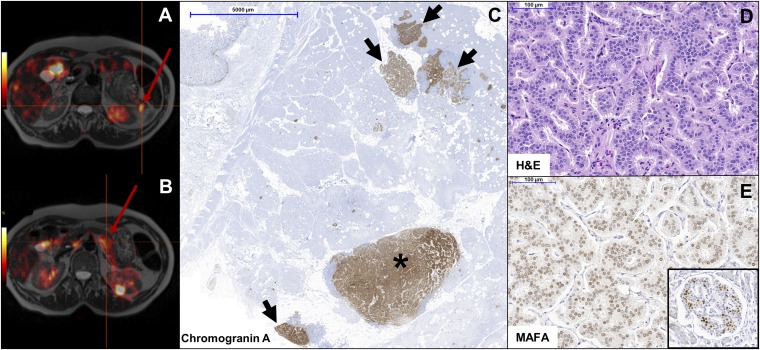
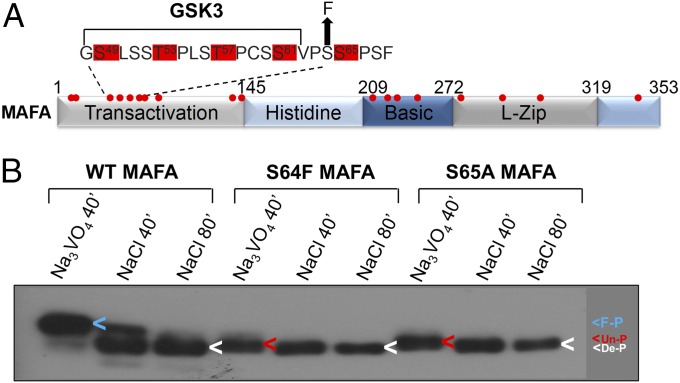
The β-cell-enriched MAFA transcription factor plays a central role in regulating glucose-stimulated insulin secretion while also demonstrating oncogenic transformation potential in vitro. No disease-causing variants have been previously described. We investigated a large pedigree with autosomal dominant inheritance of diabetes mellitus or insulinomatosis, an adult-onset condition of recurrent hyperinsulinemic hypoglycemia caused by multiple insulin-secreting neuroendocrine tumors of the pancreas. Using exome sequencing, we identified a missense mutation (p.Ser64Phe, c.191C>T) segregating with both phenotypes of insulinomatosis and diabetes. This mutation was also found in a second unrelated family with the same clinical phenotype, while no germline or somatic mutations were identified in nine patients with sporadic insulinomatosis. In the two families, insulinomatosis presented more frequently in females (eight females/two males) and diabetes more often in males (12 males/four females). Four patients from the index family, including two homozygotes, had a history of congenital cataract and/or glaucoma. The p.Ser64Phe mutation was found to impair phosphorylation within the transactivation domain of MAFA and profoundly increased MAFA protein stability under both high and low glucose concentrations in β-cell lines. In addition, the transactivation potential of p.Ser64Phe MAFA in β-cell lines was enhanced compared with wild-type MAFA. In summary, the p.Ser64Phe missense mutation leads to familial insulinomatosis or diabetes by impacting MAFA protein stability and transactivation ability. The human phenotypes associated with the p.Ser64Phe missense mutation reflect both the oncogenic capacity of MAFA and its key role in islet β-cell activity.
富含β细胞的 MAFA 转录因子在调节葡萄糖刺激的胰岛素分泌中发挥核心作用,同时在体外也显示出致癌转化潜能。以前没有描述过致病变体。我们研究了一个具有常染色体显性遗传的糖尿病或胰岛素瘤的大家庭,这是一种成年发病的疾病,由胰腺的多个胰岛素分泌神经内分泌肿瘤引起反复发作性高胰岛素血症性低血糖。使用外显子组测序,我们鉴定出一个错义突变(p.Ser64Phe,c.191C>T)与胰岛素瘤和糖尿病的两种表型共分离。这种突变也在另一个具有相同临床表型的无关家庭中发现,而在九个散发胰岛素瘤患者中未发现种系或体细胞突变。在这两个家庭中,胰岛素瘤在女性中更为常见(八名女性/两名男性),而糖尿病在男性中更为常见(十二名男性/四名女性)。来自索引家庭的四名患者,包括两名纯合子,有先天性白内障和/或青光眼病史。p.Ser64Phe 突变被发现会损害 MAFA 转录激活域内的磷酸化,并在高血糖和低血糖浓度下显著增加β细胞系中 MAFA 蛋白的稳定性。此外,与野生型 MAFA 相比,p.Ser64Phe MAFA 在β细胞系中的转录激活潜能增强。总之,p.Ser64Phe 错义突变通过影响 MAFA 蛋白稳定性和转录激活能力导致家族性胰岛素瘤或糖尿病。与 p.Ser64Phe 错义突变相关的人类表型反映了 MAFA 的致癌能力及其在胰岛β细胞活性中的关键作用。