Peter Gorer Department of Immunobiology, King's College London, London SE1 9RT, United Kingdom.
Immunosurveillance Laboratory, The Francis Crick Institute, London NW11AT, United Kingdom.
Proc Natl Acad Sci U S A. 2018 Jan 30;115(5):1039-1044. doi: 10.1073/pnas.1701237115. Epub 2018 Jan 16.
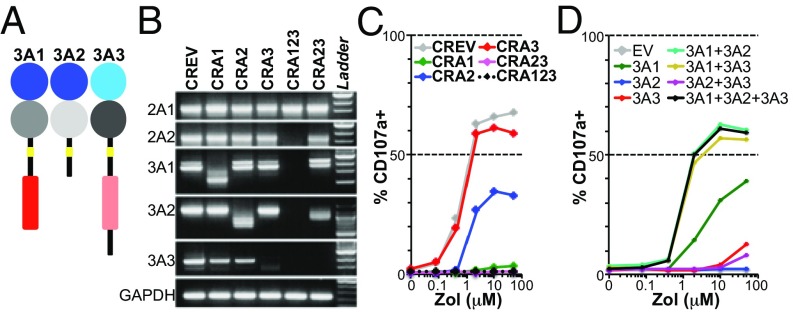
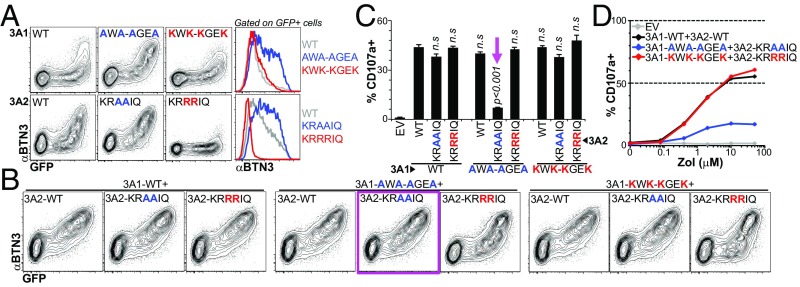
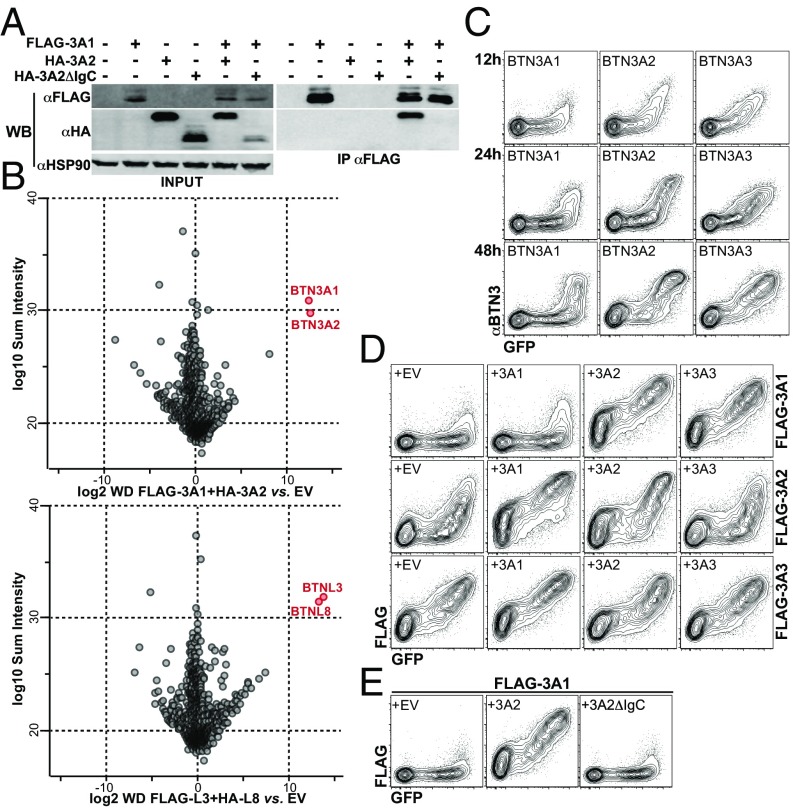
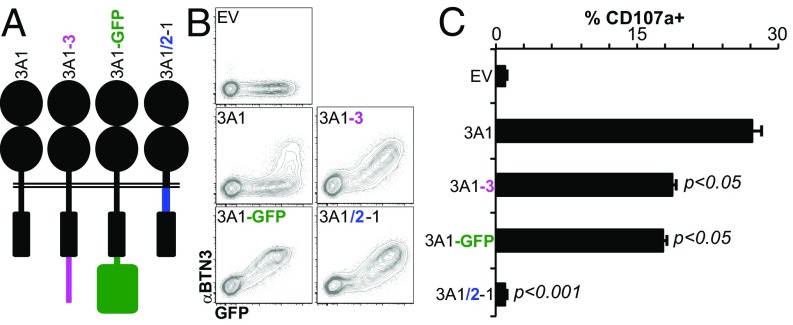
The long-held view that gamma delta (γδ) T cells in mice and humans are fundamentally dissimilar, as are γδ cells in blood and peripheral tissues, has been challenged by emerging evidence of the cells' regulation by butyrophilin (BTN) and butyrophilin-like (BTNL) molecules. Thus, murine and the related gene, , mediate T cell receptor (TCR)-dependent selection of murine intraepithelial γδ T cell repertoires in gut and skin, respectively; and are TCR-dependent regulators of human gut γδ cells; and is essential for TCR-dependent activation of human peripheral blood Vγ9Vδ2 T cells. However, some observations concerning BTN/Btnl molecules continue to question the extent of mechanistic conservation. In particular, murine and human gut γδ cell regulation depends on pairings of Btnl1 and Btnl6 and BTNL3 and BTNL8, respectively, whereas blood γδ cells are reported to be regulated by BTN3A1 independent of other BTNs. Addressing this paradox, we show that BTN3A2 regulates the subcellular localization of BTN3A1, including functionally important associations with the endoplasmic reticulum (ER), and is specifically required for optimal BTN3A1-mediated activation of Vγ9Vδ2 T cells. Evidence that BTNL3/BTNL8 and Btnl1/Btnl6 likewise associate with the ER reinforces the prospect of broadly conserved mechanisms underpinning the selection and activation of γδ cells in mice and humans, and in blood and extralymphoid sites.
长期以来,人们一直认为小鼠和人类的γδ(γδ)T 细胞在本质上是不同的,血液和外周组织中的γδ细胞也是如此,这一观点受到了 BTN 和 BTNL 分子对 γδ 细胞调节的新证据的挑战。因此,小鼠的 和相关基因 ,分别介导了 TCR 依赖性选择肠道和皮肤中的上皮内 γδ T 细胞库; 和 是人类肠道 γδ 细胞 TCR 依赖性调节因子;而 对于 TCR 依赖性激活人类外周血 Vγ9Vδ2 T 细胞是必需的。然而,一些关于 BTN/Btnl 分子的观察结果继续质疑机制保守的程度。特别是,小鼠和人类肠道 γδ 细胞的调节依赖于 Btnl1 和 Btnl6 以及 BTNL3 和 BTNL8 的配对,而血液 γδ 细胞据报道由 BTN3A1 调节而不依赖于其他 BTNs。为了解决这一矛盾,我们表明 BTN3A2 调节 BTN3A1 的亚细胞定位,包括与内质网(ER)的功能重要关联,并且是 BTN3A1 介导的 Vγ9Vδ2 T 细胞最佳激活所必需的。BTNL3/BTNL8 和 Btnl1/Btnl6 同样与 ER 结合的证据增强了在小鼠和人类以及血液和淋巴外组织中选择和激活 γδ 细胞的广泛保守机制的前景。